Get Full Government Meeting Transcripts, Videos, & Alerts Forever!
Get email alerts on the Stormwater topic
No spam. Unsubscribe anytime.
Rising Sun reviews draft MS4 illicit-discharge ordinance, declines immediate adoption
Summary
Town leaders reviewed a boilerplate MS4 illicit-discharge ordinance and heard that compliance will likely mean new inspections, education and enforcement steps; the town is not adopting the ordinance tonight and staff estimated a projected town cost of about $1,750,000 to meet a 20% stormwater footprint reduction by 2025.
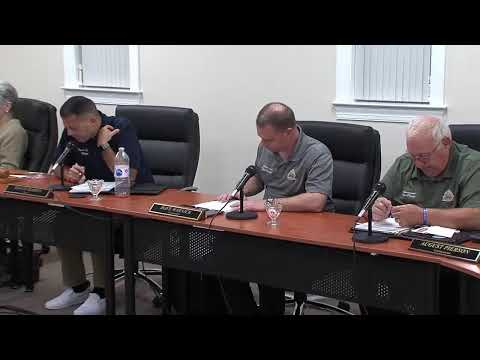
Town Administrator Calvin presented a model MS4 (municipal separate storm sewer system) illicit-discharge ordinance and asked the Board of Commissioners to review it ahead of any future adoption. Calvin said the draft is a "boilerplate sample" intended to be adapted to local needs and that the town was "not looking to adopt it tonight."
Calvin framed MS4 as a stormwater management program tied to Chesapeake Bay pollution-reduction efforts and federal law, saying, "This is coming out of the Clean Water Act, the Federal Water Pollution Control Act, and any subsequent amendments thereto, that's what's driving this." He explained the program's goal is to reduce contaminants reaching local streams and the bay and described categories of prohibited discharges—about 20 items ranging from wastewater and certain commercial cleaning discharges to improper salvage-yard runoff.
Calvin told the board the town has been filing required reports (KCI is preparing paperwork) and reiterated that MS4 compliance has been phased in across jurisdictions. He said the town faces significant costs to meet program targets and estimated, "we still have that big cost of about $1,750,000 that we are projected to have to spend by December of 2025 to do our portion of reducing our footprint," adding the 20% reduction target as the planning benchmark.
On enforcement, Calvin reviewed typical code provisions: an inspector's right of entry (with reasonable efforts to contact the owner first), appeal rights for property owners, the cost-of-abatement process (including hiring contractors and passing costs to property owners after court approval), and the potential for criminal prosecution if violations are not corrected. He also emphasized an educational-first approach, saying he prefers to "educate people on the benefits of this than to be issuing citations."
Calvin cited limited exemptions and examples where discharges are permitted (governmental water-line flushing, permitted stream diversions and events of rising groundwater). He noted the ordinance allows flexibility—some items listed as exempt could be moved into a nonexempt category if the board wishes to be stricter.
The board did not take any formal action or vote on the ordinance during the meeting; Calvin said he will convert the draft into the town's standard ordinance format for consideration at a later meeting and asked for board guidance on potential changes. The town will continue public education efforts and consultant work with KCI to meet reporting requirements.