Get Full Government Meeting Transcripts, Videos, & Alerts Forever!
Get email alerts on the Cdbg Programs topic
No spam. Unsubscribe anytime.
Hocking County holds public hearing on CDBG 2025 funding; staff outlines programs, timelines
Summary
County staff described CDBG program options for 2025 — allocation formula funds (~$150,000), competitive grants including NRG ($750,000) and Critical Infrastructure ($500,000) — announced a CBIS meeting March 26 and reminded communities that state applications are due June 11.
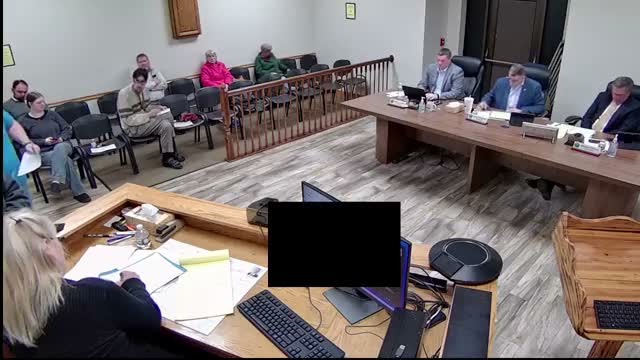
At a public hearing during a Hocking County meeting, Nathan Simons, community development coordinator with Hocking Athens Perry Community Action, outlined Community Development Block Grant (CDBG) programs available to the county for program year 2025 and urged local officials to prepare applications before the June 11 state deadline.
The hearing provided an overview of how federal CDBG funding flows through the state and how Ohio’s biennial allocation cycle affects counties. "This is funding that comes from the federal government, from HUD specifically," Simons said, and noted Ohio moved to a two‑year CDBG cycle and that Hocking County receives funds in odd‑numbered years.
Simons summarized the three CDBG national objectives that determine eligibility: low‑to‑moderate income (LMI), slum/blight and limited clientele. He said the most commonly used objective is LMI and that, for an area to qualify under that objective, about 51% of residents typically must meet the income threshold. Simons said recent American Community Survey / 2020 census data has changed eligibility in the county: "Several communities that were previously considered LMI eligible are no longer eligible," he said, and listed Murray City, Laurelville and Logan as the three municipalities currently eligible in 2025; he also named Salt Creek and Perry townships as eligible townships.
Staff described the county’s allocation (formula) program as relatively small — Simons said past allocations have been about $150,000 — and noted the state now limits counties to two allocation activities to concentrate impact. Simons said allocation funds are often used for street or sidewalk repairs, drainage, water and sewer work, and occasionally as local match to leverage larger competitive grants.
Competitive programs reviewed included the Neighborhood Revitalization Grant (NRG), a $750,000 award that must include at least three activities (for example, sidewalks, street improvements and water facility work) and allows a county to have two NRG projects open at a time; the Residential Public Infrastructure (RPIC) grant (also $750,000 ceiling) for water and sewer projects that can include up to $200,000 in household connection assistance; and the Critical Infrastructure (CI) program, which Simons described as a single‑component, high‑impact program with a $500,000 ceiling. He said the state has revised scoring and removed some match requirements to make programs more accessible to LMI communities.
Simons highlighted a flexible grant program for projects that do not fit other categories, citing a $250,000 project in Gloucester for roof, window and facade work on a downtown building. He also described fair housing work provided by Hocking Athens Perry Community Action — intake, advice for renters and landlords, and community trainings — and said staff conduct outreach through partner organizations, senior centers and public meetings.
To help communities develop applications, Simons announced a Community Development Implementation Strategy (CBIS) meeting for March 26 at 5 p.m. at the Logan Library and said the county will hold a second public hearing in May or early June after local requests are reviewed. "Applications to the state are due June 11," he said, and the county will present selected projects at the follow‑up hearing prior to submission.
On project status, Simons said the West Street Bridge/West Street Sewer project (BX‑21) completed construction late last year but remains an "open" project while the state completes monitoring, and that the county has available CI and NRG slots for new applications.
The public hearing concluded without formal project approvals; commissioners recessed and then adjourned the meeting after the hearing.