Get Full Government Meeting Transcripts, Videos, & Alerts Forever!
Get email alerts on the Housing Supply topic
No spam. Unsubscribe anytime.
Newport study: about 50 housing units a year needed; zoning tweaks and redevelopment could unlock hundreds
Summary
A state‑funded build‑out study presented to Newport City leaders says the city needs roughly 50 new housing units a year (≈1,500 over 30 years). Consultants and staff say modest zoning changes, converting single‑family lots, and targeted redevelopment (North End, Gateway Center) are the main levers to expand workforce and middle‑income housing.
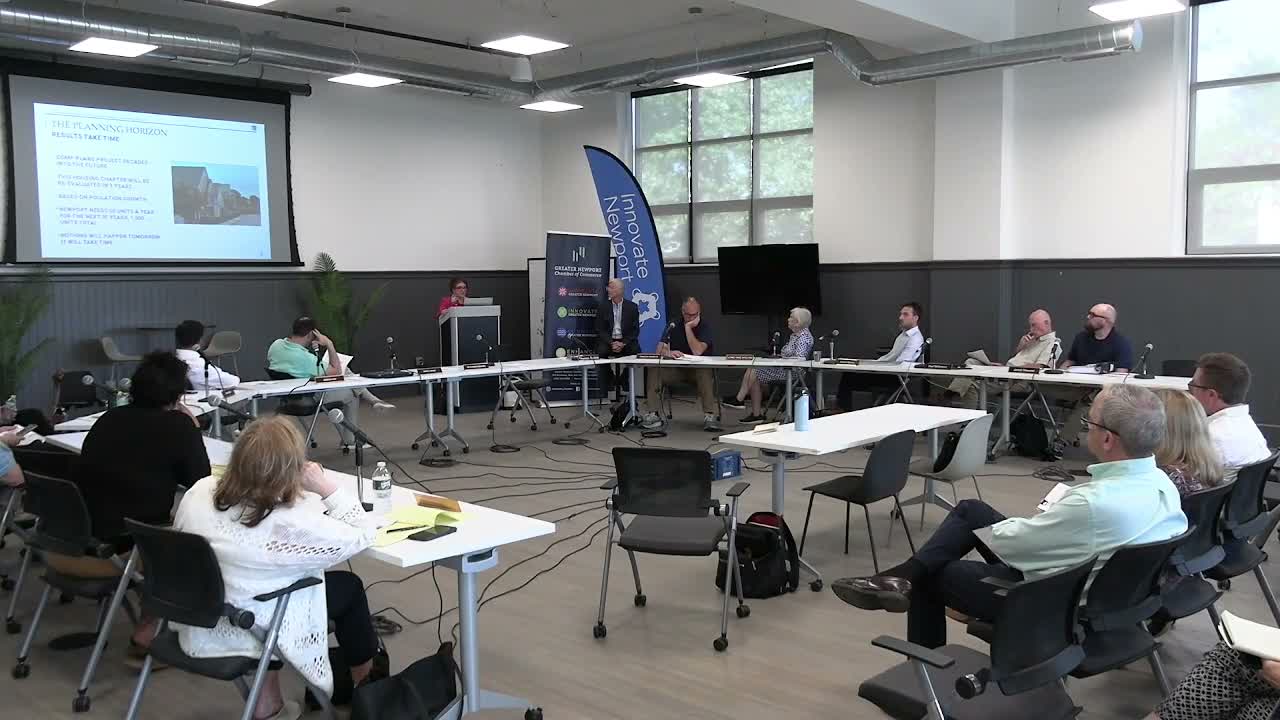
Kim Salerno, the consultant leading Newport’s state‑funded housing technical assistance program, told a joint City Council and Planning Board workshop that the city needs about 50 housing units per year for the next 30 years — roughly 1,500 units — based on the study’s population projections. “A good shorthand way of thinking about housing is that Newport needs 50 units a year for the next 30 years, amounting to about 1,500 total,” she said.
The presentation combined mapping, U.S. Census/American Community Survey data and a public survey of about 470 respondents to show rising affordability pressure. Presenters said Newport’s median house price was shown in the study at roughly $830,000 and that local rents run roughly 20%–30% above the state median, underlining why middle‑income and workforce housing are priorities.
The consultants presented a series of build‑out scenarios to show how policy changes could affect housing supply. One conservative scenario — converting existing single‑family properties to two‑family units where current zoning already allows it — produced a modest increase in potential units. More permissive scenarios, such as allowing multifamily development in more zones without a special‑use permit, would yield a much larger increase in theoretical capacity, the presenters said. The team also modeled a zoning change that would reduce minimum lot thresholds in some districts (an example compared R10 minimums to an R4‑like threshold around 4,500 square feet), which they said would make a majority of lots conforming and therefore easier to subdivide or redevelop.
Consultants flagged large redevelopment parcels in the North End (including former Navy‑associated property and the Jai Alai site) and the city‑owned Gateway Center as opportunities that could deliver hundreds of units if infrastructure investments are made. For the Gateway Center the team illustrated a high‑density scenario (using 90 units per acre with structured parking) that produced a ballpark estimate of about 366 units on the parcel in their slide set.
Survey results showed residents’ complexity of views: many respondents said rents are too high and favored more housing in principle, but also signaled reluctance about higher density near their own homes. Presenters cautioned that the online survey was self‑selected and not fully representative.
Salerno and staff emphasized the study is a tool for policymaking rather than a set of ready‑made regulations. They listed candidate policy directions — emphasizing small lots and compact neighborhoods, encouraging future two‑ and three‑family houses, and promoting mixed‑use in commercial zones — and noted short‑term rentals remain a cross‑cutting factor affecting year‑round housing availability.
The presentation closed with immediate next steps: staff will use the study to inform a zoning overhaul process, and the planning department will seek a dedicated housing planner in the coming budget to shepherd code changes and implementation.