Get Full Government Meeting Transcripts, Videos, & Alerts Forever!
Get email alerts on the ADU Ordinance topic
No spam. Unsubscribe anytime.
Newport adopts ADU ordinance that narrows state defaults; council splits over parking and neighborhood impacts
Summary
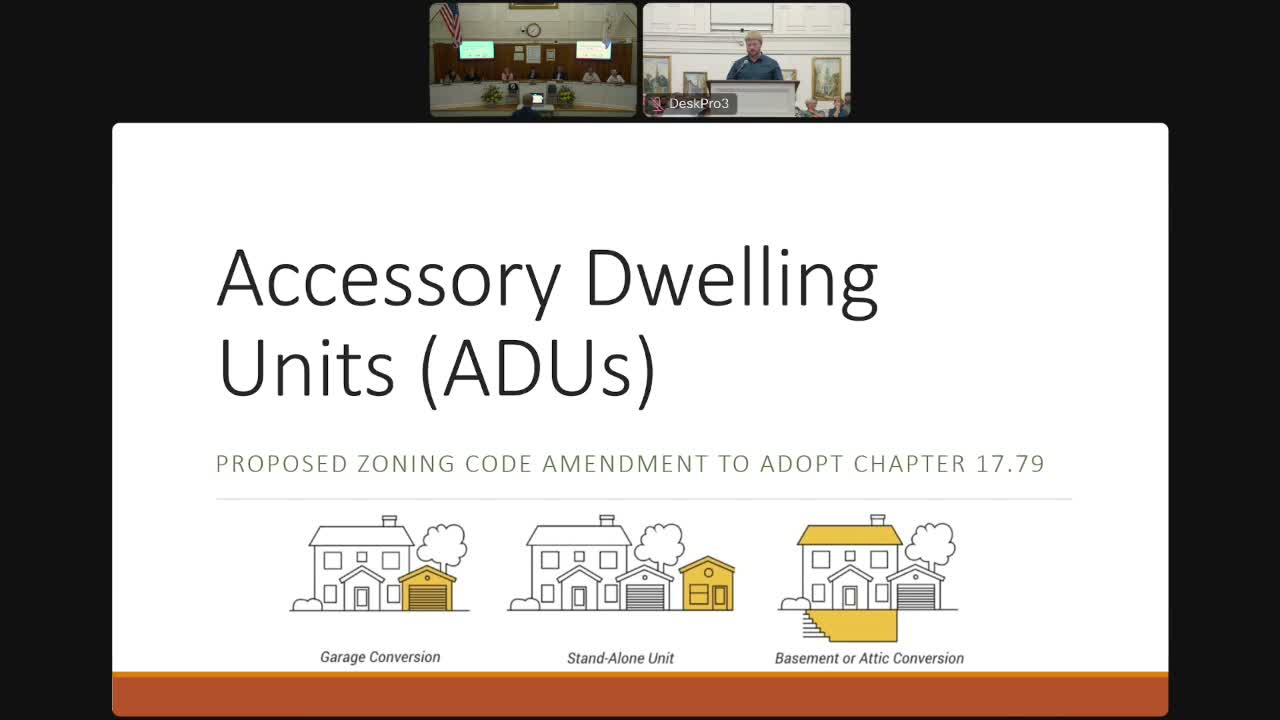
The City Council voted to adopt an ordinance implementing the state's accessory dwelling unit (ADU) mandate but limited unit sizes and bedroom counts and prohibited ADUs from short-term renting. Councilors split over parking, neighborhood character and whether ADUs will meaningfully increase affordable housing.
The Newport City Council voted to adopt a local ordinance implementing the Rhode Island law that requires municipalities to allow accessory dwelling units (ADUs), while using the local discretion the statute allows to set narrower limits.
Nick Armour, the city zoning officer, briefed the council on the state requirements and local options. He told the council the state permits new ADUs on lots of at least 20,000 square feet or, for smaller lots, conversion within an existing footprint; the state requires municipalities to permit studios and one-bedroom units of at least 900 square feet and two-bedroom units of at least 1,200 square feet. The state further prohibits ADUs from being used as short-term rentals.
Staff and the planning board recommended local limits that mirror the state minimums and cap ADUs at two bedrooms, require the minimum unit sizes (900/1,200 sq ft or 60% of the primary dwelling), and decline to require additional on-site parking while insisting that any parking removed as part of a conversion must be replaced onsite. Armour said the planning board unanimously supported the recommendation to avoid automobile-parking requirements that would create a common need for variances.
Council debate was vigorous. Opponents warned the law would change neighborhood character and predicted ADUs could convert into short-term rentals despite state prohibitions; supporters argued the local ordinance is preferable because it is more restrictive than the state's default. One councilor urged adopting the ordinance to retain local limits rather than allow the state’s broader default to apply. Another noted ADUs alone are unlikely to deliver rent-restricted affordable housing because there are no rent controls; they may instead increase property values.
After a motion and procedural vote to call the question, the council approved the ordinance as drafted with the planning staff’s recommendations. The ordinance becomes the city’s local implementing rule for ADUs and is intended to provide a narrower, more controlled pathway than the state baseline.
Next steps: staff will receive and process ADU permit queries under the new ordinance; the administration also noted the city’s short-term-rental enforcement tools (GoGov system) will be used to detect and cite illegal short-term rentals if ADUs are advertised in violation of the ordinance.