Get Full Government Meeting Transcripts, Videos, & Alerts Forever!
Get email alerts on the Infrastructure Utility Relocation topic
No spam. Unsubscribe anytime.
Lock Haven, Suburban Water Authority spar over who pays to move line for Sunset Pines Phase 2
Summary
Council and Suburban Water Authority spent extensive time debating relocation of a Suburban-owned water line required for the city's planned Phase 2 resurfacing of Sylvan Drive, with disagreement over who should pay for trench base, paving and restoration. No final cost-sharing change was adopted at the meeting.
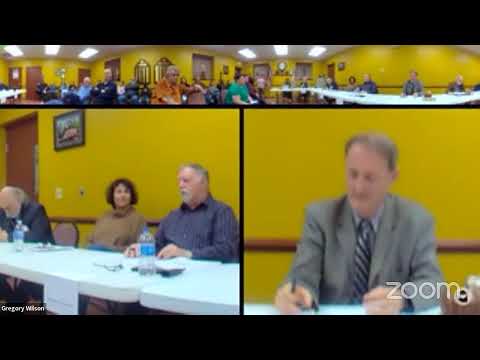
Council members and Suburban Water Authority representatives spent a sustained portion of the meeting debating how to handle a Suburban-owned water main that sits in the city's planned roadway for Sunset Pines Phase 2.
At the meeting, Suburban representatives described options for relocating the utility line and gave preliminary restoration cost ranges, citing a unit restoration price of "$132 per square yard" for a full trench restoration and contrasting that with a leveling course option that would be far less expensive. Suburban said it could move the line and do interim stone backfill, with the city or a future paving contractor expected to complete the final base and top coat.
City staff and council members pushed for a clearer, documented cost-sharing approach. Council members and the city engineer asked whether the city would be expected to pay for the "scratch" or leveling course versus the compacted stone base and the final asphalt top coat. Suburban argued that industry practice in comparable state projects is to allocate the bulk of relocation costs to the entity requiring the relocation and to leave the final road restoration to the municipality; the representative cited PennDOT practice that requires the agency driving the project to absorb a majority share of relocation costs in similar situations.
City staff noted the project currently has only Phase 1 bid documents and no dedicated line-item for Phase 2 restoration in the FY budget. Council members said that uncertainty and lack of a firm price were blocking timely decisions and could jeopardize the city's ability to use a favorable bid for Phase 2. One council member described the situation as "tripping over our shoes" over who must fill a hole, urging a pragmatic, consistent approach for public benefit.
The parties discussed next steps: Suburban will take the council's position back to its board for reconsideration and provide more concrete cost estimates and proposed allocation; the city will continue coordination with the engineering firm HRG and with HRI, the planned contractor, in hopes of keeping both phases on schedule. No formal agreement or new cost-sharing commitment was adopted during this meeting.
What happens next: staff said that if Suburban agrees to absorb relocation costs then the city could re-bid or proceed with Phase 2; otherwise, the city would need to identify funds or risk losing the window to complete the work under the current favorable bid.
Authority and documents cited in the meeting included the existing cost-sharing agreement between the city and Suburban and examples of PennDOT relocation-cost practices used for comparison.