Get Full Government Meeting Transcripts, Videos, & Alerts Forever!
Get email alerts on the Transportation topic
No spam. Unsubscribe anytime.
Council opens public hearing on countywide transportation impact-fee facilities plan; hearing continued after robust discussion
Summary
County staff presented an updated transportation impact-fee facilities plan that expands fee coverage countywide, identifies 17 eligible road projects through 2030 and produces a proposed per-PM-peak-trip fee of $3,461.65. Councilors and the public raised concerns about the fee magnitude and effects on childcare, senior housing and affordable housing; meeting continued the facilities-plan hearing to April 12 for further input and the fee ordinance to a later date.
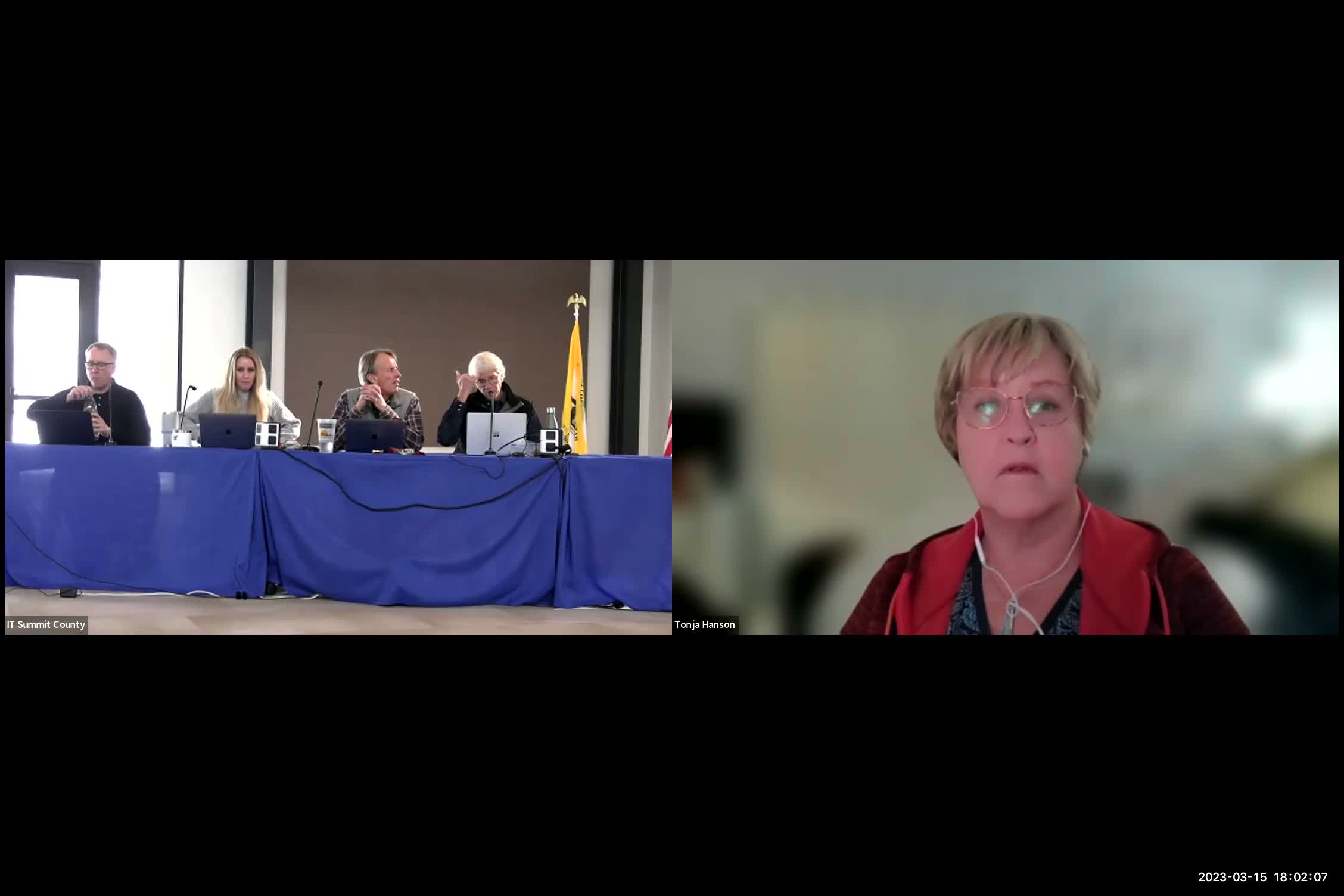
Summit County opened a public hearing March 8 on a countywide Transportation Impact Fee Facilities Plan and related impact-fee analysis. Brandon Brady (staff) and Helen Strawn (staff) presented the study and described two companion deliverables: (1) the facilities plan that lists eligible projects and (2) the fee analysis that converts project costs into a per-trip fee.
The facilities plan draws on the county’s 2022 long-range transportation plan and identifies 17 county-road projects that could be funded, in whole or in part, by impact fees. Staff said the analysis forecasts about 4,656 new PM-peak trips from 2022 through 2030; Zions Public Finance (Susie Becker) produced an analysis that yielded a gross cost per PM-peak trip of $3,461.65 (compared with the Snyderville Basin fee of $1,924.38 established in 2008).
Council members and attendees questioned the scale and distribution of the projects (staff noted roughly $179 million in eligible project costs in the plan) and pressed on potential impacts to childcare providers, senior housing and affordable-housing developments. Staff and the consultant explained that the fee is an upper-bound calculation tied to the project list; the ordinance contains provisions for adjustments, individualized studies and waivers in unusual circumstances and for certain public purposes. Staff also said credits exist for existing uses and that developers can submit site-specific traffic studies to seek different assessments.
Council asked staff to consider simplification of land-use categories (to avoid very large disparities between uses) and to provide additional examples showing how the formula and credits would be applied in practice. Susie Becker (Zions Public Finance) and Brandon explained how trip-rate data were drawn from the Institute of Transportation Engineers and how per-use fees convert to per-dwelling or per-1,000-square-feet assessments (for example, multifamily mid-rise units produce fewer trips per unit than detached housing, so the per-unit fee is proportionally lower).
After extended discussion, the council voted to continue the public hearing on the facilities plan to April 12 (Richards Building) to allow time for additional staff work and public input. The fee enactment ordinance and detailed fee schedules will be considered separately after the facilities-plan hearing is complete.
What’s next: staff will refine the presentation materials, consider combining or simplifying categories per consultant advice, and return with the facilities plan (public hearing resumed April 12) and the separate enacted-fee ordinance at a later date.