Get Full Government Meeting Transcripts, Videos, & Alerts Forever!
Get email alerts on the Pensions topic
No spam. Unsubscribe anytime.
County staff urges council to pick up URS Tier 2 public‑safety increase and adjust hybrid pay to 'make employees whole'
Summary
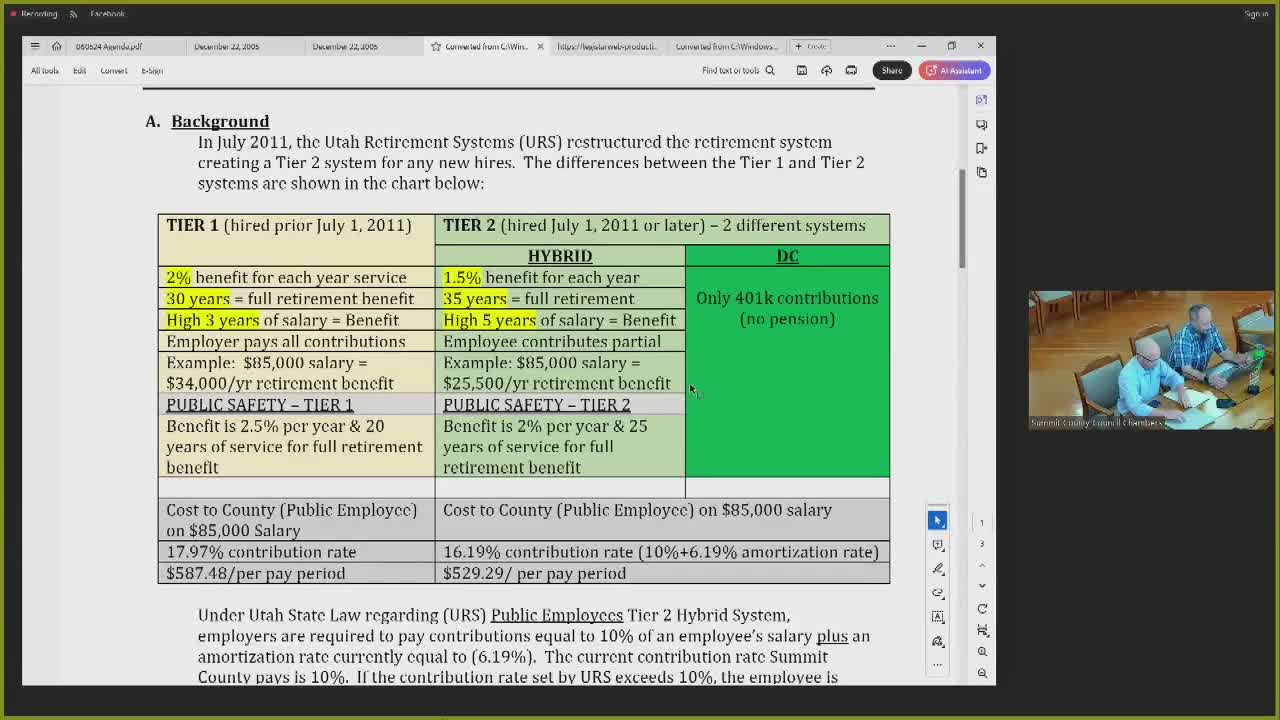
Staff told the Summit County Council that Utah law prevents the county from picking up the Tier 2 public‑employee contribution above 10%, recommended picking up the Tier 2 increase for public‑safety employees (2.14%), and recommended a 0.95% salary increase for Tier‑2 hybrid employees to offset a 0.7% URS deduction.
County financial staff briefed the council on an impending change to employer contribution obligations under the Utah Retirement Systems (URS) Tier 2 plan.
David Warnock explained that URS established Tier 2 in 2011 and that current Utah law limits employer pickup for public‑employee Tier 2 participants to a 10% contribution. Forecasts show the URS rate for public‑employee Tier 2 will reach approximately 10.7% in July, meaning the county is not allowed by law to 'pick up' (pay on behalf of) the excess for public employees. The county can, however, pick up increases for public‑safety Tier 2 participants; staff estimated that pick‑up at about 2.14% on the public‑safety side.
To keep affected employees whole, staff recommended the county (1) pick up the 2.14% Tier 2 public‑safety increase and pay it directly to URS, and (2) increase base pay for Tier‑2 hybrid public‑employee participants by 0.95% so the after‑tax increase approximates the 0.7% needed to offset the employee contribution to URS.
Council members raised operational questions: how to treat new hires, whether the increase will be repeated if URS rates continue to climb, and how to handle long‑term compensation policy. Staff recommended that long‑term solutions could come through legislative change or the county’s compensation committee; for the near term the council directed staff to implement the recommended approach. Staff estimated the prorated fiscal impact for the current year at about $162,250 and said HR and departmental budgets can be adjusted to absorb the cost for the current fiscal year.
Council emphasized the need for the compensation committee to evaluate longer‑term policy and concurred with staff’s recommendation to take immediate steps to maintain pay competitiveness for recruitment and retention.