Get Full Government Meeting Transcripts, Videos, & Alerts Forever!
Get email alerts on the Housing Policy topic
No spam. Unsubscribe anytime.
Summit County officials debate housing targets and county-owned land after data briefing
Summary
At a council retreat, county staff presented housing data showing a notable deficit of deed-restricted units and projected future demand; council members debated goal-setting, use of county parcels (Cline/Dolly, Gilmore), and whether to pursue targeted RFPs or revise zoning tools. A facilitated follow-up was agreed.
Summit County Council spent the bulk of a retreat workshop examining local housing data and policy choices, after staff presentations showed a persistent gap in deed-restricted housing and projected future demand tied to job growth.
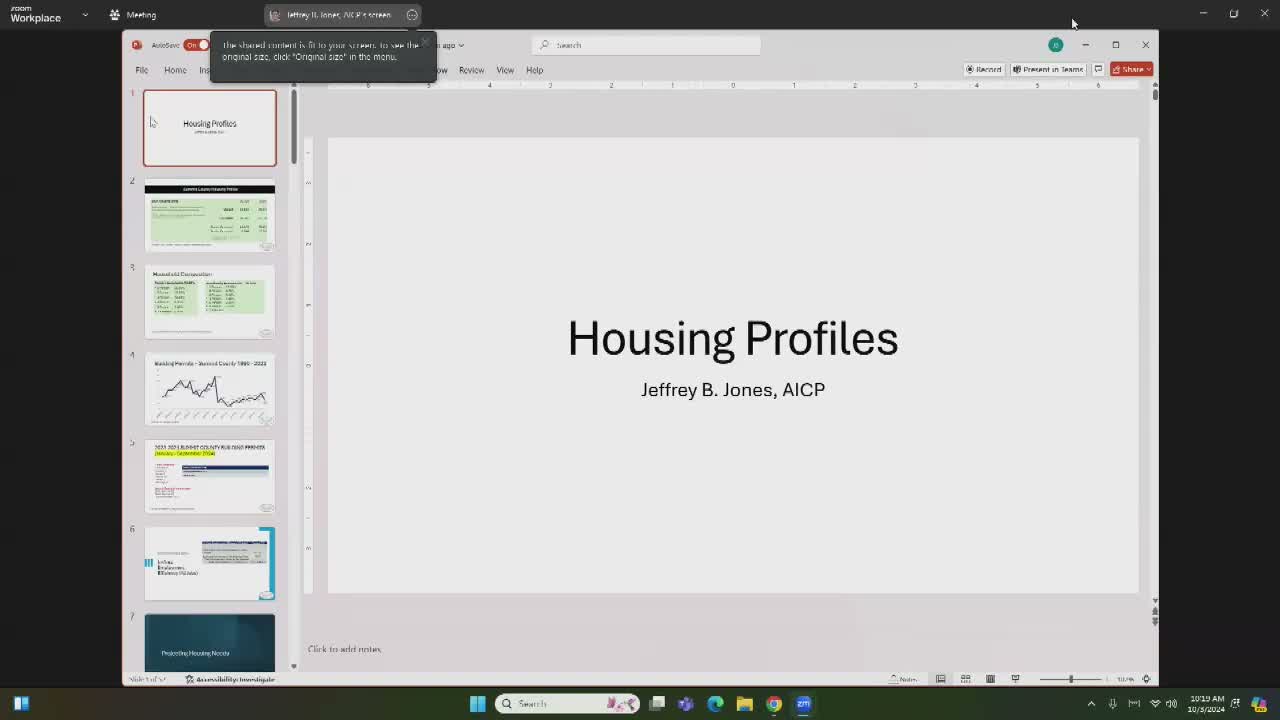
Jeff, a county housing analyst, summarized the inventory and need, saying: "This first slide shows total housing units being 26,708. And of those, 38.3% [are] vacant," and he explained that vacancy figures include seasonal and short-term rentals. He cited a Kim C. Gardner Policy Institute analysis that identified a sizable deficit concentrated in lower-AMI bands and said the institute projected roughly 1,600 deficit units (with methodology caveats depending on how deed-restricted units are counted). Jeff also laid out employment-driven models and population trends that underlie a 10-year projection for housing demand.
The presentation flagged several categories of need: rental and deed-restricted workforce housing, seasonal-worker beds, and senior/ memory-care capacity. Jeff noted that an aging population would raise demand for specialized senior units and estimated a modest but meaningful need for assisted- or memory-care units over the coming decade.
Planning Director Peter gave a separate, broader presentation on tools and tradeoffs. He urged the council to be explicit about the built environment it wants and warned that simple "units-per-acre" targets can be misleading. "Tell me what you wanna do," he said near the end of his presentation, "I'll create the tools to do it." He also described current large projects in the pipeline and pointed out that existing code and inclusionary ratios can make mixed-use proposals economically infeasible without additional policy adjustments.
Council members debated two competing approaches: set clear targets first and then align zoning and incentives to reach them, or rely on inclusionary requirements and project-by-project negotiation. Several councilors argued for a target-driven approach and for directing staff to craft specific RFPs for county-owned parcels that would seek particular outcomes (for example, units for teachers or firefighters, or a mix of for-sale and rental products). Others cautioned that targets must be grounded in defensible data and careful phasing to avoid creating unmet expectations.
There were no formal votes. By the end of the day the council agreed on two procedural next steps: (1) schedule a facilitated workshop to translate policy goals into clear targets and tradeoffs, and (2) direct staff to prepare materials and possible RFP concepts for county land (including the Cline/Dolly site and other county holdings) so the council can review focused options.
What happened next: staff will circulate Jeff's presentation materials and follow up on logistics for the facilitated session. The council did not adopt new policy or a numeric housing target at the retreat; members emphasized continued public engagement and more granular modeling before committing to binding goals.
Why it matters: Summit County faces both an accumulated shortage of deed-restricted housing and projected demand tied to employment growth. The council’s choice—whether to set explicit targets now or continue refining tools and project-specific negotiations—will shape whether future development delivers the kinds of affordable and workforce housing the county’s employers and residents have said they need.
What to watch for: a forthcoming facilitated policy session, staff memos with RFP options for county parcels, and future planning commission reviews of major applications noted by staff.