Get Full Government Meeting Transcripts, Videos, & Alerts Forever!
Get email alerts on the Budget topic
No spam. Unsubscribe anytime.
Summit County manager presents FY25 spending plan, flags ESST timing and $7M net increase
Summary
County manager and staff presented a recommended FY2025 budget of about $89.8 million — roughly $7 million above last year — describing a rigorous budget committee review, deferred projects, and reliance on partial emergency services sales tax (ESST) revenue in FY25 with full-year yield expected later.
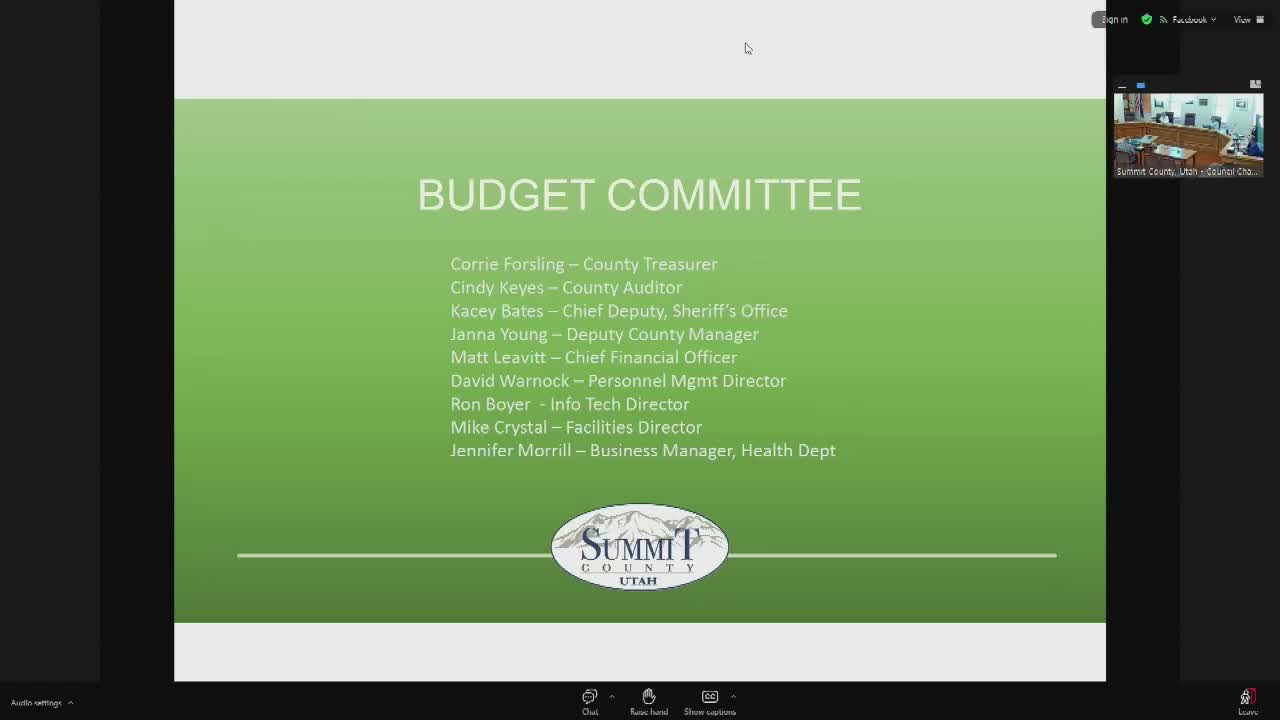
Summit County Manager and budget staff presented the recommended fiscal year 2025 budget to the County Council on Oct. 2, describing a multi‑week budget committee review that pared roughly $17.5 million in department requests down to a proposed $89.8 million spending plan.
Manager said the packet reflects a working document and emphasized that the committee logged dozens of hours meeting with departments — noting approximately 38 hours of department review and about 70 committee hours overall — to prioritize requests. Staff highlighted three decision rules: participation in a new performance initiative, demonstrable funding sources or return on investment, and deferral where projects can wait until anticipated revenues materialize.
Key figures presented included 35 new full‑time position requests with 15 recommended for funding in the manager’s proposal, and a proposed budget that is roughly 8% higher than last year’s adopted spending. Staff explained the difference between budget increases and net spending, stressing that budgets reflect both revenues and expenditures and that grants or enterprise revenues can drive larger budgets without requiring new local taxes.
A major revenue assumption in the draft is a partial year of an emergency services sales tax (ESST) if voters approve it this November. Staff showed a partial‑year ESST estimate of about $6.9 million for FY25 while flagging that a full‑year yield could approach $17 million in FY26. Councilors and staff discussed whether to proceed with truth‑in‑taxation this year or to rely on ESST receipts and defer some projects to await full ESST revenues.
Other items flagged as excluded or deferred from the recommended budget included 20 requested FTEs not funded, $10 million in cuts from overall departmental requests, no new housing/master plan funding beyond a $250,000 carryover to the housing authority, a postponed courthouse remodel pending a facilities study, and partial funding for a childcare request ($280,000 of $400,000 requested).
Staff also answered council questions on specific capital items and ongoing contracted services, including an estimated $3.5 million landfill cell project budgeted in the landfill enterprise fund and a proposed mental health contract that would increase the line from roughly $3.0 million in 2024 to about $4.2 million in 2025 (a $1.2 million increase). The budget presentation concluded with staff scheduling next steps and appeals as the council continues deliberations.
The manager and council agreed to continued review in coming weeks, including targeted work sessions and detailed slides on variances and revenue breakdowns.