Get Full Government Meeting Transcripts, Videos, & Alerts Forever!
Get email alerts on the Youth Survey topic
No spam. Unsubscribe anytime.
Summit County health staff urge use of SHARP student survey data as schools resume
Summary
Summit County public‑health staff described the SHARP youth survey, its anonymity, parental‑consent process and uses for local prevention planning; Park City’s in‑registration consent boosted opt‑in to about 82% this year, staff said.
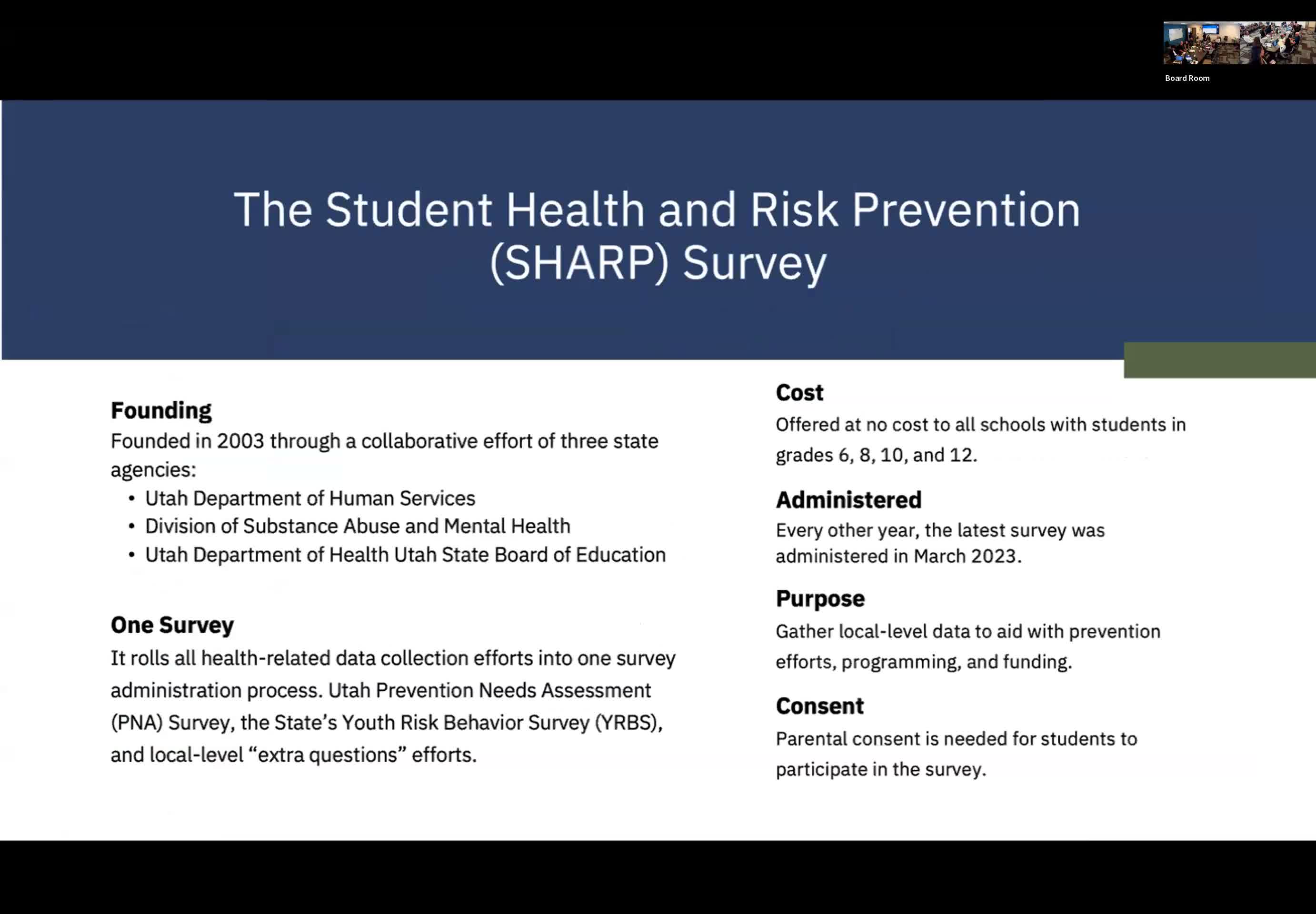
Pamela, prevention staff with the Summit County Health Department, presented the SHARP (School Health and Risk Prevention) survey to the Board of Health on Oct. 7, describing the instrument’s purpose, administration and local utility. The survey, administered to 6th, 8th, 10th and 12th graders, collects data on substance use, mental health, protective factors and social determinants. Pamela said the survey is anonymous and that schools send a single link for administration; students cannot resume an interrupted survey once they close it.
Pamela explained the parental‑consent process and recent changes to boost opt‑in. Park City School District began including SHARP consent in its student registration, which Pamela said yielded about 82.4% parental approval. The department uses a 60% participation threshold as a validity guideline; if participation falls below that level, analysts apply additional scrutiny or adjust interpretation.
Staff highlighted local findings and uses: reported alcohol and marijuana use trends, reductions in prosocial school involvement, screen time and sleep metrics, and an estimated 12.1% of students reporting food insecurity in the county. Pamela said schools, nonprofits and the health department use SHARP results to target grants and prevention programs.
Board members asked about consent versus actual student completion rates, whether students can complete the survey at home (administration is set by each school and can vary), and whether sensitive items (suicide, drugs) prompt parental concern. Pamela said research indicates asking about mental health does not increase risk and that the survey’s added items and shorter sixth‑grade instrument were intended to balance comprehensiveness with participation burden.
Pamela asked the board for continued support in encouraging school districts to use and act on the data; she said the department will follow up with communication material for students and parents to explain the survey’s purpose and how it gives students a voice.
The presentation was informational; no board action was taken at the meeting.