Get Full Government Meeting Transcripts, Videos, & Alerts Forever!
Get email alerts on the Housing Production Plan topic
No spam. Unsubscribe anytime.
Sudbury boards review Housing Production Plan; debate added town parcels and measurable targets
Summary
Consultants and staff presented a draft Housing Production Plan that aims to preserve Sudbury’s subsidized housing inventory and propose strategies (zoning, programs, town parcels). Planning and Select Board members requested more public engagement, redlines for parcel listings, and clear, measurable housing goals before adoption.
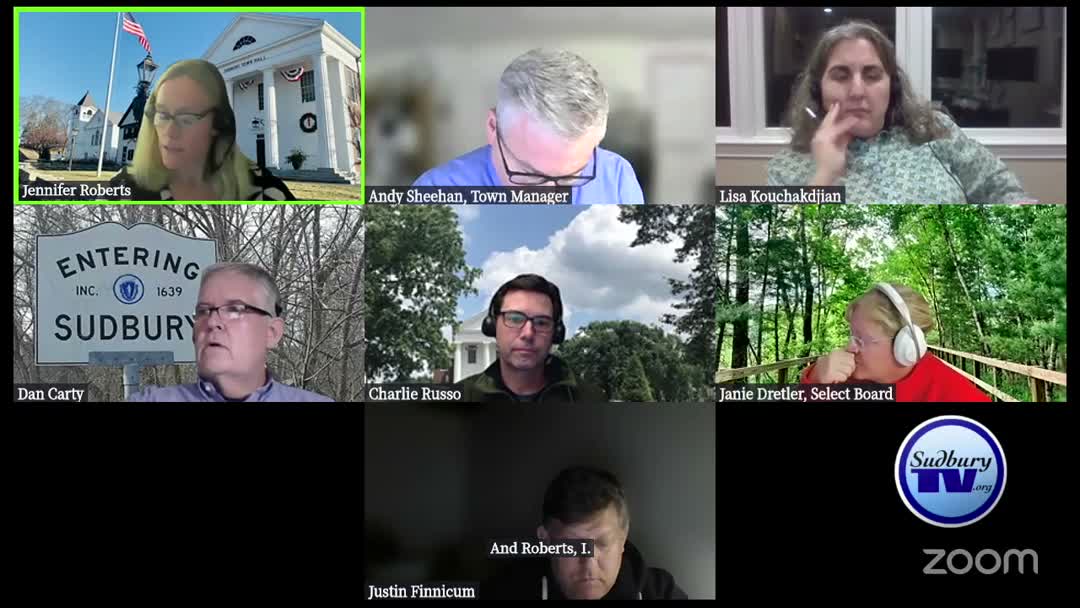
Consultants from JM Goldson presented an updated Housing Production Plan (HPP) to a joint meeting of the Town of Sudbury Select Board and Planning Board on Oct. 8, describing goals and strategies intended to preserve existing subsidized housing and guide future affordable housing production.
The presentation by the consultant emphasized four goal areas — mixed housing types, preserving affordable housing, greening homes, and maintaining the subsidized housing inventory at 10% or higher — and outlined an implementation matrix assigning responsibilities and approximate timelines. Consultant Cadenice said the plan “is not binding in any way” and is intended to build consensus and provide an implementation roadmap, including the safe‑harbor benefit that can help towns manage state review of housing projects.
Board members focused their questions on two central issues: which town‑owned parcels the plan lists as potentially developable, and whether the plan contains measurable production targets. Several Select Board members and planning board members expressed concern that parcels such as Broadacre, Frost Farm and others were added after initial drafts and should have additional public review before being labeled developable. Adam Berney, the town’s Director of Planning and Community Development, said staff and the housing trust reviewed roughly 260 town parcels to identify a smaller set of potential candidates and that contested parcels can be moved from an immediate strategy list to a longer‑term discussion category so they remain visible while the town seeks more public input.
Many members also urged the addition of specific, numeric metrics to judge success. Select Board member Dan said a housing production plan should produce measurable outcomes — for example, “Creation of 1 unit, 10, a hundred” — and recommended the plan set a galvanizing metric so the town can tell whether it is succeeding. Staff noted that Sudbury already exceeds the 10% subsidized‑housing threshold (the Town has been reporting roughly 11–12% in recent counts) and that inclusionary zoning language acts as a minimum production mechanism, but agreed to consider drafting clearer numerical targets or a process for revisiting metrics during periodic updates.
The consultants and staff recommended that if each board wants changes, staff will prepare redlined edits reflecting the evening’s feedback and circulate them. Once adopted by the board(s), the plan would be submitted to the Executive Office of Housing and Livable Communities (EOHLC, formerly DHCD) for certification; EOHLC is expected to respond within 30 days of submission. Staff emphasized the HPP is a five‑year plan intended to guide a mix of zoning, programmatic and local initiatives rather than to mandate immediate projects.
Next steps: staff will prepare a redline that incorporates board feedback on parcel categorization, public engagement, and measurable goals; the Planning Board and Select Board will revisit the plan and decide whether to adopt and forward it to EOHLC for certification.