Get Full Government Meeting Transcripts, Videos, & Alerts Forever!
Get email alerts on the Transportation topic
No spam. Unsubscribe anytime.
Transportation committee warns Go Sudbury funding will end by spring; urges transition to regional service with a 'safety‑net' subsidy
Summary
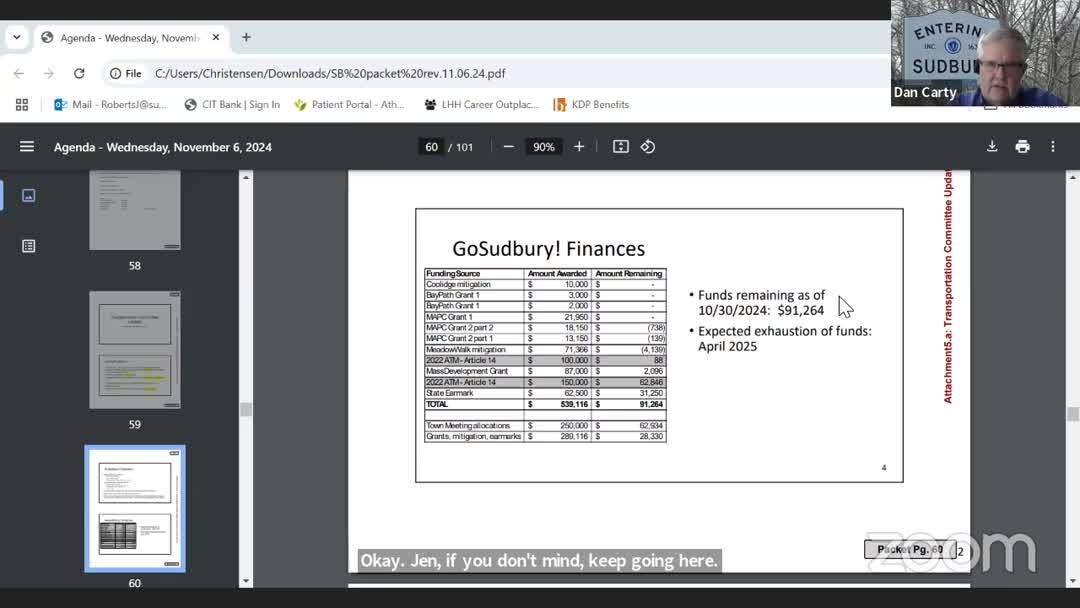
The Transportation Committee told the Select Board it expects Go Sudbury program funds to exhaust in spring 2025 (about $91,000 remaining) and recommended transitioning to MWRTA services (CATCH Connect) with a smaller voucher safety net for vulnerable residents; board asked staff and finance director for cost and budget guidance.
The Sudbury Transportation Committee told the Select Board on Nov. 6 that local subsidies keeping the town's Go Sudbury rides program running are running out and recommended a phased transition to regional transit services.
Committee member Dan summarized program usage and finances and said, "as of the October is we've got about 91,000 left, and, you know, we expect that that's gonna take us into around April." He said the Go Sudbury program (taxi and Uber vouchers) has been valuable for older residents, people with disabilities and households with limited means but relies heavily on one‑time grants, state earmarks and town meeting approvals.
The committee described two emerging regional options: CATCH Connect, an on‑demand service run by the MetroWest Regional Transit Authority (MWRTA), and a hospital shuttle that provides limited scheduled service to Boston medical centers. Early CATCH Connect data show the service is concentrated within Sudbury and nearby plazas; initial ridership samples included roughly 267 rides in an early period for the MWRTA pilot.
Because grant funding for CATCH Connect and the hospital shuttle is time‑limited, the transportation committee recommended sunsetting the town's current Go Sudbury model and negotiating longer‑term MWRTA service, while creating a smaller "safety net" program to help the most vulnerable residents (vouchers, taxi coupons or limited Uber gift cards) for medical or urgent needs. The committee estimated that ongoing program costs could be in the ballpark of $150,000 per year if replicated in Sudbury as a full service, and noted that fully funding a continuing service may require changes to regional MBTA assessments, a new town budget line, or one‑time ARPA support.
Select Board members asked for more data on actual monthly users (distinct riders vs. registrants), use cases (medical, grocery, social), and options to pilot a fixed loop shuttle to commuter rail as a complement to microtransit. Several members emphasized the need for a finance office assessment and recommended the Transportation Committee and town staff return with specific funding scenarios for the board to consider during budget season.
Next steps: staff will provide the finance director's view of budget feasibility for continuing some form of service beyond current grant expirations; the Select Board will consider transportation funding and program priorities as part of its Nov. 19 financial review.