Get Full Government Meeting Transcripts, Videos, & Alerts Forever!
Get email alerts on the Tax Classification topic
No spam. Unsubscribe anytime.
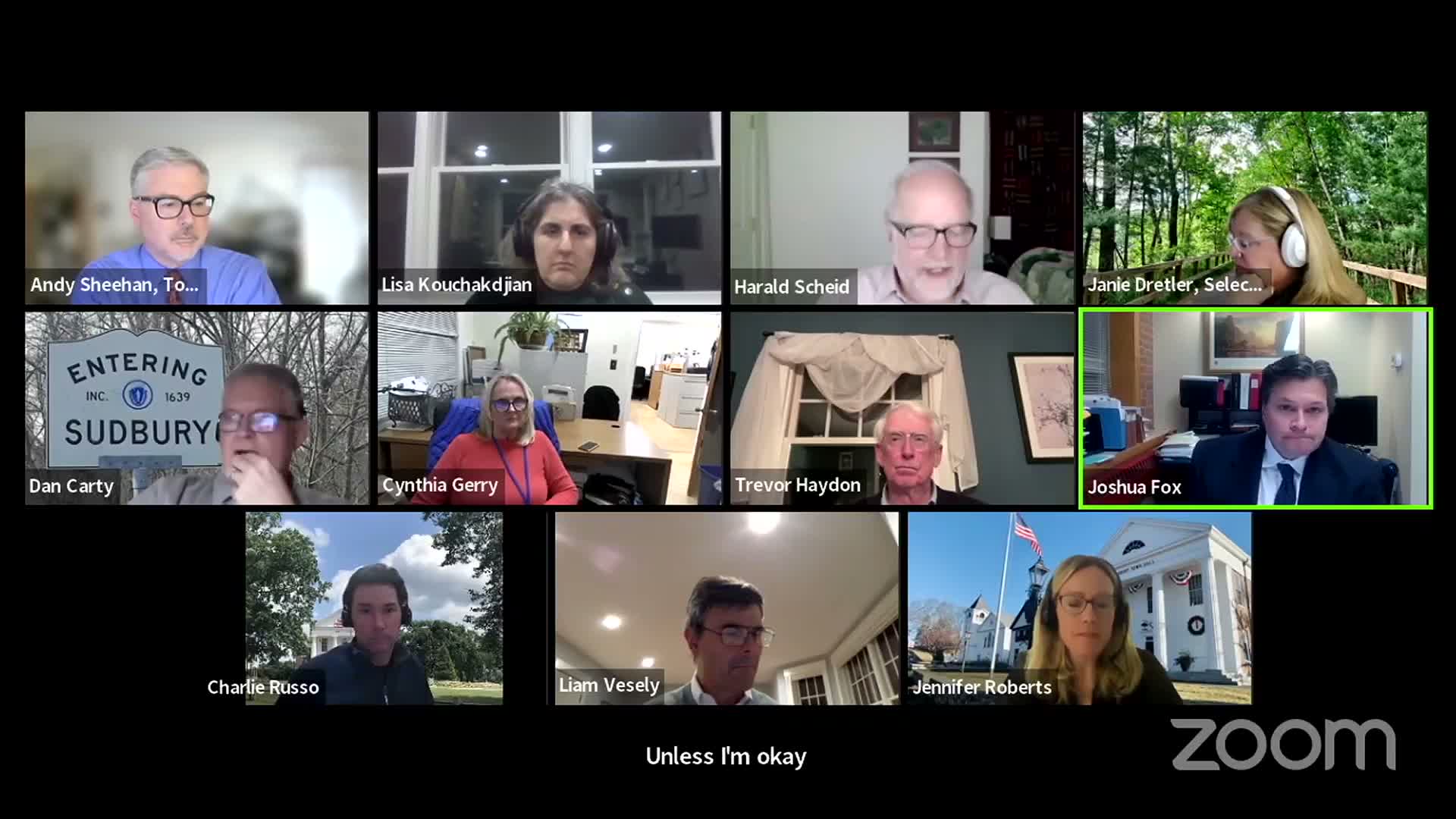
Sudbury assessors recommend 1.4 commercial shift; board rejects residential and small‑commercial exemptions
Summary
At a Dec. 3 public hearing, Sudbury assessors presented valuations and tax-class options, recommending a 1.4 CIP shift and a residential factor of 0.9705; the Select Board rejected motions to adopt residential and small‑commercial exemptions but approved the 0.9705/1.4 shift pending state certification and capped senior means‑tested exemptions at 0.5% of the residential levy.
Sudbury’s Board of Assessors presented the town’s annual tax‑classification hearing to the Select Board on Dec. 3, laying out valuation changes, exemption options and a recommended shift that would shift more of the local tax burden onto commercial and personal property.
“ We are looking this year, to raise a 9,827,875,” Harold Sheed, principal regional assessor, told the Select Board, describing the property tax levy and explaining that the increase reflects both operating needs and new‑growth revenue. Sheed said single‑family values rose modestly, “around 3.7%,” while some apartment valuations fell after recent abatements.
Sheed described three common exemptions — residential, small commercial and open‑space — and said the assessors’ packet shows motions for the first two; he also explained how a commercial/industrial/personal‑property (CIP) shift works and offered a factor of about 1.4 as one option to balance impacts across property classes.
During deliberations, the Select Board moved on two procedural motions to adopt the residential and small‑commercial exemptions for fiscal year 2025. Both motions were defeated in roll‑call votes. The board then approved a motion to set the residential factor at 0.9705 with a corresponding CIP shift of 1.4, subject to the Massachusetts Department of Revenue’s certification of the town’s annual tax recap.
The assessors also briefed the board on the senior means‑tested exemption, reporting they had acted on 85 applications and tentatively granted 83 exemptions. The board voted to cap FY2025 senior exemptions at one‑half of 1% of the residential property tax levy, the level recommended in the packet.
Board members asked assessors to provide more details on several items: the drivers of changes for the multifamily class (Sheed said recent abatements on newer projects lowered apartment valuations), how new utility assets (for example, Eversource installations) are reported and valued under Department of Revenue rules, and how Proposition 2½ interacts with levy increases and abatements.
The decisions change how taxes will be allocated among residential and commercial property owners once certified by state officials; the Select Board scheduled implementation steps and asked staff to publish updated figures and explanatory material for residents.
What’s next: The CIP shift and residential factor will take effect after the Department of Revenue completes its certification. The Select Board and assessors said they will make the certified rates and example tax bill impacts available to the public when the DOR posts its final recap.