Get Full Government Meeting Transcripts, Videos, & Alerts Forever!
Get email alerts on the Water Quality topic
No spam. Unsubscribe anytime.
Columbia County eDNA pilot finds human, pet and poultry markers in creeks; commissioners weigh septic‑fee, signage and outreach
Summary
A county-funded eDNA pilot covering Aug 2023–Feb 2024 found widespread human, dog and poultry genetic markers across Columbia County watersheds, with peaks during cold, wet months; presenters asked the Board of Commissioners for direction on outreach, signage and a small septic‑permit fee to fund ongoing monitoring and signage.
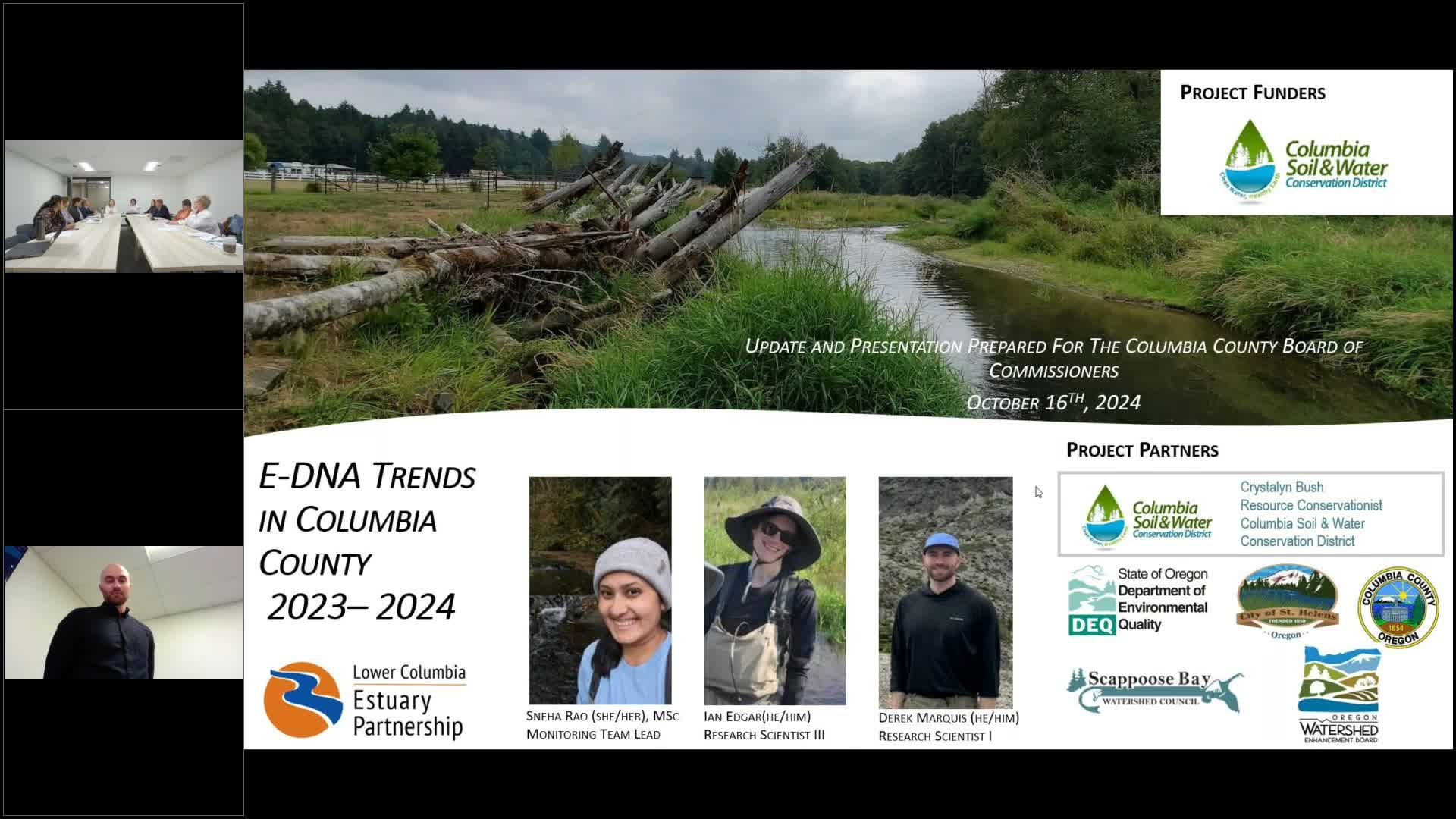
County staff and project partners presented results of an environmental DNA (eDNA) pilot to the Columbia County Board of Commissioners on Oct. 16, saying genetic markers tied to humans, dogs and poultry are present across multiple county watersheds and that the results could help target septic repairs and restoration work.
Derek, a research scientist who leads sampling for the project, explained the testing approach: “eDNA is the genetic material that is left behind by organisms in the environment,” and the team used qPCR assays to screen for six source markers, including human, bovine, dog, swine, poultry and sheep. He described field sampling, sealed filters and partner lab workflows the team used to process samples.
The presenters reported that bovine markers were concentrated at particular tributary and Milton Creek sites in winter months, poultry signals were more geographically spread, and dog markers appeared at many sampling stations. Presenters said human markers were widespread and often showed higher contributions during January–February, when rainfall and runoff were high and many tested locations lie outside municipal sewer service.
“The data let us start to see where sources are likely coming from,” a project presenter said, describing how eDNA results can guide riparian restoration, targeted septic‑system evaluations and outreach. Presenters recommended placing advisory signage at public access points, running ground and aerial surveys to narrow sources, and continuing eDNA monitoring to measure whether interventions work.
County staff and commissioners discussed practical next steps. Staff described outreach options (mailings, door drops, farmers‑market contacts and partnerships with Community Action Team, 4‑H and FFA), potential restoration actions (buffer planting, fencing and technical assistance for producers) and funding ideas. A commissioner framed a revenue option: a modest per‑permit “water quality fee” on septic permits. Figures discussed ranged from $10 to $25; staff modeled the example that $10 on 400 permits would yield about $4,000 and $20 about $8,000 annually.
No formal motion or vote was recorded on adopting a fee; presenters asked for board direction to pursue outreach, refine sign locations and seek funding. Public health director Jamie Anantzen noted the county does not routinely receive confirmed human illness case reports tied to creek exposures, and staff said under‑reporting is expected because people often do not seek testing for mild illnesses. Commissioners requested staff check health‑department records for any investigated E. coli cases tied to county creeks.
The presenters emphasized that eDNA profiling is a tool to focus follow‑up work, not a regulatory determination. They suggested pairing continued sampling with targeted septic repairs, restoration projects and informational signage in coordination with cities such as St. Helens and Scappoose.
The board did not adopt a policy in the session; staff said they would return with refined signage plans, partner‑engagement proposals and options for a funding mechanism, and that procurement and grant avenues would be pursued.