Get Full Government Meeting Transcripts, Videos, & Alerts Forever!
Get email alerts on the Medical Marijuana topic
No spam. Unsubscribe anytime.
Lauderhill tables text amendment to allow medical-marijuana dispensaries, asks staff for more research
Summary
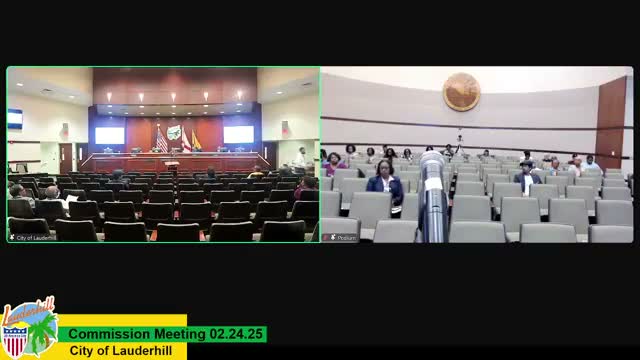
The Lauderhill City Commission voted 5-0 on Feb. 24 to table a citywide text amendment that would permit medical‑marijuana dispensaries (treated like pharmacies) until staff provides more research and options to limit proliferation; the item was set for April 14, 2025.
Lauderhill — The City Commission voted unanimously on Feb. 24 to table a proposed amendment to the city’s land-development code that would allow medical‑marijuana dispensaries to operate under rules mirroring pharmacies. Commissioner Danielle Dunn moved to delay the measure while staff researches limits and best practices; the motion passed 5-0 and the item was set for April 14, 2025.
The ordinance (listed in the packet as 25O-02-007) would add “medical marijuana establishment/dispensary” as a permitted nonresidential use and align standards with pharmacy zoning. Daniel Keystrell Mills, the city’s development‑services director, told the commission that using pharmacy spacing and zoning could allow as many as 14 dispensaries citywide under worst‑case spacing assumptions, and that pharmacies currently number eight in the same zoning schematic.
Commissioner Dunn framed her questions around public health and neighborhood impact, citing a 2019 RAND study she said found young adults living near dispensaries use marijuana more often and hold more positive views. “My concern is the number of medical marijuana dispensaries that would be permitted,” Dunn said, pressing staff for comparisons with neighboring municipalities and for mechanisms to limit local proliferation.
Hope Calhoun, an attorney for the applicant proposing the change, said the text amendment is citywide but not site‑specific; any operator still must apply for location approval and may require a special exception that brings additional review before the commission. “Just because it’s possibly permitted doesn’t mean it will definitely happen,” Calhoun said, describing security measures and operational rules applicants typically propose.
Several residents and community leaders urged caution. Lawrence Martin warned that authorizing one site could prompt a rapid increase in applications, and Willie Mae Cooper, a homeowners association president, asked the commission to heed residents’ concerns about loitering and neighborhood impacts. Varian Harris questioned whether existing pharmacies (CVS/Walgreens) could dispense medical marijuana under current rules and raised proximity concerns to residential projects.
Mayor Grant and other commissioners said they were not opposed to the medical use in principle but sought more data and options to limit the number and placement of dispensaries. The commission directed staff to return with additional research, including how Fort Lauderdale and other nearby cities regulate dispensaries, potential limits consistent with state law, and public‑safety implications. The item was tabled to a date certain of April 14, 2025.
The ordinance remains under discussion and no location was approved; staff will report back with findings before the second reading.
Votes: Motion to table made by Commissioner Danielle Dunn; motion approved 5-0. Ending: The commission set a follow‑up for April 14, 2025.