Get Full Government Meeting Transcripts, Videos, & Alerts Forever!
Get email alerts on the Budget Legislation topic
No spam. Unsubscribe anytime.
ALIEF ISD CFO and deputy superintendent outline budget, enrollment and legislative risks
Summary
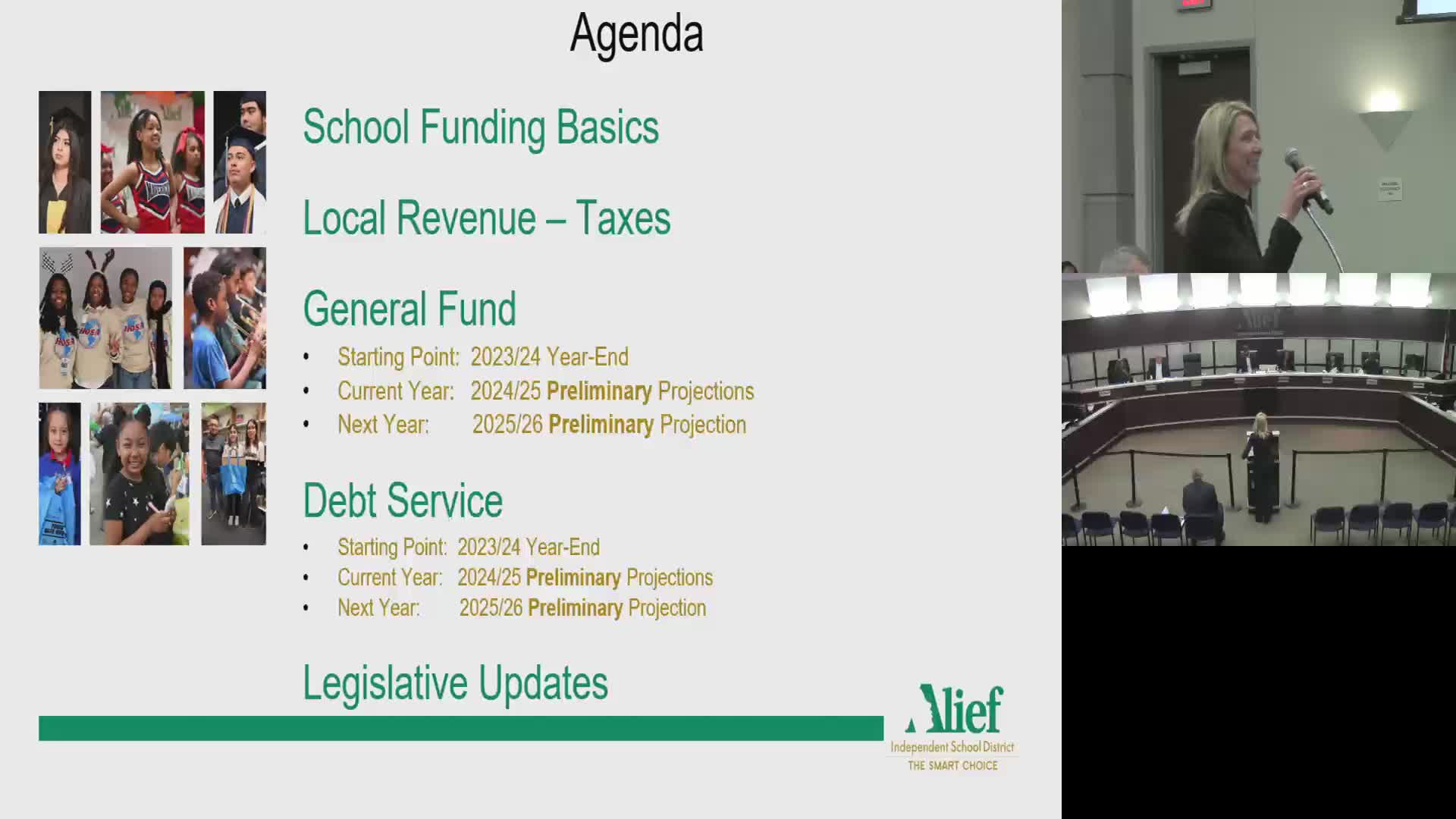
Deputy Superintendent Charles Woods and CFO Emily Littlefield presented the district's 2025–26 budget outlook, projecting a preliminary enrollment decline of 376 students, a planned $50.27 million bond issuance with no tax‑rate increase, and outlined how pending state bills could affect funding and operations.
ALIEF ISD administrators told trustees Feb. 18 that the district is beginning its 2025–26 budget process with caution but remains positioned to protect staffing and core services.
Emily Littlefield, the district’s chief financial officer, and Charles Woods, deputy superintendent of business services, reviewed school‑funding basics, described the district’s revenue mix from state, local and federal sources and said the district’s 2023‑24 starting point included a fund balance of about $1.016 billion (as reported in the presentation). Littlefield said state funding provides roughly 63% of the district’s revenues while local revenue provides the remainder and noted that ALIEF is treated as “property poor” under the state formula.
For 2025–26, Littlefield reported a preliminary projection of a 376‑student enrollment decline and said the district is building the budget on that estimate. She said local revenue is being affected by tax‑rate compression and that preliminary property values—which will be certified in summer—are being monitored. Littlefield listed major expenditure pressures: planned payroll increases (the board previously approved a one‑time 3% midpoint supplement), higher health insurance costs tied to a new carrier, and rising utility costs after an expired electricity contract.
Woods said the district plans a bond issuance of approximately $50,270,000 to fund long‑range capital needs but intends to keep the tax rate the same as a result of the issuance. He summarized recent bond‑related activity (including QSCAP securities set aside for 2027 repayment) and said the district intends to be conservative in forecasting hold‑harmless revenue tied to recent homestead‑exemption proposals.
Both administrators briefed the board on several bills pending in the Texas Legislature and their likely effects: Senate Bill 26 (teacher retention allotment, with proposed stipends targeted by experience and teacher incentive allotments), Senate Bill 569 (expanded virtual‑school/provider approvals with proportionate funding following students who take courses outside the district), and Senate Bill 568 (proposals to revise special‑education funding by tiers). Woods said some bills could provide short‑term funding increases but that long‑term effects are uncertain; he warned that many proposals carry significant reporting requirements and could shift funds away from current uses.
Trustees asked detailed questions about federal Title I funding risk, Texas Education Agency (TEA) PEIMS snapshot changes and their potential effect on compensatory and accountability funding, audit filing deadlines for property‑value appeals, and the district’s options if vouchers or provider-approval bills move forward. Woods said the district had filed a 2023 property‑value audit and was monitoring results. He also said the district has fund balance to manage short‑term federal changes but that sustained federal reductions would pose long‑term risk.
No formal board action was taken on legislative matters; staff said they will continue to update the board as bills move through the session and will present final budget recommendations later in the spring.