Get Full Government Meeting Transcripts, Videos, & Alerts Forever!
Get email alerts on the Adus And Affordability topic
No spam. Unsubscribe anytime.
Coupeville planners weigh state-mandated two‑ADU rule, affordability and neighborhood character
Summary
At a March 4 workshop, Coupeville planning staff outlined a model showing how allowing up to two accessory dwelling units (ADUs) per single‑family lot could add capacity but may not produce affordable housing without partnerships or incentives; residents raised safety, traffic and historic‑preservation concerns.
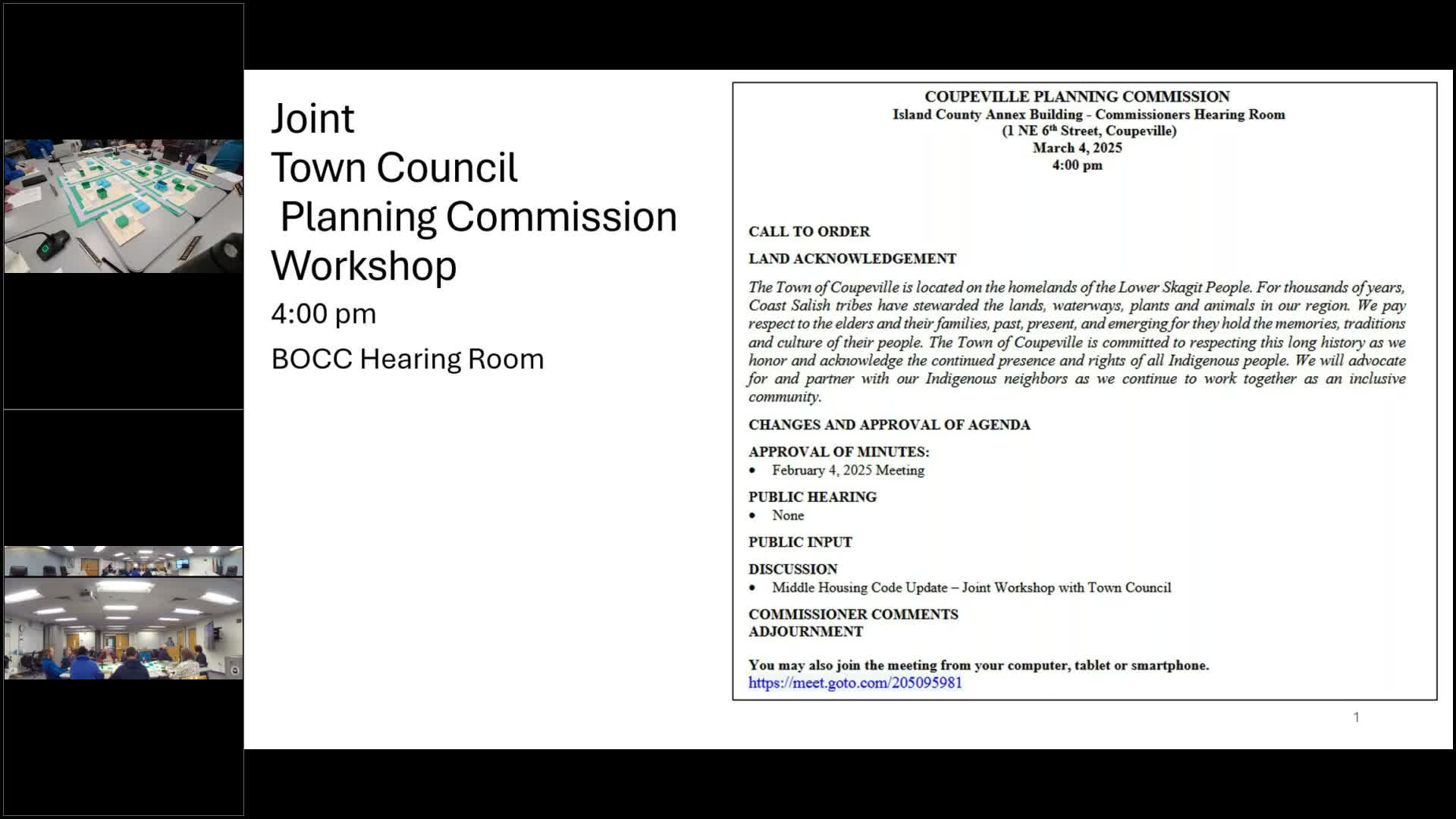
Coupeville — Planning staff and commissioners spent much of a March 4 workshop parsing how state requirements to allow accessory dwelling units might reshape the town and whether those changes will improve affordability.
Staff presenter Joshua said the proposed code would allow two ADUs per single‑family parcel in a range of configurations and that the town’s long‑range land‑capacity analysis assumes about one in four feasible ADUs will be built over 20 years. “We expect one out of every four possible ADUs to be constructed,” Joshua told the commission, noting construction costs in the area commonly run about $300 per square foot.
The presentation mapped lots by remaining lot coverage and setbacks to show where detached or internal ADUs are physically feasible. Staff also described incentives under consideration — reduced setbacks for an initial ADU, modest lot‑coverage bonuses and targeted parking waivers — intended to make small‑lot development more practical.
Several commissioners and residents said the economics make it unlikely many ADUs will be built quickly. One resident, Susan McClellan, who said she lives at 208 South Main Street in a restored 1893 Queen Anne Victorian, urged the commission to consider how rezoning a two‑acre parcel behind her home from medium to high density could affect access and the neighborhood’s historic character. “High density means potentially many more vehicles would be using the driveway multiple times per day,” McClellan said during public comment, citing an ambulance access incident and school/ferry traffic near her block.
A recurrent theme was enforceable affordability. Commissioners discussed partnering with Habitat for Humanity and community land trusts to keep units permanently affordable, and a range of regulatory options, such as limiting two detached ADUs in some areas or requiring nonprofit partnership for condominiumized units. Staff said legal options exist but warned the town lacks the administrative capacity to manage income‑restricted covenants without outside partners.
Commissioners also flagged practical constraints that will limit how many ADUs are constructed: small or irregular historic lots, existing lot coverage and driveway/curb‑cut limitations, stormwater and parking impacts on one‑lane local streets. Staff summarized the broader planning context: Coupeville is allocated roughly 351 housing units under countywide planning policies and currently projects a townwide ADU capacity of about 69 units, but emphasized ADUs alone will not satisfy the town’s lower‑income housing needs.
The commission did not take formal code votes at the workshop. Several members expressed that, while they had reservations about wholesale change, they were not uniformly opposed to allowing two ADUs and asked staff to return with refinements and research on enforcement, partnerships and detailed design guidelines. The commission plans to continue work on draft code amendments with the goal of moving forward to formal hearings in April.