Get Full Government Meeting Transcripts, Videos, & Alerts Forever!
Get email alerts on the Earned Wage Access topic
No spam. Unsubscribe anytime.
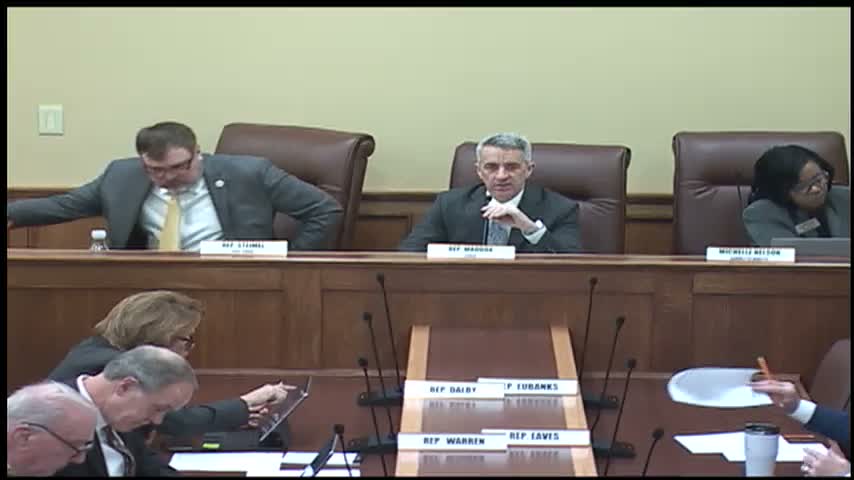
House committee approves bill to regulate earned‑wage‑access with consumer protections
Summary
The House Insurance & Commerce Committee voted to pass HB15‑17, which defines and regulates earned‑wage‑access (EWA). Sponsors and industry witnesses said the optional, nonrecourse product gives workers faster access to pay but preserves a free standard transfer while allowing paid expedited transfers (industry average cited ~$3.18).
Representative Ray (House District 69) asked the Insurance & Commerce Committee to adopt HB15‑17, legislation to define and set minimum consumer protections for earned‑wage‑access (EWA) services. Ray said the bill clarifies definitions, requires providers to offer a free standard transfer option and establishes prohibited conduct for providers while allowing optional expedited transfers for a fee.
The bill drew industry witnesses: Andrew Welch, government‑relations manager for DailyPay, described EWA as an employer‑integrated benefit that operates similarly to PayPal or Venmo for payroll, and Phil Goldfeder, CEO of the American Fintech Council, represented multiple EWA providers. They told the committee the product is optional for employers and employees, operates on net wages (after withholdings) and is nonrecourse — users cannot be pursued by collections or see credit impacts if they access wages then later are unable to continue using the service.
Committee members pressed on fees and business models. Representative Allen asked whether the bill’s definition of a fee covers both instant transfer fees and subscription or membership charges. Industry witnesses said every provider in their standards offers a free standard transfer (that typically takes two to three business days) and that an expedited transfer is an optional paid service; the Consumer Financial Protection Bureau industry average was cited as about $3.18 per expedited transaction. Witnesses also described other revenue models: some providers are offered to employers as part of a payroll suite (an employer‑paid subscription), while others offer direct‑to‑consumer options.
Lawmakers also asked about potential overuse or dependence on the service. DailyPay testified that high‑frequency usage tends to decline over time and emphasized the product differs from loans because consumers cannot access wages that have not yet been earned. Representatives sought clarity on whether payroll‑based benefits or withholding calculations are affected; DailyPay said amounts available for transfer are net wages after taxes, garnishments and other withholdings, and the company integrates with payroll systems to check wages multiple times per day.
Representative Ray closed by saying the measure sets "rules of the road" and an affirmative voice vote passed HB15‑17 through committee. The committee approved the bill as amended and recommended a favorable report to the full House.
What happens next: The bill moves to the House floor for consideration under regular calendaring rules.