Get Full Government Meeting Transcripts, Videos, & Alerts Forever!
Get email alerts on the Underground Storage Tanks topic
No spam. Unsubscribe anytime.
Petroleum UST board: fund shortfall vs. liabilities could push per‑tank fees higher in 2027
Summary
Jonathan Manival of the Petroleum Underground Storage Tank Release Compensation Board told the committee the fund had an unobligated balance of $20.49 million (total $25.18M obligated and unobligated) versus an estimated $39.0 million liability as of 6/30/2024; the board kept fees and deductibles unchanged for fiscal 2026 but warned inflation could force fee increases in 2027.
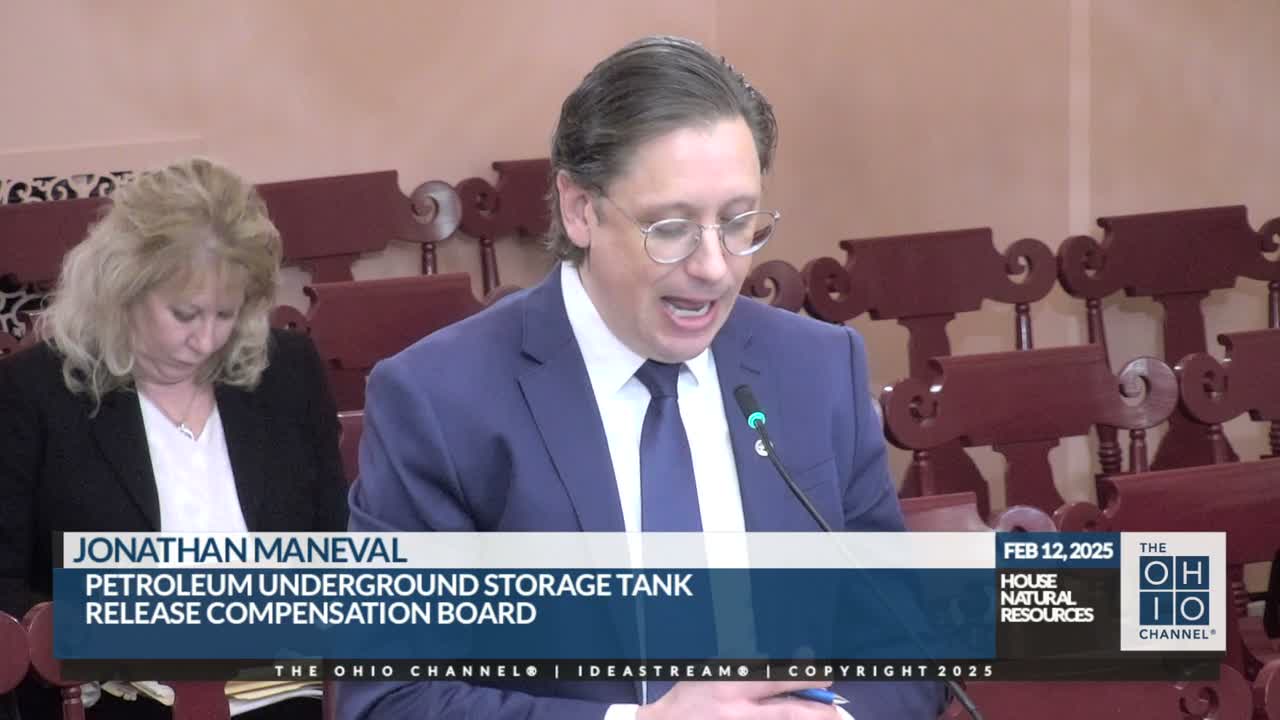
Jonathan Manival, assistant director of the Petroleum Underground Storage Tank Release Compensation Board, told the House Natural Resources Committee the board manages a fee‑funded financial assurance fund that reimburses corrective action and third‑party damages from petroleum releases and that recent actuarial estimates show liabilities exceeding current reserves.
As of Jan. 31, 2025, Manival said, the fund’s unobligated balance was $20,490,000 and an additional $4,690,000 was obligated for claim payments, totaling $25,180,000. He said the board’s estimated liability for reimbursements tied to discovered releases as of June 30, 2024, was $39,000,000.
"Unfortunately, an increase in claim costs ultimately forces an increase in the amount of reimbursements and could lead to an increase in the annual per tank fee in the 2027 fiscal year," Manival told the committee, pointing to inflation‑driven increases in labor and material costs that are only now being realized in the claims process.
Manival said the board voted at its Nov. 20, 2024 meeting to maintain per‑tank fees and deductible amounts at current levels for fiscal 2026; under that action, fees remain at $350 and $550 per tank for the respective deductible tiers (the transcript referenced $55,000 and $11,000 deductible amounts). He said the budget request presented to the committee covers personnel costs for the board’s 16 staff and that all board expenditures are financed by fee collections rather than general revenue funds.
Manival described the board’s two‑step reimbursement process (eligibility review and evaluation of reimbursable costs), administrative appeals rights under chapter 119 of the revised code, and historical disbursements of about $311 million since the fund’s inception. Committee members did not press follow‑up questions during the hearing.
The committee did not take action during the session on fee levels or statutory changes.