
Board reviews TAPR: Lewisville ISD outperforms region on graduation but sees targeted gaps in emergent bilingual and subgroups
Get AI-powered insights, summaries, and transcripts
Subscribe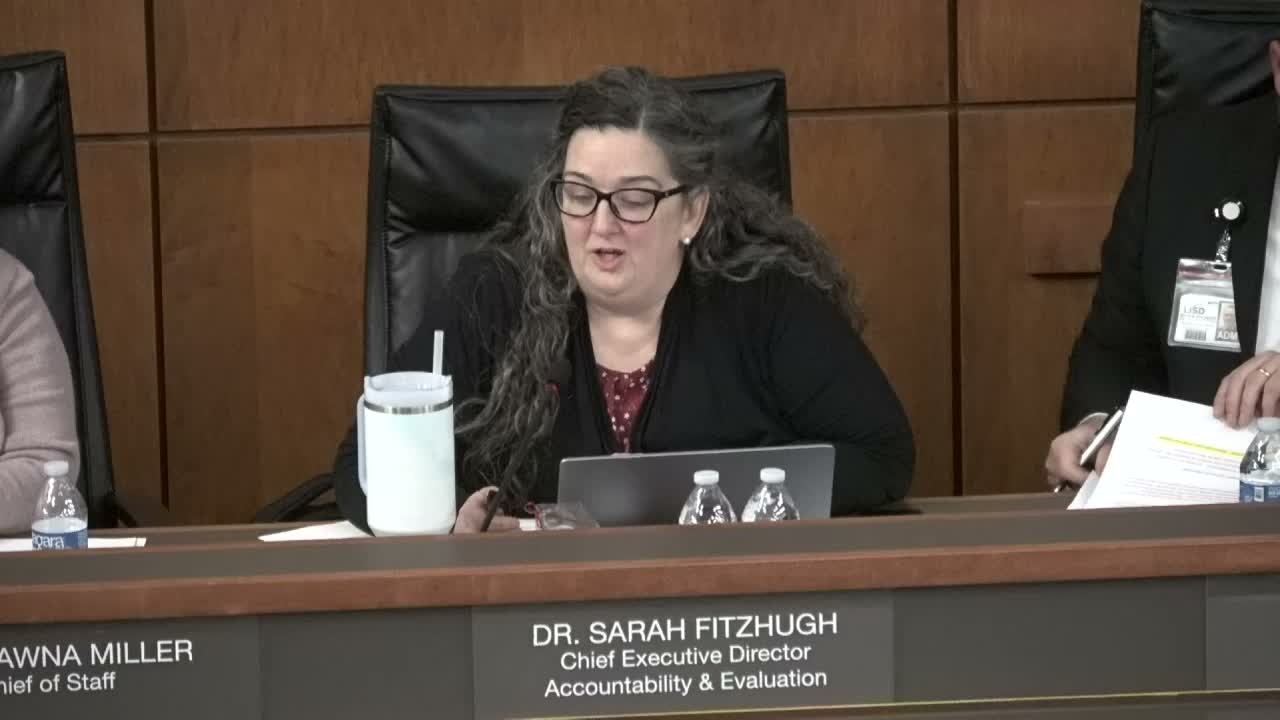
Summary
At a public hearing the superintendent and staff presented the TAPR and related accountability measures: district graduation rates exceed state and regional averages, dropout rate fell to 0.9%, but emergent bilingual and some special populations are marked as 'needs assistance.'
Trustees opened a public hearing on the Texas Academic Performance Report (TAPR) for 2023–24 and heard district staff summarize academic outcomes, subgroup performance and accountability determinations.
Dr. Fitzhugh noted the district’s four‑year graduation rate remains higher than the state and region despite a small dip from the prior cohort. The district’s dropout rate improved from 1.0% to 0.9%, the presentation said. Staff highlighted strengths for students who are reclassified out of emergent‑bilingual status and noted that students served through emergent bilingual programs who take EOC assessments perform well once reclassified.
Fitzhugh said the results‑driven accountability framework identified emergent bilingual and certain smaller special‑population cohorts as a 'needs assistance' determination (level 2), while the district met requirements for special education. Staff singled out social‑studies STAAR performance and cohort dropout numbers as areas informing those determinations and said the district is developing local plans to address gaps.
Finance and operations staff also presented fiscal context tied to TAPR reporting. Mr. Rayer reviewed fiscal‑year 2022–23 operating revenue and expenditure comparisons; payroll and operating expenditures were discussed and the presentation included per‑student revenue and an estimated $101 million shortfall versus a state average benchmark cited in the slides. Trustees asked for cohort‑level state comparisons, and presenters said some state data downloads were not yet available to produce the requested breakdowns.
Board members praised district strengths and asked clarifying questions about small subgroup sizes, the timing of state data releases and how locally implemented interventions are expected to affect lagging CCMR (college, career, and military readiness) indicators over the next one to two years.