Get Full Government Meeting Transcripts, Videos, & Alerts Forever!
Get email alerts on the Special Education topic
No spam. Unsubscribe anytime.
LISD outlines strategic support plan after SD3 finding for out‑of‑school suspensions
Summary
After a TEA designation of significant disproportionality (SD3) for out‑of‑school suspensions among African American students with disabilities, LISD told the board it will allocate 15% of IDEA‑B funds to improvement strategies and has submitted a Strategic Support Plan to TEA.
Lewisville ISD officials told trustees the district has been designated SD3 (significant disproportionality, year 3) for the use of out‑of‑school suspension of African American students with disabilities and outlined steps to respond.
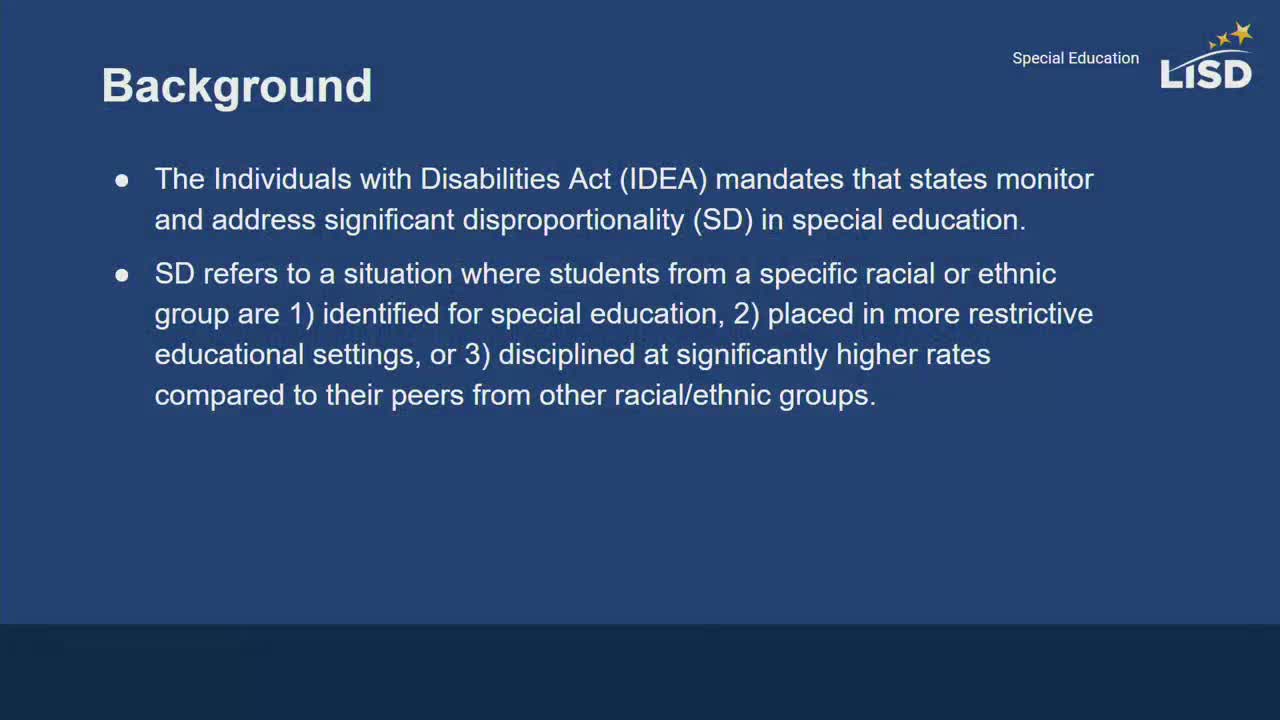
Tina Clark explained that the Individuals with Disabilities Education Act requires Texas to monitor and address significant disproportionality in three areas: identification for special education, placement in more restrictive settings and discipline. Based on TEA's 2024 results driven accountability, LISD was identified for disproportionate use of out‑of‑school suspension (up to 10 days) for African American students with disabilities; the district has been SD‑year‑3 for two prior school years but showed some improvement in risk ratios (from a 3.1 risk ratio down to 2.8).
Under federal requirements for SD year 3, local education agencies must allocate a mandatory 15% of existing IDEA‑B federal funds toward improvement strategies for the identified area. Clark said LISD submitted a Strategic Support Plan (SSP) to TEA in December and will engage in technical assistance through the LEADS cohort and Region 11 ESC liaisons.
District staff described targeted steps including Safe and Civil Schools training, restorative practices integration, behavior interventionist support and MTSS tiered supports. Lisa Cranfield and partners outlined training progress: 54 of 69 campuses have participated voluntarily, roughly 450 staff trained so far, and campuses will continue implementation and coaching. Trustees requested campus‑level breakdowns, mandatory versus discretionary discipline counts and rate calculations to measure proportionality; staff committed to provide those data.