Get Full Government Meeting Transcripts, Videos, & Alerts Forever!
Get email alerts on the Education Performance Report topic
No spam. Unsubscribe anytime.
Round Rock ISD presents annual Texas Academic Performance Report; staff cite TEA testing changes and note mixed results
Summary
Round Rock ISD trustees heard the districts 2023-24 Texas Academic Performance Report: staff said statewide test redesigns and litigation limited released accountability data, reported declines in some third-grade reading and math "meets" percentages, noted a district CCMR improvement, reviewed discipline trends and staffing metrics, and discussed adding explanatory footnotes for the public.
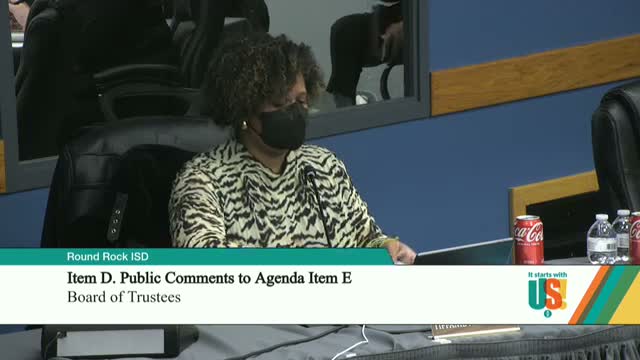
Round Rock ISD staff presented the districts annual Texas Academic Performance Report during a board meeting that began at 5:31 p.m., telling trustees that changes to statewide testing and litigation at the Texas Education Agency (TEA) limited release of some accountability determinations for the 2023-24 reporting year.
Erica Simmons, Executive Director of Assessment and Evaluation, told the board the annual report (released 01/23/2025) meets the districts obligation under Texas Education Code 39.362 and is a one-year-lagged snapshot covering the 2023-24 school year. Simmons said the district relies heavily on local property taxes for operations (about 85.76%), with roughly 7% from the state, about 2.5% federal funds, and roughly 4.5% other local revenues; she also reminded trustees the district returned about $115,000,000 to the state in a prior year, which affects local budgeting decisions.
On academic performance, Simmons reported that third-grade reading at the "meets" level fell from about 66% in 2023 to about 61% in 2024 and that early-numeracy math "meets" also declined (62% in 2023 to 57% in 2024). Simmons and Dr. Aziz emphasized that substantial changes in the statewide STAAR testincluding new constructed-response and short-answer items, increased rigor and a switch to computer testingmean year-to-year comparisons are not "apples to apples." As Simmons put it, the district is "not comparing apples to apples" when presenting the data and will provide context so the public understands the measurement changes.
The presentation included disciplinary and safety measures: the district reported a total of 611 violent/criminal incidents for 2023-24 across elementary, middle, high and alternative campuses (examples cited in the presentation included assault and possession incidents). Simmons said referrals increased year over year but cautioned that referrals do not directly equate to suspensions; in-school suspension counts stayed roughly constant while out-of-school suspensions rose by about a hundred incidents.
Simmons also explained CCMR (College, Career and Military Readiness) is reported as a lagging indicator. For the annual reportwhich reflects the class of 2023the district recorded 84% CCMR; staff noted more recent board briefings show higher, in-year CCMR rates (the presentation cited a later figure of 90% reported in current board materials), and stressed the annual reportby statute and practiceuses the prior graduating class as its reporting cohort.
Presenters and trustees discussed limitations in tracking postsecondary enrollment: the district can only confirm students who enroll in Texas institutions; students who go out of state are not reported to TEA and therefore do not appear in the districts official college-enrollment counts.
Trustees pressed for clearer context in public materials. Trustee Zerate asked whether a student who leaves and later earns a GED is counted retroactively in graduation statistics; Dr. Nichols answered no, clarifying the district does not retroactively add GED completions except under the graduation provisions the district uses. Several trustees asked staff to add explanatory footnotes and context slides that explain TEAs test redesigns, litigation and the lagging nature of some measures so community readers are not alarmed by year-to-year shifts.
The presentation also addressed staffing and retention. Simmons reported a modest decline in average principal years of experience (from 6.9 to 6.3 years) and said teacher experience changed slightly (11.4 to 11.2 years). District turnover was reported at about 18.7% versus the states ~19.1%; staff noted targeted hiring and retention work to stabilize staffing, especially at campuses with higher concentrations of economically disadvantaged students.
During a discussion about testing operations, presenters described changes in how open-response items are graded at scale: the state uses human grading of samples to train automated systems, and families may pay $50 per test to request a manual regrade; trustees noted the cost can be prohibitive for many families and that some districts have litigated aspects of district/state testing and scoring.
Public comments at the end of the presentation included praise for special-education services and requests for more explicit gifted-and-talented information and for SAT/ACT average scores to be included in future reports. After the presentation the board recessed to reset the dais until 6:50 p.m.
The board did not take a formal vote on any new policy during the presentation portion of the meeting; trustees directed staff to add clarifying materials and to consider augmenting the public-facing annual-report package with explanatory footnotes and contextual slides.