
Wichita Falls ISD superintendent criticizes education savings accounts, urges action on attendance and discipline
Get AI-powered insights, summaries, and transcripts
Subscribe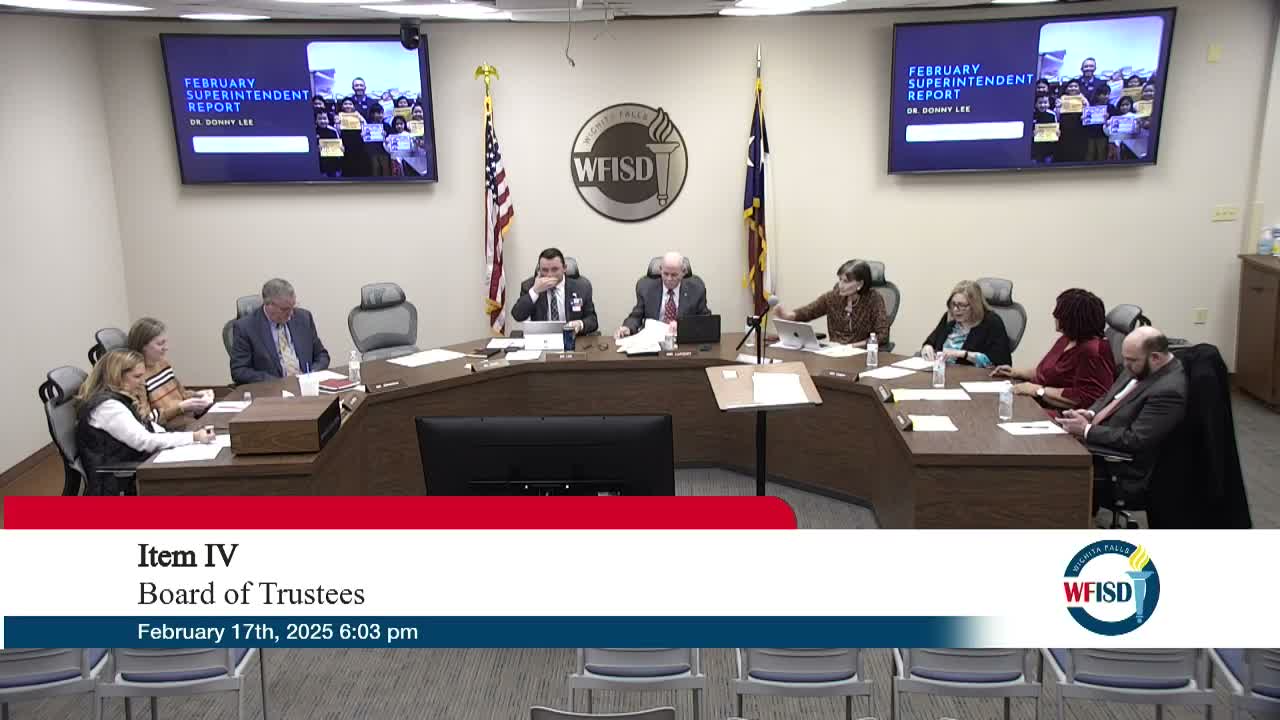
Summary
Superintendent Dr. Donnie Lee told the board enrollment is steady but average daily attendance has fallen to 93.27 and warned state proposals for education savings accounts could divert public funds to private schools that ‘select’ families. He urged local advocacy and restored discipline tools for public schools.
Dr. Donnie Lee, superintendent of the Wichita Falls Independent School District, told the Board of Trustees on Monday that enrollment is steady but average daily attendance has dropped to 93.27 and that the district plans principal and teacher incentives to push attendance higher. He argued that state policy proposals, including education savings accounts, threaten public-school funding and oversight.
Lee said recent classroom and community visits have reinforced the district’s priorities while raising doubts about how private-school admissions would interact with publicly funded vouchers. “This is Andrea Shivaler. She’s the head of school at Denton Academy. She said, ‘We want families here that God wants here,’” Lee told trustees, quoting a private-school statement he said was published. “If we’re really talking about parent choice, they should have the choice of going to public or private or homeschool, and so we should be talking to your constituents from a broad audience, not preaching to the choir.”
The superintendent and several trustees framed the issue as one of equity and of different regulatory standards for private and public institutions. Lee pointed to operational differences that affect costs and services, saying some private schools “don’t even have an ISS room” and “they send them home,” which shifts behavioral and special-education costs away from private campuses. He also raised numbers cited in the meeting—public funding formulas and per-student figures discussed during the report (a figure of 6,160 was referenced in the superintendent’s remarks)—as part of a broader argument that funding parity is not equitable when service responsibilities differ.
On discipline and state regulation, Lee criticized federal and state-era policies for limiting local disciplinary authority, citing No Child Left Behind and subsequent programs as contributing to an overemphasis on testing and constraints on discipline. “They stripped all of our discipline power in regards to special education students…and if it is [a manifestation], you can’t be out of placement for more than 10 days,” he said, summarizing how federal special-education rules have constrained disciplinary responses. Trustees discussed pursuing legislative relief and said the district is coordinating with Region 9 superintendents to advocate for reinstated enforcement tools that would increase local accountability for attendance and behavior.
Board President (name not specified) and other trustees asked how the public can respond; the superintendent recommended contacting state representatives and said the legislative process still has time for changes ahead of House deliberations. “If we’re a representative government…call their representative,” Lee said. Trustees noted the district is participating in regional lobbying conversations and will monitor the bills as they move through the legislative process.
The board did not take a formal vote on policy direction during this portion of the meeting. Lee’s remarks closed with an emphasis on monitoring implementation and pressing for statutory or regulatory changes that would restore local tools for discipline, attendance enforcement and accountability.
The board proceeded to other agenda items; the meeting later moved to closed session for personnel and real-property deliberations.