Get Full Government Meeting Transcripts, Videos, & Alerts Forever!
Get email alerts on the Budget topic
No spam. Unsubscribe anytime.
Council gives early budget guidance: prioritize animal shelter, review indoor rec center and target ARPA for housing
Summary
During budget guideline hearings, council discussed revenue pressures from state changes, directed staff to pursue conceptual costing for five capital priorities and signaled support for using ARPA creatively to unlock housing lots. Council also endorsed a staff recommendation to give ASSET human services a 5% increase and approved a 5% increase for arts grants.
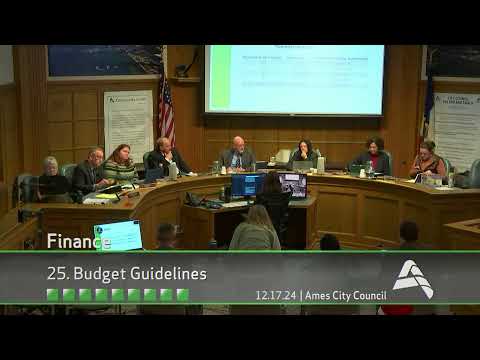
Finance and department staff briefed the City Council on FY25/26 budget assumptions, state tax law impacts, fund balances and a set of proposed capital priorities.
Revenue and constraints: staff reviewed recent state changes to property valuation rollbacks, increases to military and 65+ exemptions and the state's evolving distribution rules; staff warned these changes lower predictable local property tax revenue and argued for relying on one‑time fund balance for one‑time expenses. Fund balance at year end was reported roughly $16.9M with $2.1M net available after carryovers.
Capital priorities and Council direction: staff identified five capital projects for near‑term focus: a new animal control shelter, relocation of Fire Station 2, development of West Ames park, a new indoor recreation center, and Fire Station 4. Council consensus (not unanimous on a strict ranking) favored treating the animal shelter as an urgent near‑term need while also requesting conceptual costs for the indoor rec center and West Ames park so the council can weigh operating subsidy implications. Several councilmembers urged avoiding bond referenda where possible; others said a mix of funding (donations, council capital funds and limited bonding) should remain on the table.
ARPA and housing leverage: staff reported exploratory developer conversations to use ARPA or other city funds to underwrite infrastructure work that unlocks multiple residential lots; council directed staff to develop yield‑focused options so any ARPA use maximizes housing units per public dollar and to avoid creating undesirable precedent.
Outside funding and agency allocations: Council voted to direct ASSET to work with a 5% funding increase scenario for human service agencies and approved a 5% increase to the Arts Commission annual grant pot and a 5% increase to outside funding allocations (local option sales tax requests). Council also asked staff to consider routing any unallocated ASSET funds to coordination efforts for unsheltered individuals and to further develop any youth scholarship issues later.
Next steps: staff will return with CIP cost estimates, operating cost projections for candidate facilities (animal shelter, rec center, fire stations), ARPA recommendations and detailed budget packages for council review in the January–February budget cycle.