Get Full Government Meeting Transcripts, Videos, & Alerts Forever!
Get email alerts on the Housing topic
No spam. Unsubscribe anytime.
Taunton adopts state-mandated ADU zoning updates, bars short-term rentals for ADUs
Summary
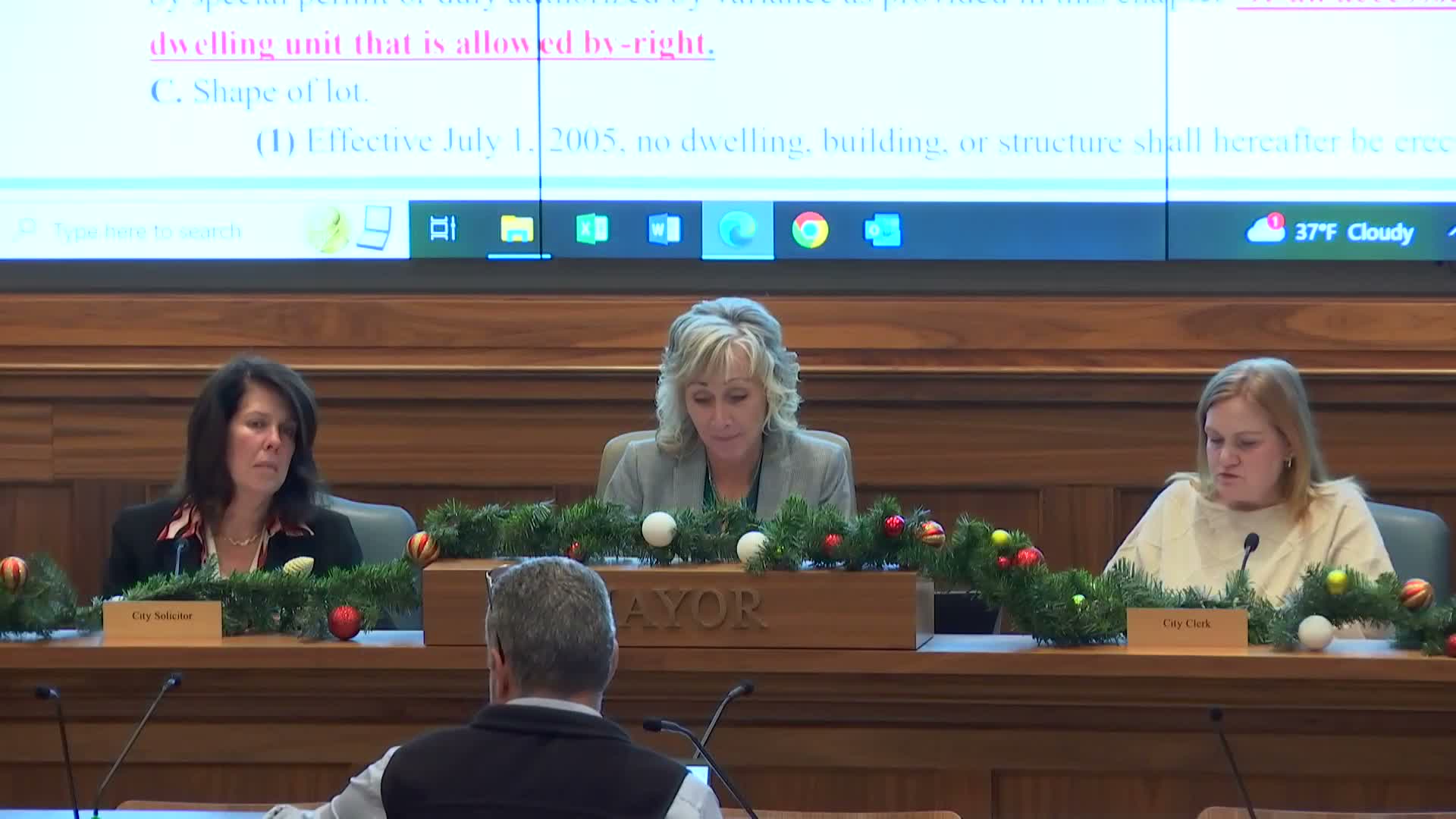
Council approved zoning changes to allow accessory dwelling units (ADUs) by right in single-family districts under the state law, setting a 900-square-foot or 50% cap and removing owner-occupancy requirements; the ordinance prohibits using ADUs as short-term rentals and adds clarifications recommended by the planning board.
Taunton’s City Council voted to adopt zoning changes to bring the city into compliance with a state law expanding access to accessory dwelling units (ADUs). The adopted ordinance clarifies that ADUs are permitted by right on single-family lots, raises the maximum size to 900 square feet or 50% of the principal dwelling (whichever is smaller), allows attached or detached ADUs, and removes the owner-occupancy requirement from the local ordinance where state law forbids it.
Planning staff and the mayor’s office presented the changes and the planning board’s unanimous recommendation to add clarifying language that an ADU and the primary single-family home remain under the same ownership and on the same lot. Kevin Scanlon summarized the state-driven changes in plain terms: new allowances for rural residential lots, the size and parking updates (parking reduced from two spaces to one or none, depending on circumstances), and the ability for detached ADUs where allowed by right.
The council discussed whether to permit ADUs to be used as short-term rentals (Airbnb-style). Planner Scanlon and several councilors warned that the state statute limits how the city may regulate owner-occupancy for ADUs and that prohibiting short-term rentals for ADUs is an allowable carve-out; the committee’s proposal prohibited transient use for ADUs. Councilor Sanders and others emphasized the policy goal is to increase long-term housing stock, not create transient vacation units. The council accepted the planning board’s clarifying items (labeled G and H in the packet) and approved the zoning changes in a vote after a brief public-input window.
What passed: the zoning revisions were approved following the public hearing and committee recommendations; the planning board’s clarifications and departmental comments were incorporated. The council instructed staff to implement reporting mechanisms required by state draft regulations (for example, an annual ADU creation report).