Get Full Government Meeting Transcripts, Videos, & Alerts Forever!
Get email alerts on the Cannabis Policy topic
No spam. Unsubscribe anytime.
Council committee tables cannabis ordinance for more work; license increase held out
Summary
Taunton’s ordinance committee discussed updates to local cannabis rules to align with state Cannabis Control Commission guidance, but tabled final action and removed the proposed increase from 9 to 11 retail licenses for separate consideration while referring a social-equity scoring matrix and application language to the full council.
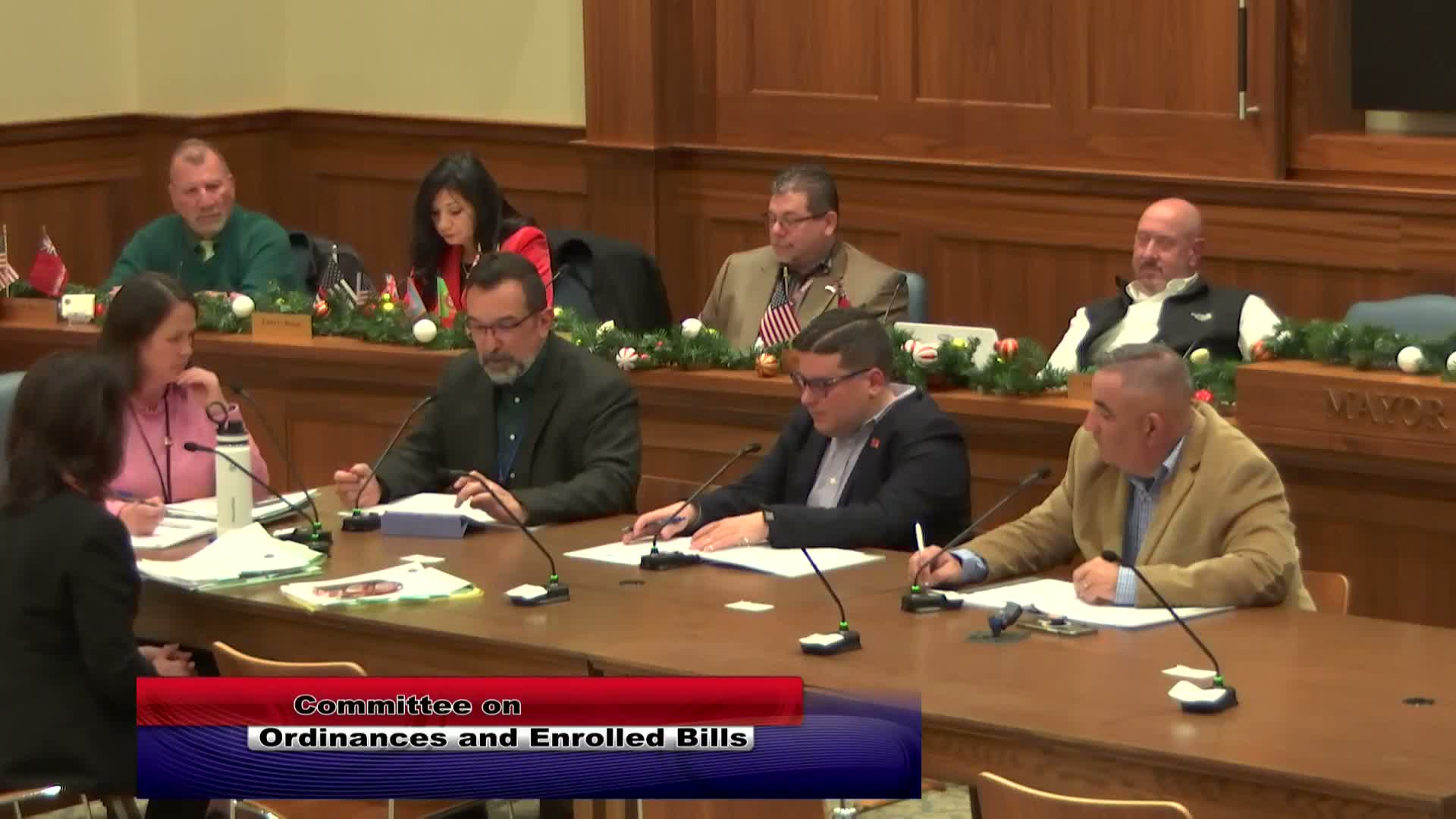
Taunton’s Committee on Ordinances and Enrolled Bills reviewed proposed edits to the city’s cannabis ordinance intended to align local rules with recent state Cannabis Control Commission (CCC) updates and to fix inconsistencies among the ordinance, license form and application.
Attorney Bond, representing the law department, told the committee he had tried to make the ordinance, the license and the application consistent and recommended that enforcement steps include notifying the CCC when the city believes an establishment is in violation so the state can exercise its licensing authority. He also warned that an earlier council vote to increase retail licenses from nine to 11 had not been codified and that the law department recommends against creating an automatic-reconsideration rule for tied votes because it could hamstring smaller boards and commissions.
Several councilors pressed for clarity about how many licenses are operational and about the financial benefit to the city. “Not to my knowledge,” Bond said when asked whether the two additional retail licenses have been issued. He added the city’s local options now primarily generate excise and tax revenue rather than the impact fees that once accompanied licenses.
Councilor Coit asked the committee to separate technical ordinance changes from the more controversial license-cap increase so members could vote to advance routine fixes without endorsing the additional retail slots. The committee chair proposed a compromise: move the ordinance forward to a first reading while excluding the 9→11 license increase, and send the social-equity matrix and manager/application language to the full council for prompt review.
Given a time-sensitive enforcement window for social-equity rules, the committee ultimately withdrew the initial motion, voted to table final action and referred the social-equity matrix and application details to the council of the whole for a forthcoming discussion and a written legal opinion on the prior license vote counts. Attorney Bond noted that enforcement of the social-equity provisions is expected to begin on 2025-05-01, creating some urgency for the council and law department to finalize the matrix.
Next steps: the committee’s draft ordinance will be revised per the committee’s direction, the council will receive the social-equity matrix and manager/application language for review, and the council may separately consider the 9→11 license change on a distinct vote.