Get Full Government Meeting Transcripts, Videos, & Alerts Forever!
Get email alerts on the Trs Pension Basics topic
No spam. Unsubscribe anytime.
How TRS Tier 2 pensions work: ages, formula, buying service and survivor rules
Summary
An instructional overview for Tier 2 Teachers' Retirement System members on how pensions are calculated (2.2% formula), routes to add service credit, early-retirement reductions, disability and survivor benefits, post‑retirement work limits, and where to get estimates.
Sandy Benhart, an outreach coordinator with the Teachers' Retirement System, outlined how Tier 2 pensions are calculated and how members can prepare for retirement.
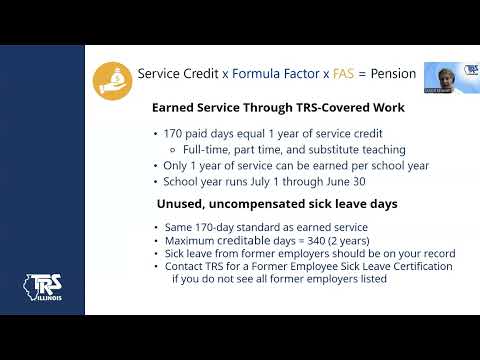
Benhart said a TRS defined‑benefit pension is determined by a simple formula: service credit × the formula factor × final average salary. "It is just 1 thing, 2.2%," she said, referring to the formula factor that applies per year of service. Final average salary is the average of the eight highest consecutive salaries out of the last 10 years, subject to the annual salary cap (noted in the presentation as $127,283 for the coming year).
The formula means a common example: a member with 30 years of service and an $85,000 final average salary would calculate 30 × 2.2% × $85,000 to arrive at a $56,100 starting pension. Benhart showed how retiring earlier reduces that amount: "Anything under the age of 67 is going to be considered early retirement, and that will come with a reduction in your pension. The reduction is 6% for each year that you're under 67." She illustrated a five‑year reduction (age 60) as a 30% cut to the starting pension.
Benhart warned that reductions taken when a member begins collecting are permanent: "Once you retire with a reduced pension, it is a permanent reduction." Alternatively, if a member stops working but waits to collect until 67, TRS treats the retirement date as when payments begin and the pension would not be reduced.
Service credit — the component with the most complexity — can come from TRS‑covered work (170 days equals one year), unused sick days (converted at retirement and capped at two years), optional purchased service (examples include out‑of‑state teaching, military service, refunded TRS service with specific rules), and reciprocal service from other Illinois systems such as IMRF. Benhart stressed members should check TRS account records and correct any missing years or earnings early, because adjustments are harder later.
On disability and survivor protections, Benhart said temporary disability requires two physicians' certifications within 90 days of the last day worked, requires exhausting sick days, pays 40% of the contract rate while on temporary disability, and continues service credit accrual during disability. For survivor benefits she explained TRS divides the 9% contribution: 1% funds survivor benefits and 8% is invested for the member's retirement; an eligible spouse can receive 67% of the member's pension for life. If there are no dependents, a one‑time lump sum (no less than one‑sixth of the member's highest salary) is paid to alternates or the estate.
Benhart urged members to prepare early: review earnings and service credit on the TRS account annually, upload proof of birth, update beneficiaries, and meet with TRS counselors (in Springfield or Lisle or virtually) especially 12–18 months before retirement. She recommended members provide details TRS needs for benefit estimates — expected retirement age(s), current salary and raise expectations, sick‑day counts, and any district retirement incentives — and noted TRS can include reciprocal service if contacted.
On post‑retirement work, Benhart said a retiree must receive the first pension check before working in TRS‑covered positions and may then work up to 120 days or 600 hours per school year (statutory minimums can be 100 days/500 hours); she emphasized there is no limit on earnings for such work. She closed with TRS contact directions for counseling and benefit estimates.
The Teachers' Retirement System encourages members to use individualized estimates and counseling to avoid mistakes that can be difficult to correct and to confirm beneficiary and service‑credit records before finalizing retirement plans.