Get Full Government Meeting Transcripts, Videos, & Alerts Forever!
Get email alerts on the Streets topic
No spam. Unsubscribe anytime.
San Gabriel reports PCI of 85 as public works outlines durable, lower-cost paving strategy
Summary
Public Works Director Greg Devink told the City Council the city—s Pavement Condition Index rose from 59 (2018) to 85 after shifting to targeted treatments, in-house project management and new grant strategies. Staff warned maintaining 85 requires larger annual spending or steady grants.
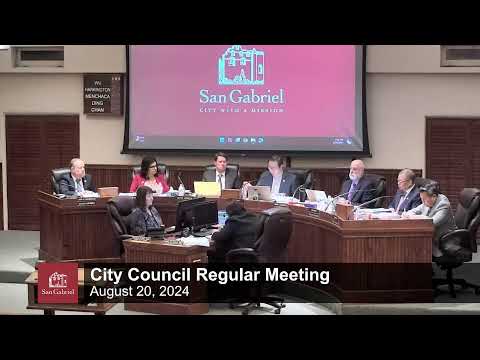
San Gabriel 99Public Works Director and City Engineer Greg Devink told the City Council that the city—s Pavement Condition Index (PCI) has climbed to 85 after a multi-year change in how the city selects street treatments, pursues grants and manages projects.
Devink said the city moved from paving one mile a year with full reconstruction to a preservation-first approach that extends the service life of many streets. "We put treatments on 12 miles instead of 1," he said, describing slurry seals, asphaltic rubber aggregate membrane (ARAM) and targeted grind-and-overlay work. He said ARAM can extend a street—s life up to 15 years and that rubberized asphalt rides quieter and resists cracking.
Devink described additional cost-saving measures: bringing design and construction management in-house, using sewer-development funds for manhole work tied to paving and pursuing specialized grants such as CalRecycle's used-tire program that allows rubberized asphalt mixes. He said those changes, combined with clustered project planning, helped the city go from a PCI of 59 in 2018 to 82 and now 85.
But Devink warned that maintaining an 85 PCI is more expensive than modest annual budgets allow. He presented scenarios from the PCI software showing that at a $2.5 million annual spend the PCI would decline to about 82 over 10 years; other scenarios show multi-year upfront spending (one year above $5 million) would be needed to hold the number steady. "The bottom line is in 10 years it goes up to $28,000,000" in recommended work under one algorithm, he said, and added that staff believes the city's chosen processes are more cost-effective than county averages.
Council members asked for the GIS layer and the full PCI report to be shared with the public; Devink said the city's Public Works maps include per-street scores and are available on the city's website. Council raised several street-specific questions (Del Mar, Ramona, San Gabriel Boulevard) and intersection projects funded by Metro; Devink confirmed the three funded intersection reconstructions near the 710 cancellation will be large multi-million-dollar efforts and are managed by Metro's design timeline.
What happens next: Staff said they will continue to prioritize grind-and-overlay for the worst streets, pursue grants that reduce local match needs and bring an intersection repaving contract (a consent item) back to council for award and scheduling. The department also plans to post the PCI map and the presentation materials online for residents seeking detailed per-street scores.
Provenance: topicintro SEG 117; topfinish SEG 652.