Get Full Government Meeting Transcripts, Videos, & Alerts Forever!
Get email alerts on the Police Facility topic
No spam. Unsubscribe anytime.
San Gabriel council approves purchase of modular locker rooms to address immediate police facility needs
Summary
The San Gabriel City Council unanimously approved buying two modular buildings for about $277,508 plus roughly $65,000 in site and utility work to create temporary, ADA‑compliant locker rooms while staff plans a longer‑term master plan and possible facility expansion.
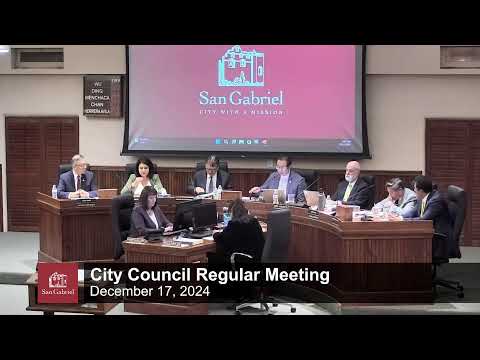
The San Gabriel City Council on Tuesday voted 5–0 to buy two modular buildings as temporary, ADA‑compliant locker rooms for the Police Department, approving roughly $277,507.78 for the structures plus an estimated $65,000 for utility installations and site preparation.
Police Chief Elizalde told the council the department’s station — built in 1962 — is undersized in key areas such as locker rooms and that staff have outgrown existing space. "Phase 1 would focus on the purchasing of these modular structures that would be placed in the rear lot of the station," Chief Elizalde said, describing the units as a near‑term solution while the city completes a master plan.
City Manager Mark Lazaretto emphasized the council was being asked only to approve the purchase of the two modular buildings, not to commit to a specific long‑term plan or consultant. "We're laying out what a plan could be for the future, but we're not locked into anything," Lazaretto said, adding that consultants and any remodel versus new‑build decision would return to council for further discussion.
Members of the public offered mixed reactions during public comment. Isaac Chan urged caution and accountability, saying the community should "still be held accountable, and we should still be cautious" before making a large investment in facilities. John Ramirez and Sylvia Ramos spoke in support of the police and urged the council to back the chief’s proposal.
Council members pressed staff on timing and finances, asking how the modular purchase would interact with a possible future bond measure or a master‑planning timeline. Vice Mayor Menchaca and others said the modules address immediate needs for women’s locker rooms and improved infrastructure while the city pursues a master plan, which staff estimated could be completed in roughly 12–18 months and a full construction timeline of 3–5 years if the council pursues a larger project.
Councilmember Ding moved to approve the staff recommendation to purchase the modular units; Vice Mayor Menchaca seconded the motion, which passed unanimously. The motion included authorization for the city manager to proceed with necessary contracts and site work tied to the modular installation.
The council’s action authorizes only the modular purchase and related site work; staff said they will return with a master plan, cost estimates and any financing options for council consideration before committing to long‑term construction or bond measures.