
Tennessee migrant education team urges flexible, immediate enrollment to prevent school delays for migrant and homeless students
Get AI-powered insights, summaries, and transcripts
Subscribe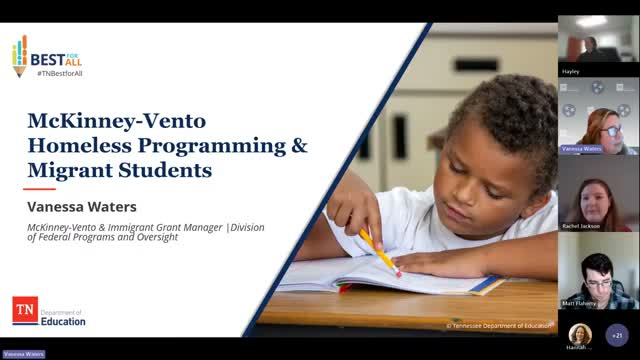
Summary
State migrant‑education presenters told a Tennessee webinar that front‑desk checklists and strict document demands are delaying enrollment for migratory families; they urged immediate enrollment under McKinney‑Vento, stronger liaison coordination, and language access so students can begin school while verifications follow.
In a Tennessee webinar on McKinney‑Vento and ARP homeless supports, state migrant‑education staff and local liaisons urged districts to prioritize immediate enrollment for migratory and homeless students and to reduce front‑desk barriers that often send families away.
Presenters from the Tennessee Migrant Education Program and Arroyo Research Services said front‑office staff should accept a McKinney‑Vento identification at face value for enrollment and complete verification afterward. "If somebody already says they're McKinney Vento, you automatically enroll them," the session host, Vanessa, said, adding that verification can and should happen on the back end.
The webinar included a role play in which a parent arriving at a school lacked Tennessee‑specific residency paperwork and was told to return with local utility bills or a lease. Presenters said that checklist‑first approaches can prevent families from being flagged for McKinney‑Vento services. Rachel Jackson, who oversees pre‑K through 12 migrant services in the state, said the solution is a human connection at the door: "Send someone to the door to have that human connection," she said, describing practices where staff do house visits or complete paperwork in the field to avoid sending families away.
Speakers also emphasized language access as a legal and practical requirement. A state staff member identified on the call as Hannah summarized the federal obligations: "You cannot require families to bring in their own translator. You cannot ask another parent to translate or a student to translate. It has to be a trained, verified translation." Presenters said failing to provide interpreters can block families from saying they are entitled to services such as transportation.
Presenters shared state data indicating that a portion of migratory students are also identified under McKinney‑Vento. Rachel said assessments completed for migratory students produced a subset marked as McKinney‑Vento, and that since August 2023 her team had supported enrollment for 112 migratory children across the state. She cautioned that identification practices vary by district and that some counties report much higher overlap; presenters said they are working to reduce under‑identification statewide.
District staff described practical approaches. Shannon from Washington County said her district enrolls children immediately and obtains birth or immunization records later: "We get them enrolled, and we can get a birth certificate or an immunization record from another source or get that after we have them enrolled," she said.
Presenters pointed attendees to funding sources to support services — including Title I Part C (the Migrant Education Program), Title I Part A homeless set‑asides, local funds and donations — and encouraged districts to coordinate migrant and homeless liaisons to streamline identification and supports. The hosts said contact information for presenters and the recording would be posted in ePlan and encouraged districts to reach out when they meet resistance to immediate enrollment.
The webinar closed with a reminder about reporting suspected fraud, waste or abuse and with a commitment to continued outreach and training to help front‑line staff identify and enroll eligible students.