Get Full Government Meeting Transcripts, Videos, & Alerts Forever!
Get email alerts on the Grant Program topic
No spam. Unsubscribe anytime.
Tennessee opens $50 million competitive grant to expand rural health-care training; NOIs due Dec. 20
Summary
The Tennessee Higher Education Commission outlined a $50 million Rural Health Care Pathways Expansion Grant that will award up to $2 million per collaborative for 48-month contracts, reviewed eligible partners, allowable costs and deadlines (NOI due 12/20/2024; proposals due 01/31/2025).
A Tennessee Higher Education Commission presenter on the Rural Health Care Pathways Expansion Grant said the program will distribute $50,000,000 through a competitive process to build defined health-care career pathways in rural counties across the state, with awards up to $2,000,000 per local collaborative and 48‑month contract periods.
The presenter said collaboratives must include at least one eligible public postsecondary institution (or a TACUA member) identified as a fiscal agent, two or more health-care employers located in eligible rural counties that can employ credentialed graduates and serve as clinical or work-based learning sites, and at least one K–12 local administrator representing health‑care programs, including secondary CTE. "A postsecondary institution may serve as both the lead and fiscal agent," the presenter said.
Applicants may include multiple postsecondary partners and a lead entity may submit more than one proposal, but presenters warned institutions to consider internal capacity for managing multiple awards. The presenter also said collaborative proposals serving more than one rural county do not receive automatic scoring preference.
The RFP limits eligible instruction to programs classified in CIP 51 (health professions) that lead to occupations aligned with SOC code 29 (health-care practitioners and technical occupations) or SOC code 31 (health‑care support occupations). The presenter emphasized that instruction, training or clinical placements must take place in an eligible Tennessee county; the postsecondary institution itself need not have a physical presence in that county.
On allowable costs, presenters said indirect costs are capped at 8% of the total budget and that no new construction is permitted. Capital equipment will use the $5,000 threshold defined in the RFP. For student supports, presenters described two options: stipends (for education‑related costs such as exam fees, licensure fees, supplies and books) and completion grants (targeted at food, housing, childcare and transportation). "Completion grant participants may receive up to a thousand dollars each semester," the presenter said. The presenter added that stipends are intended as last‑dollar funds and not to be used for tuition.
Key deadlines: the notice of intent (NOI) is mandatory and must be submitted by 12:00 p.m. Central on Dec. 20, 2024 via the Formstack link in the RFP; final proposals are due by 12:00 p.m. Central on Jan. 31, 2025. The presenter warned that Formstack links will close at the deadline and late submissions will not be considered. The presenter also noted tentative post‑award timing: award notifications around April–May 2025, a technical assistance webinar for grantees in July 2025 and contract start dates in August 2025, with contracts running through about August 2029.
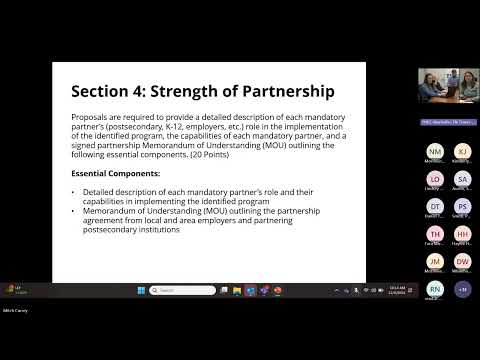
During a question-and-answer period, presenters clarified common applicant questions: an employer with multiple rural locations counts as one employer (applicants must secure two distinct employers); a lead may be listed on multiple NOIs; if 51% or more of training occurs in an eligible county a program may qualify even if some instruction occurs elsewhere; and applicants must include signed MOUs with at least two local or regional health-care employers to earn partnership points in the rubric.
The RFP includes detailed scoring rubrics and appendices (Appendix D for pathway examples, Appendix E for stipend/completion grant processes and crosswalks). Applicants who submit an NOI will receive additional submission instructions and communications from THEC. Questions may be directed to the workforce technical assistance email provided in the presentation.