Get Full Government Meeting Transcripts, Videos, & Alerts Forever!
Get email alerts on the Volunteer Recruitment Retention topic
No spam. Unsubscribe anytime.
DDA webinar: strategies to recruit and retain volunteers for home-delivered meals
Summary
Sydney Enns, director of volunteer engagement at the Department of Disability and Aging, told coordinators that recruitment and retention must be balanced, outlined intake and screening procedures, and recommended practical recruitment channels, ambassador programs, short orientations and low-cost recognition to hold volunteers.
Sydney Enns, director of volunteer engagement and senior center liaison at the Department of Disability and Aging (DDA), led a statewide webinar for nutrition-site coordinators on recruiting and retaining volunteers for the home-delivered meals program.
Enns framed the session around two priorities: finding volunteers where they are and keeping the ones that already serve. "Statistically we spend five times more money and time recruiting volunteers than focusing on retaining the good volunteers that we have," she said, urging coordinators to shift part of their effort toward retention as well as recruitment.
Why it matters: coordinators told Enns they are working with limited staff and budgets, and volunteers keep meal routes running for many rural and urban clients. Losing volunteers risks missed deliveries and more travel for remaining drivers. Enns offered concrete tactics intended to limit coordinator workload and strengthen volunteer loyalty.
Key recommendations
Recruit where volunteers already gather. Enns recommended word-of-mouth, volunteer ambassadors, college and high-school students (including Tennessee Promise participants), service clubs and faith groups. She advised using media—press releases, public-service announcements and visual material on websites and social media—to advertise openings and to include a clear call to action after public presentations.
Use online recruitment platforms and a simple intake workflow. "Most of our volunteers come in through our website or through our Volunteer Match site," Enns said, and she encouraged programs to maintain a prominent volunteer page. Enns described DDA’s intake workflow: volunteers enter via recruitment sites, DDA does initial screening, and local coordinators receive contact and screening details for follow-up.
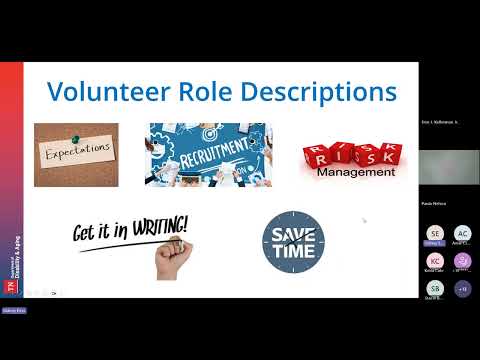
Screening and role clarity. Enns recommended clear written role descriptions that cover title, duties, time commitment and transportation requirements. She said screenings include checks for "adult abuse, *** offender, felony offender, [and] drug offender registry," and stressed that role descriptions reduce risk and make it easier to remove volunteers who breach expectations.
Build volunteer ambassadors and short orientations. Enns proposed training seasoned volunteers to act as ambassadors and presenters—so coordinators do not carry every outreach burden—and suggested short "volunteerathon" events or 30– to 60-minute orientations to introduce new recruits before deeper training. "Volunteers don't like to be called volunteers," she said, recommending catchy titles (her programs call volunteers "motivators" or "music managers").
Prioritize retention through training, supervision and recognition. Enns urged a mix of training methods (visual, auditory, hands-on) and a "learn one, do one, teach one" approach so experienced volunteers can train newcomers. She recommended informal supervision—brief check-ins or small group meetings—and annual evaluations and volunteer satisfaction surveys to collect stories and measure impact. Low-cost recognition ideas included thank-you notes, milestone acknowledgements, shirts, small gifts and volunteer spotlights for those who want attention.
Data points and follow-up materials. Enns said the statewide program tracks volunteer numbers (she referenced "almost 12,000 volunteers across the state" and noted that roughly 40% serve the nutrition program). She also referred to templates and toolkits (press-release drafts, recognition toolkits and a proposed statewide orientation video) and offered to share materials and a proposed volunteer-satisfaction survey by email.
What changed or will follow: Enns asked coordinators for input on a statewide volunteer satisfaction survey and offered to help run screenings if local sites fall behind. The webinar closed with a pledge to distribute materials and sample templates via the chat and email.
Attribution: quotes and observations in this article come from Sydney Enns' presentation and the webinar host Kita as recorded in the webinar transcript.