Get Full Government Meeting Transcripts, Videos, & Alerts Forever!
Get email alerts on the Volunteer Engagement topic
No spam. Unsubscribe anytime.
Webinar: American Cancer Society’s Kathy Oakes urges formal volunteer–staff partnerships to strengthen nonprofits
Summary
Kathy Oakes of the American Cancer Society told a Tennessee Department of Disability and Aging webinar that nonprofits should treat volunteer–staff partnerships as a culture, using role descriptions, career-pathing, partnership agreements and codes of conduct to scale volunteer impact.
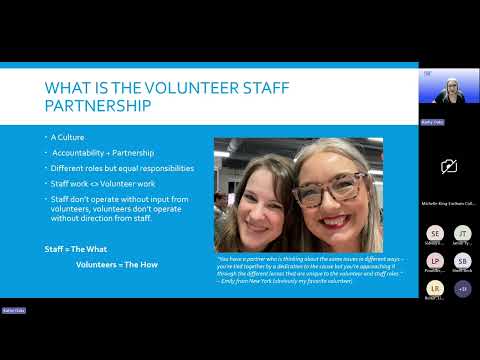
Kathy Oakes, strategic director for volunteer engagement at the American Cancer Society, told attendees of a Tennessee Department of Disability and Aging webinar that organizations should treat volunteer–staff partnerships as a culture rather than an informal arrangement.
Oakes said staff bring subject-matter expertise while volunteers provide community connections and mobilization, and that formalizing expectations helps both sides work together more strategically. “We don't make decisions without volunteer input,” she said, adding that volunteers have “an equal seat at our table.”
Why it matters: large volunteer forces require deliberate structure. Oakes noted the American Cancer Society’s roughly 1-to-419 staff-to-volunteer ratio and used that figure to explain why organizations need mid-level volunteer roles and clearer pathways for advancement. Without those structures, she said, staff cannot effectively manage or represent volunteer networks across programs and events.
Practical steps Oakes recommended include starting with an evaluation of current volunteer roles, writing clear job or role descriptions, deploying feedback loops such as annual engagement surveys, and designing volunteer career paths that move reliable contributors from entry-level tasks to coordination and leadership roles. She described one example where a volunteer with IT experience served as a volunteer project manager on a software pilot and worked alongside staff project managers to lend both technical skills and the volunteer perspective.
Oakes urged programs to adopt partnership agreements for 1:1 staff–volunteer relationships. She described such agreements as a nonlegal way to record duties, communication norms, recognition preferences and deadlines — “wedding vows,” she said — so both parties understand expectations and escalation steps. She also recommended a mutual code of conduct and a clear disqualification process for volunteers who break organizational policies or the law.
On conflict and management, Oakes reframed “difficult volunteers” as “difficult relationships” and encouraged staff to use clear, mission-focused conversations to resolve problems. She cited training resources (LinkedIn Learning courses on communication and leadership) and recommended books used in ACS staff training, including Crucial Conversations and titles on leading change and organizational accountability.
The presenter invited attendees to complete a six-question self-assessment during the session (leadership volunteer coverage, career paths, conflict processes, staff accountability, volunteer value as strategic partners, and existence of formal partnership agreements) and offered to share the recording and materials after the webinar.
The webinar closed with contact information and a QR code linking to Oakes’s LinkedIn for follow-up resources and sample partnership tools.