Get Full Government Meeting Transcripts, Videos, & Alerts Forever!
Get email alerts on the Homelessness topic
No spam. Unsubscribe anytime.
Eureka staff outline how winter warming center opens, who it serves and why locations are kept private
Summary
City staff described the winter warming center's criteria, volunteer-driven operations and partner network, saying openings depend on forecast thresholds, staffing and site availability; the program served 65 guests in a recent three-night activation.
Jacob Rosen, the city's project managing mental health clinician, told the City Council on Dec. 3 that Eureka's winter warming center (referred to in staff materials as the Ewok or "E Walk") has moved from an emergency, ad-hoc response to an organized, documented program supported by volunteers and partner agencies.
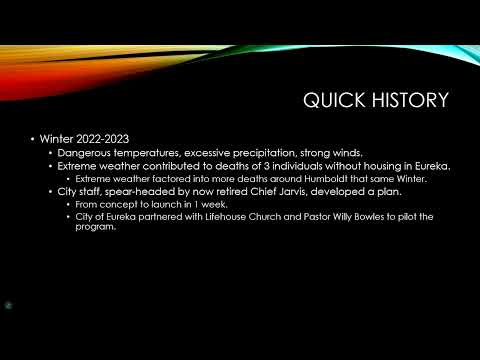
Rosen said the first rapid activation came in winter 2022'23 after several weather-related deaths in the county. That early, seven-day turnaround relied on Lifehouse Church and Pastor Willie Bowles to provide a site and volunteers. "It wouldn't have happened without our partnership with Lifehouse Church," he said. Rosen credited subsequent partners including Faith Center and Betty Chin, Redwood Coast Teen Challenge and nonprofit transport providers for helping scale the response.
Staff provided recent operational figures as evidence of the program's continued use. For a November storm that triggered a three-night activation (Nov. 17'20), Rosen reported the city served 65 guests, engaged 23 community volunteers, and recorded 11 pets and five couples among those sheltered. For earlier, short-notice activations staff reported nightly guest counts ranging from 3 to 15 and, in peak nights, 22 guests over two nights.
Rosen said the city uses four primary criteria when deciding to open the center: a temperature threshold at or below freezing (he cited "under 33 degrees"), an expected precipitation total exceeding 1 inch between 4 p.m. and 4 a.m., sustained winds above 40 mph, or the cumulative impact of a prolonged multi-day storm that justifies lowering thresholds. He added staffing and volunteer availability are operational prerequisites: "Opening also depends on staffing and volunteers," Rosen said.
Entry is structured to protect intake and screening. Rosen listed four methods of entry: designated pickup locations, a roamer vehicle that does targeted outreach to known encampments, referrals from St. Joseph's Emergency Department and the county crisis stabilization unit, and patrol drop-offs. Designated pickup locations named in the presentation include the Free Meal site, the Saco Amphitheatre (as listed in staff materials), the Hope Center, and the corner of 14th and Coster; Rosen said staff are evaluating some pickup locations following the last storm.
Staff stressed that clinical screening is performed by trained city teams (CARE, CSET and Uplift), not volunteers, so that people are routed to the safest, most appropriate place (including ER or higher-level care when necessary). "The purpose of screening is not necessarily to screen people out, but to screen people into the correct location," Rosen said. He described screening criteria that consider health, safety and intoxication level and noted that severe psychiatric or medical crises are directed to hospital care or evaluated for a 5150 hold.
Rosen also explained why overnight site locations are not publicly shared: volunteers and site hosts run the site overnight and the city does not want uncontrolled walk-ins that would bypass screening and place hosts and volunteers at risk. "If volunteers don't feel safe, we risk losing those volunteers. And if the facility hosts don't feel safe, then we're going to lose those sites," Rosen said.
Council members asked staff to post the presentation and a short FAQ online so residents and potential volunteers can understand how to help. Council member Moulton said making the details public could expand volunteer recruitment and help residents point people to services after an activation.
Next steps: staff said they will continue to refine data collection, post a public FAQ and coordinate with county partners through the Emergency Weather Community Response Network to improve regional capacity.