Get Full Government Meeting Transcripts, Videos, & Alerts Forever!
Get email alerts on the Regional Climate Action Plan topic
No spam. Unsubscribe anytime.
Eureka reviews countywide Climate Action Plan; councilors and public press for HCOG leadership and faster, funded implementation
Summary
Development Services Director Kenyon presented the county's new 2024 draft regional Climate Action Plan and CEQA schedule; council members raised concerns about grid capacity, funding and accountability, while public speakers urged HCOG to house the regional committee and recommended staffing and fleet electrification. No votes were taken.
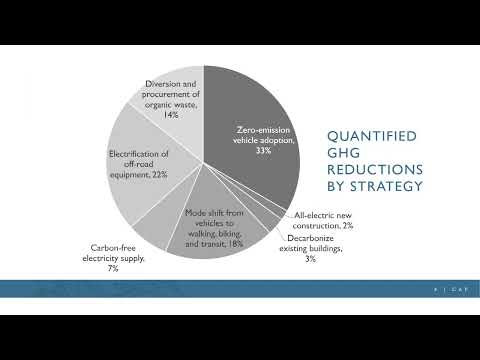
EUREKA, Calif. — Development Services Director Kenyon presented Humboldt County's 2024 draft regional Climate Action Plan at a special Eureka City Council meeting, outlining countywide targets to cut greenhouse gas emissions 40% below 1990 levels by 2030 and reach carbon neutrality by 2045 and describing a CEQA schedule that starts with a Notice of Preparation issued Aug. 30 and a public review draft expected in spring 2025.
Kenyon said the county replaced its 2015 emissions inventory with a 2022 inventory and reworked the plan after consultant Rincon flagged evidentiary gaps in a 2022 draft. "The county just released a new draft of the Climate Action Plan on August 14," Kenyon said, and the updated draft narrows the inventory to sources that have corresponding reduction measures and distinguishes urban and rural strategies.
Why it matters: The plan covers the city's principal levers — municipal fleet and facility upgrades, building electrification, permit streamlining, support for transit and organics processing, and incentives or requirements for new construction — but council members and public commenters pressed for clarity on who will staff and govern regional implementation and how the work will be funded.
Council members repeatedly raised grid capacity and financing as central hurdles. "We really have about 5 to 10 years to completely change what we do," Council member Bauer said, adding that the region will need extensive charging infrastructure and grid upgrades. Bauer asked how the CAP addresses utility capacity and whether microgrids or other local distribution solutions will be pursued to enable electrification.
Kenyon said the plan includes measures to position the region for funding and calls for microgrids, incentive programs and collaboration with utilities and wind developers, but that economic consequences of mandates must be weighed. He described a proposed regional climate committee staffed by a climate program manager who would produce annual or biannual progress reports and update the greenhouse gas inventory.
Public comment echoed council concerns and proposed near-term governance. Deborah Dukes thanked the city for taking the CAP seriously and pressed the city on leading by example, citing a recent municipal purchase of internal-combustion SUVs instead of electric vehicles: "Leading by example, those should have been EVs," Dukes said. Dukes recommended that the Humboldt County Association of Governments (HCOG) serve as the lead agency for the regional committee because it already includes representatives from each jurisdiction and has meeting infrastructure.
Colin Fisk of the Coalition for Responsible Transportation Priorities also urged HCOG to house the regional committee but cautioned that centralized housing does not relieve jurisdictions of staffing and funding responsibilities. Fisk further recommended revising the CAP's urban/rural definition — which the draft ties to whether an area is inside Eureka, Arcata or Fortuna city limits — and suggested using the U.S. Census Bureau's 2020 urbanized area definition to avoid misclassifying communities and reducing funding opportunities for transit and active transportation.
Several council members expressed support for HCOG as the regional home of the committee and stressed permit streamlining, municipal leadership on fleet and employee commute programs, and exploring local distribution options such as municipal-owned microgrids or utilities. Council member Castellano asked whether the city has a designated staff lead; Kenyon said he attends regional meetings and that implementation would draw on multiple departments including community services, public works and planning and building.
Next steps: Kenyon said the county's NOP was issued Aug. 30 and the 30-day NOP comment period extends to Sept. 30, with an expected public review draft of the EIR in spring 2025 and Board of Supervisors adoption of the final EIR and CAP in summer 2025; Eureka would consider local adoption after the county acts. No formal motions or votes were taken at the special meeting.
Public documents and participation: Kenyon noted the county funded EIR work with $150,000 from HCOG and hired Rincon as the consultant on the environmental review. Members of the public and several councilors urged the city to continue the conversation about staffing, accountability and financing as the EIR comment and review process proceeds.