Get Full Government Meeting Transcripts, Videos, & Alerts Forever!
Get email alerts on the Prohibited Camping topic
No spam. Unsubscribe anytime.
Roseburg council adopts prohibited-camping ordinance after extended public testimony on homelessness and navigation center
Summary
After extended public comment focused on conditions at the navigation center and competing views on enforcement versus services, Roseburg City Council adopted Ordinance 3605, which restores prohibited-camping as an offense with tiered fines and potential short jail terms for repeat violations.
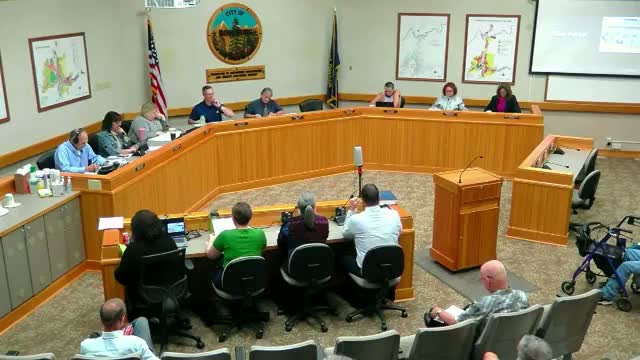
Roseburg City Council voted to adopt Ordinance 3605, amending municipal code chapters 7.02 and 7.12.15 to reintroduce prohibited-camping as an enforceable offense with tiered penalties. Council members recorded the motion and vote after more than an hour of public comment about homelessness, the city navigation center and enforcement practices.
Mayor Kelly opened the second reading and framed the council’s choice as balancing public safety, enforcement tools and the city’s prior work on low-barrier shelter options. Kelly summarized the newly described penalty structure as “a first citation up to $100, a second up to $250, and third and subsequent offenses potentially up to seven days in jail,” and noted the council had discussed whether that change affects the council’s ongoing decision about creating an urban campsite or navigation site.
During public comment, housing-advocacy and lived-experience speakers urged the council to favor housing-first approaches and services over criminalization. Betsy Cunningham, who said she founded Housing First Umqua, told the council that “criminalization makes homelessness worse” and cited federal interagency guidance urging humane, nonpunitive responses to encampments.
A navigation-center resident described repeated incidents she said staff did not address: “There’s people fist fighting each other in the navigation center around children,” the speaker said, and added accounts of drug use and overdoses on site. Other public speakers described both the human impacts of homelessness and concerns about safety on the riverbank and bike trails; some urged more shelter capacity and better case management, while others supported stronger enforcement to protect public spaces.
Council members asked staff to clarify how the ordinance interacts with the city’s time/place/manner restrictions. Staff answered that the ordinance amends the code to make certain camping conduct a criminal citation and that it retains existing time/place/manner restrictions; staff also said the ordinance adds prohibited camping as an exclusion-zone offense that can lead to downtown exclusion when paired with the city’s diversion and court programs.
Councilmember Andrew Zelensky made the motion to adopt Ordinance 3605 and Kylie Rummel seconded. Following brief discussion about enforcement priorities and diversion programs, the mayor called the vote and the motion carried; the council announced the ordinance was adopted.
The ordinance’s adoption does not itself create new shelter or campsite capacity. Council members and speakers repeatedly distinguished between three types of responses the city could take: enforcement (citations and exclusion), wraparound services and housing-first placement. Several council members said they expect staff and the Homeless Commission to compile bed inventories and report back with implementation questions and options before taking further steps on any urban campsite project.
Next steps noted on the record included a request for staff to provide more detail on enforcement prioritization and to share the bed-inventory results the Homeless Commission is compiling for a future meeting.