Lifetime Citizen Portal Access — AI Briefings, Alerts & Unlimited Follows
Staff recommends keeping four Smart Scale final applications and advancing small turn‑lane project via revenue sharing
Loading...
Summary
Staff told the Board it must cut Stafford’s five Smart Scale pre-applications to four before the July final deadline and recommended removing the Poplar and Treslow Road turn‑lane project from Smart Scale while allocating $1.25 million of local funds to start engineering and pursue VDOT revenue sharing.
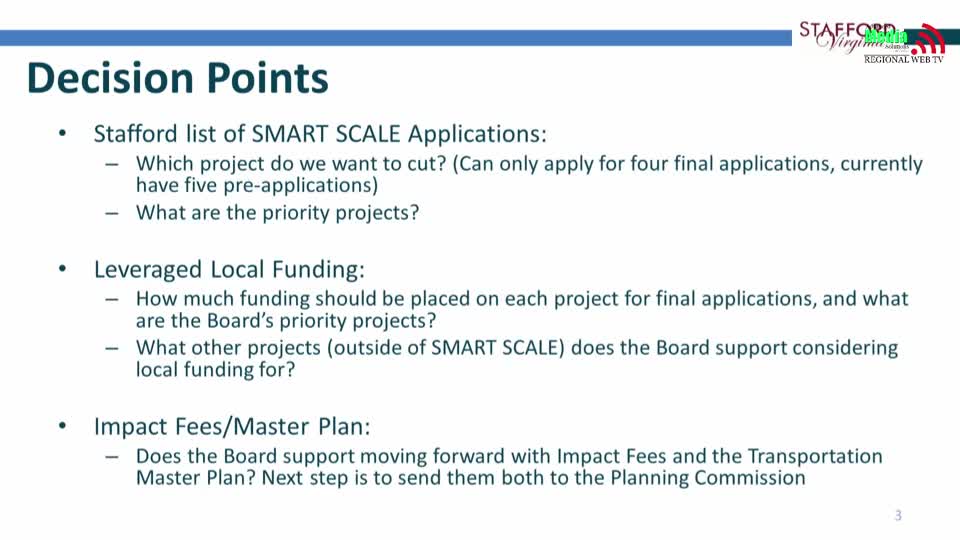
Staff presented options for implementing the Transportation Master Plan and asked the Board to choose which four of Stafford County’s five Smart Scale pre‑applications should move forward to final application.
Brian (staff) told the Board the county had submitted five Stafford applications and that final Smart Scale applications are due in July. "These projects total $324,000,000," he said, and noted the cost estimates in the packet are preliminary. Staff outlined priority projects including Garrison Road widening (phase 1), Route 1 at I‑95 (Coachmen Circle) access management, Route 1 Potomac Hills corridor safety, and Route 1 at Foreston Woods and Cole Landing, and described available matching programs such as CMAQ, STBG and TAP.
On which project to drop, staff recommended removing the Poplar and Treslow Road turn‑lane project from the Smart Scale final list but not abandoning it. "The project that we would recommend removing from those 5 is the Poplar And Chester Return Lane project," Brian said, and proposed allocating $1,250,000 to begin engineering this summer and then applying for VDOT revenue sharing next year so the work can proceed outside the Smart Scale cycle.
Board members questioned the choice because the turn‑lane project is relatively small. Staff explained the reasoning: smaller projects can be advanced more quickly using local funds and revenue sharing, while the Smart Scale program is competitive and better suited for larger, higher‑scoring projects. Matt (staff) summarized the decision points for the Board: select four Smart Scale final applications, provide direction on local funding allocations for each project and confirm priorities so staff can prepare a resolution for the Board to adopt ahead of the final application deadline.
Staff also reviewed the county’s current CIP and funding mix, saying the county’s existing CIP projects total about $310,000,000 with roughly $110,000,000 in local funding and about $130,000,000 in grant funding. Staff projected roughly $15,000,000 in available local transportation funding through FY31 under conservative assumptions, with a possible higher range if contingencies and revenue are realized.
The Board did not record a roll‑call vote but indicated no opposition to the staff recommendation during the discussion and staff said it would bring a Smart Scale resolution and local funding plan to a future Board meeting for formal action.