Get Full Government Meeting Transcripts, Videos, & Alerts Forever!
Get email alerts on the Belmont Rezoning topic
No spam. Unsubscribe anytime.
Stafford supervisors approve Belmont Park rezoning in 4–3 vote after hours of public comment
Summary
After more than three hours of presentations and public testimony, the Stafford County Board of Supervisors approved rezoning about 132 acres for the Belmont Park industrial project (O24‑07) with proffers including buffers, building height limits, a 5‑acre park dedication and a cap of 3,206 vehicle trips per day; the measure passed 4–3.
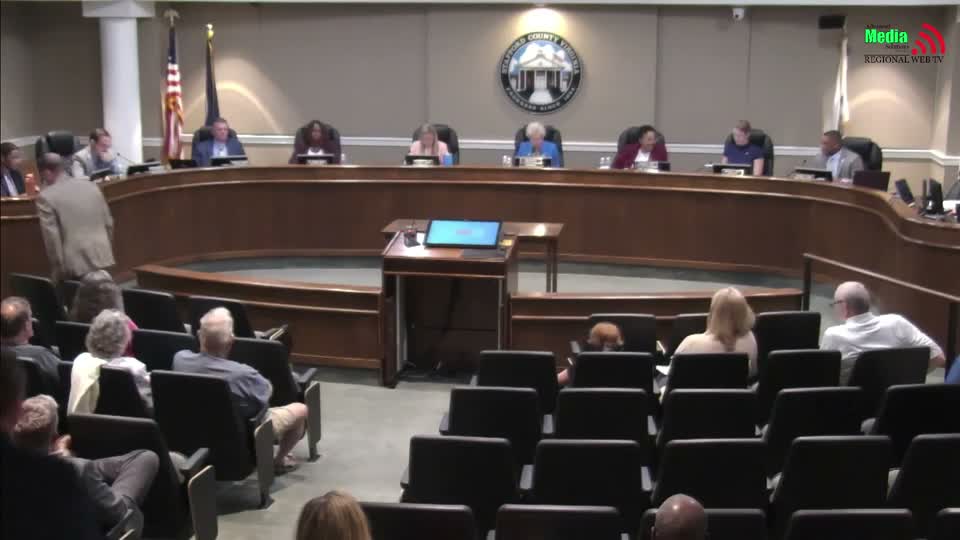
The Stafford County Board of Supervisors narrowly approved a rezoning request for the Belmont Park project on July 2, 2024, passing ordinance O24‑07 by a 4–3 vote after a lengthy public hearing that lasted several hours.
Planning staff described the project as a 132.8‑acre, multi‑parcel reclassification that would change portions of A‑1 and R‑1 land to M‑1 (light industrial) and M‑2 (heavy industrial). Director of Planning and Zoning Mike Sarraf outlined the applicant’s package of proffers: a minimum 100‑foot vegetative buffer and increased building setbacks (150–200 feet), a maximum building height of 50 feet (reduced to 45 feet within 200 feet of Sanford Drive), a 5‑acre parcel dedicated to county parks and recreation (pad‑ready, with utilities and access provided), right‑of‑way dedication along Sanford Drive, and monetary contributions for localized transportation work.
Charlie Payne, speaking for the applicant, described traffic mitigation, building limitations and a capped total trip generation. “The total density in the project…the project will only generate, be capped at, I should say, at 3,206 total average vehicle trips per day,” Payne said during his presentation. He told the board the applicant had reduced an earlier, higher‑density concept after multiple rounds of community feedback and planning commission review.
Opponents and supporters traded sharply different views during the public hearing. Neighbors who live adjacent to the site and along Sanford Drive said the corridor already suffers congestion and safety problems, that school counts and new high‑school traffic would compound impacts, and that the rezoning conflicts with Stafford’s comprehensive plan land‑use recommendations. “Route 17 and South Stafford County are not the county’s truck stop,” one resident said, urging supervisors to deny the request. Residents from Little Falls Road and nearby neighborhoods also warned about runoff and stream impacts in the site’s watershed.
Supporters, including some landowners and commercial‑realty representatives, said the project would create jobs, diversify the county’s tax base and bring economic opportunity to parts of the county that residents say have been neglected. Several landowners who contracted with the applicant said they had negotiated for years and asked the board to approve the rezoning.
Applicant proffers include a requirement to extend and improve Powell Lane to serve site access, construction of a northbound left‑turn lane at Commerce Parkway if certain trip thresholds are reached, a $75,000 contribution for future Powell Lane repairs, a $40,000 contribution for traffic signal retiming, and a proffered commitment to phase site clearing rather than mass clearing. The applicant indicated that off‑site sewer and utility improvements would be constructed to serve the site.
During board deliberations supervisors split on whether the proffers were adequate to protect safety and the environment and whether the county should insist on different uses (for example, indoor recreation) instead. Supervisors who voted to approve emphasized the economic development benefits and the need to diversify the county’s tax base; those who opposed cited traffic and land‑use conformance concerns.
The board approved ordinance O24‑07 by roll call (motion carried 4–3). The planning commission had recommended approval 6–0 earlier in the process; the item returns to staff and applicants for downstream site plan and permitting steps if developers pursue build‑out.