Get Full Government Meeting Transcripts, Videos, & Alerts Forever!
Get email alerts on the Local Government Finance topic
No spam. Unsubscribe anytime.
Stafford County staff present five‑year plan that hinges on speculative data‑center revenue
Summary
Stafford County staff presented a five‑year general‑fund plan that relies on projected data‑center revenue and includes a $163.6 million revenue increase over five years; supervisors pressed staff for clearer project timelines, asked for a by‑right project spreadsheet and questioned built‑in assumptions including a meals‑tax increase.
Stafford County officials reviewed a general‑fund five‑year financial plan that projects $163,600,000 in additional revenue over five years and treats data‑center development as a major revenue source, but supervisors pushed staff for more precise schedules and cautioned that several assumptions are speculative.
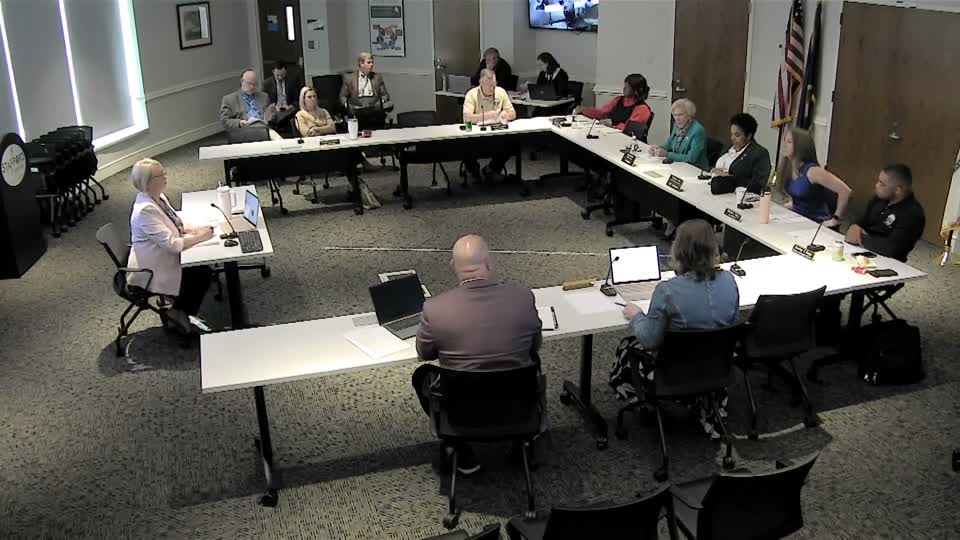
At a board work session, county staff described the FY25 operating budget baseline as $427,000,000 and said the five‑year plan adds incremental changes to that base. "This is really the beginning of our budget season," a staff presenter said as they opened the review of projected revenues and expenditures. Staff warned that fiscal year 2026 is the first and most immediate challenge, with only $19,900,000 of new revenue built into the model for that year.
Why it matters: the plan’s revenue assumptions drive the county’s ability to fund schools, public safety and capital projects without raising property taxes. Staff flagged that real estate remains the largest revenue source and that a substantial portion of the plan’s growth is tied to data‑center real estate and business personal‑property assessments.
Key figures and assumptions - Five‑year projected increase in general‑fund revenue: $163,600,000 (incremental to the FY25 $427,000,000 operating base). - Education: staff said roughly $89,200,000 of the five‑year increase is dedicated to schools (operating and debt service components). - New positions and salaries: the plan includes $17,100,000 in salary changes and $23,300,000 budgeted for new positions over five years. - Data centers: staff modeled two approved projects and assumed one building would be built and assessed with business personal property by Dec. 31, 2025; additional buildings are added across FY27–30 under the plan’s incremental scenario. - Meals tax: the FY26 projection includes a modeled increase in the meals tax from 5% to 6%, estimated to add about $3,100,000 in FY26.
Board requests and points of caution Supervisors repeatedly asked staff for a clearer project‑level schedule. "Can we have sort of a spreadsheet that actually talks about the projects, how many buildings are expected, when we think they're gonna come online," one supervisor said, urging a by‑right column and timeline for approvals and construction. Staff replied they added a "by right" column to the spreadsheet and planned to distribute it to the board that evening.
Multiple board members cautioned that data‑center revenues are speculative until developers build and place taxable business personal property. A staff presenter said revenues are "very speculative at this point" and depend on developer schedules and when personal property is placed. Supervisor Banooch urged caution about counting revenue for projects lacking a water‑services agreement, saying the county should not "be counting any of that revenue whatsoever in these projections" for projects that are not fully approved.
Allocation options under consideration Staff outlined several possible policy choices for handling future data‑center revenue, including using the funds to reduce the tax rate, investing in services, setting aside a portion for a revenue‑stabilization reserve, or directing a portion to one‑time capital needs. Staff referenced neighboring jurisdictions that set aside 10% of data‑center revenue for stabilization or capital and recommended the board adopt a formal policy on the allocation and risk tolerance for those proceeds.
Schools, staffing and systems Board members asked for a deeper breakdown of school operating versus debt‑service costs and whether the school requests account for operating costs of newly built schools. Staff said school numbers in the plan come from the schools' CIP and that the $89.2 million increase includes debt service. The plan also proposes investments in core systems: staff said the county needs to replace an antiquated financial system (installed in 1999) and a 30‑year‑old CAD system; federal reporting requirements were cited as a driver for modernization by 2027.
Benefits and employee concerns Supervisors raised employee benefits issues, including whether the county should consider adding hearing‑aid coverage. Staff said prior analysis estimated roughly $100,000 to add limited hearing‑aid coverage to the plan but cautioned costs and usage would affect final pricing.
Next steps Staff told the board it will continue refining projections through the budget process and the board retreat, bringing more precise timing and a spreadsheet of projects. Staff also said follow‑up questions from the session will be posted in the board portal. No formal vote occurred at the session; staff will return with updated numbers and policy options for how to allocate potential data‑center revenues before finalizing the proposed budget.
Staff and board attendees identified in the session included the staff presenter (referred to in the transcript as Mr. Ashton/Andrea) and multiple supervisors who asked for follow‑up materials and clearer timelines.