Get Full Government Meeting Transcripts, Videos, & Alerts Forever!
Get email alerts on the Public Safety Training topic
No spam. Unsubscribe anytime.
Warren County planning commission tables sheriff’s proposed firearms training range after hours of public comment
Summary
After hours of testimony and dozens of residents raising noise, water and safety concerns, the Warren County Planning Commission voted to table a conditional-use permit application for a sheriff’s firearms training range at the Bentonville transfer station, pending agency reviews and further study of alternative sites.
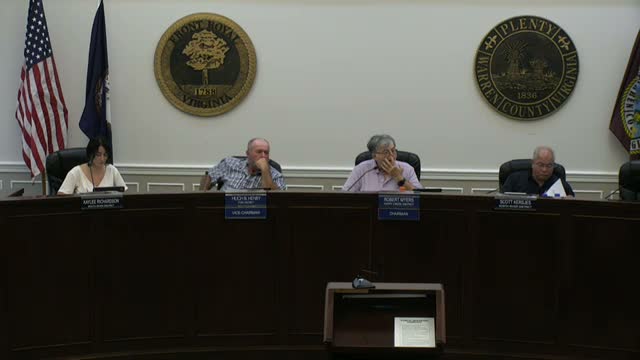
The Warren County Planning Commission on July 2 tabled a conditional-use permit application from the Warren County Sheriff’s Office to build a firearms training range at the county’s Bentonville transfer station, after members said they wanted more agency reviews and time to consider alternative sites.
Planning staff had presented a draft application that included 13 conditions: compliance with Virginia Department of Transportation, Warren County Building Inspections, the Warren County Health Department and the Virginia Department of Environmental Quality (DEQ); a county-approved site plan showing buildings, parking and range layout; required landscaping and 5-foot evergreen buffers; visible signage warning of live-fire; limits on leasing and personal use; hours restricted to 8 a.m.–8 p.m.; no Sunday firing; a cap on scheduled training visits and participants; and a DEQ-approved lead-reclamation and remediation plan before a zoning permit could be issued.
Officer Jay Roy, who identified himself as the sheriff’s office accreditation, grants and training coordinator, told commissioners the county’s 74 full-time and eight part-time sworn officers must meet recurrent live-fire and scenario training. He argued that a local range would reduce travel to distant facilities such as Harpers Ferry and Luray, keep officers in the county during training and save taxpayers money. Roy described range engineering intended to capture and reclaim lead — rubber mats, sand backstops and donated railroad ties — and said the office proposed about 25 live-fire training days per year and routine maintenance and lead reclamation on a multi-year schedule. “This is the most significant I’ve seen, to date, in this area,” Roy said of the proposed safety features.
Residents who live near the transfer station — many within the one-mile buffer shown in staff maps — urged the commission to delay action. Speakers cited noise, potential groundwater and runoff contamination given the site’s proximity to a closed landfill and transfer operation, methane monitoring at nearby basements, and the risk that property values would fall. “It really violates my human rights to a peaceful existence,” said resident Lorraine Smelzer, who lives directly in front of the proposed range site and described ongoing methane and well-testing at her home. Others questioned the sufficiency of the environmental review, asked why other county-owned sites or an indoor regional facility were not pursued, and urged the commission to wait for outstanding DEQ and health-department comments.
Planning staff acknowledged that the Warren County Health Department comments were not yet in the record and that the county had requested a DEQ permit amendment tied to the transfer station boundary; staff said the project could not move forward without those agency inputs. Commissioners debated noise attenuation, the proposed caps on visits and participants, lead-capture and reclamation procedures, enforcement and whether the transfer-station site was the county’s least-impact option. Several commissioners said the public’s concerns and missing agency reviews warranted tabling the item.
A motion to table the sheriff’s application — which commissioners said would allow staff to gather outstanding agency comments and further explore site options — passed on a voice vote. The commission will revisit the application after staff and external-agency feedback are received.
The petition is advisory to the Board of Supervisors; any final permitting or land-use decision will occur at a future board meeting when all required agency reviews and staff recommendations are complete.