Get Full Government Meeting Transcripts, Videos, & Alerts Forever!
Get email alerts on the Disaster Recovery topic
No spam. Unsubscribe anytime.
Washington County board declares local emergency, authorizes contracts and $600,000 for flood response
Summary
The Washington County Board of Supervisors approved an emergency declaration, authorized emergency debris/hauling contracts, and reallocated $600,000 in ARPA/local funds — $400,000 for response costs and $200,000 for a small-business relief program — after widespread flooding damaged infrastructure and businesses.
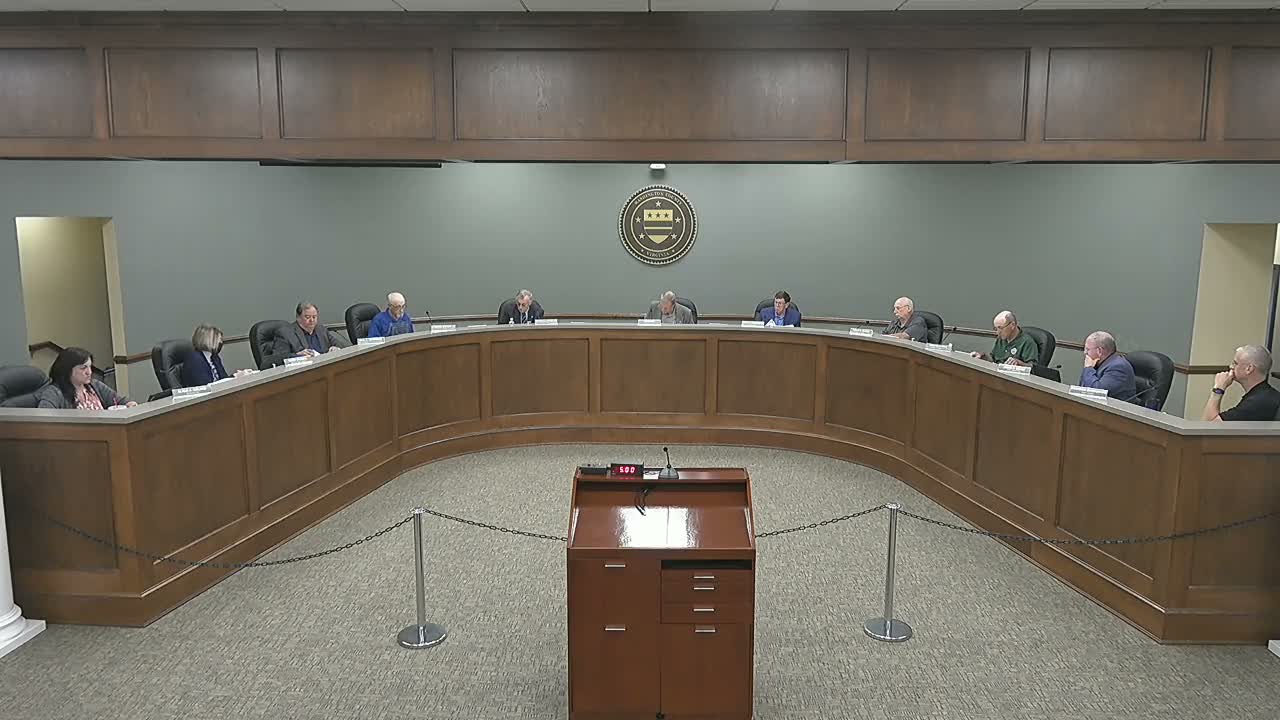
At a Washington County Board of Supervisors meeting, members approved a declaration of local emergency, authorized emergency procurement contracts for debris and waste hauling, and reallocated $600,000 in federal ARPA/local funds to support recovery after recent floods.
County attorney Mr. Snogress explained that the resolution invokes Virginia Code §58.1-3014 to provide personal-property tax relief for affected residents retroactive to Sept. 27 and running through Dec. 31, 2024, and staff noted that FEMA individual assistance applications must be filed by Dec. 2, 2024, to be eligible. The board approved the resolution and related signature authority by voice vote.
The board authorized two emergency hauling contracts to speed debris removal in Taylors Valley and Damascus. Mr. Snogress told supervisors the county invoked contract terms with its private hauler and provided model FEMA language in the contracts to preserve reimbursement eligibility. The solid-waste department also received a $20,200 contingency transfer to rent two roll-off trucks for four weeks while the transfer station is offline.
Finance and county staff proposed reallocating $600,000 from ARPA government-services funds: $400,000 for emergency-management and response costs and $200,000 for a small-business relief program. County staff said the small-business program will accept rolling applications with an initial maximum award of $5,000 per applicant. The board approved the allocation by motion; staff said the program would begin rollout the next morning.
County officials also formally established a County Disaster Relief Fund — a resurrected CARES-era account at First Bank & Trust — to accept private donations and to supplement recovery efforts. Staff reported more than $20,000 in donations to the fund and said those dollars may be used to augment small-business assistance.
Officials repeatedly cautioned that FEMA support is limited. As a county official put it during the meeting, “FEMA is not a lifeboat; it’s a life jacket,” meaning the agency may provide partial but not full recovery reimbursement and individuals and businesses must apply to learn what assistance is available. Supervisors urged residents and business owners to document damages and file required FEMA and SBA applications promptly.
Board members also discussed near-term recovery priorities including restoring water service, repairing roads and bridges, reestablishing broadband and cellular communications, and funding swift-water rescue capabilities. Supervisors asked staff to compile after-action lessons and to pursue state and federal funding opportunities for long-term repairs, including options to rebuild segments of the Creeper Trail and to co-locate utility lines with trail reconstruction where feasible.
The board voted on the emergency resolution, contract approvals and the ARPA reallocation by voice vote; no roll-call tallies were provided in the meeting transcript. The board also directed staff to return with implementation details for the small-business program and to report on distribution criteria for the disaster-relief fund.