Get Full Government Meeting Transcripts, Videos, & Alerts Forever!
Get email alerts on the Police Retirement topic
No spam. Unsubscribe anytime.
Subcommittee advances bill letting Catawba Nation join police retirement system after limited sovereign-immunity waiver
Summary
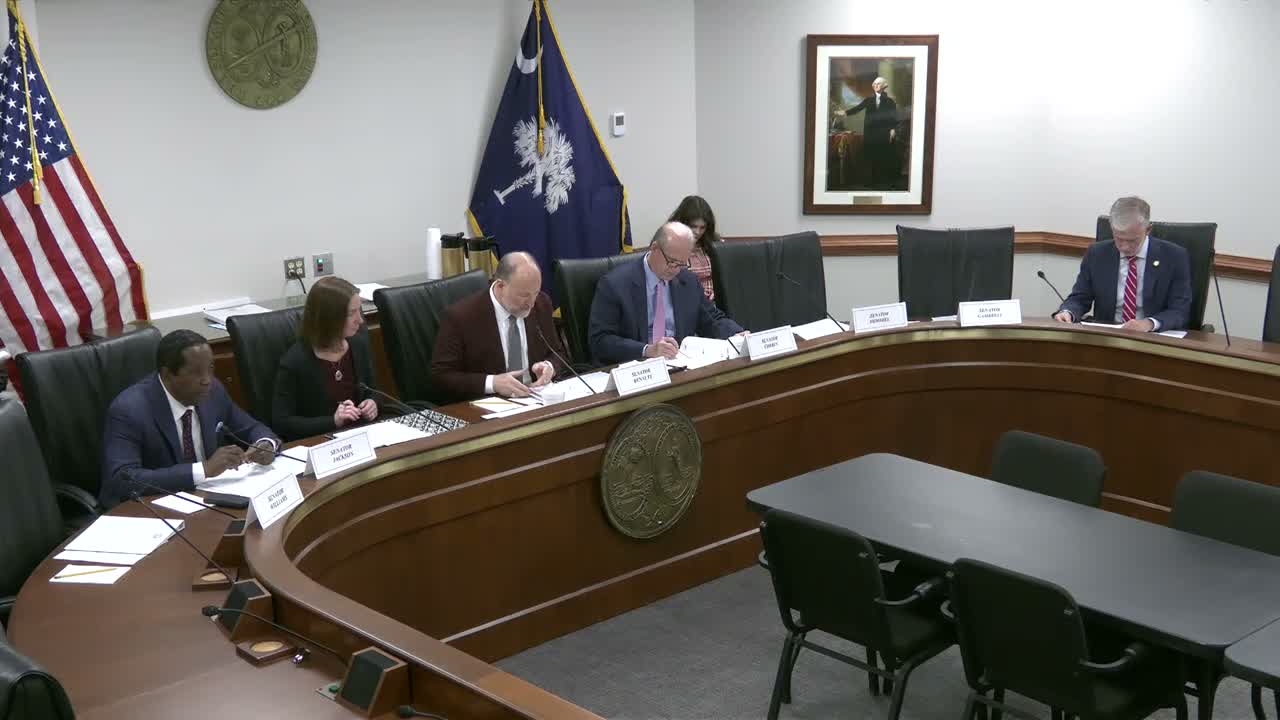
The Retirement Subcommittee for Finance gave a unanimous favorable report to S.127, which would allow the Catawba Nation to join the state Police Officers Retirement System if it applies for admission, complies with system rules, and waives sovereign immunity for disputes arising from participation.
The Retirement Subcommittee for Finance on the record advanced S.127, a bill that would allow the Catawba Nation to join the state Police Officers Retirement System after the Nation applies to the retirement board and agrees to be subject to the system’s laws and dispute resolution.
Senator Johnson, the bill’s sponsor, told the panel the measure aims to help the Nation recruit and retain police officers. “Imagine if you can for a second living in an area that every time you hire law enforcement … you can't give them benefits, because they can't get in any retirement system,” Senator Johnson said, arguing that access to retirement benefits is necessary to retain officers.
Olivia, a staff presenter, summarized the bill’s mechanics: it would add the Catawba Nation to the statutory definition of an employer for the Police Officers Retirement System upon admission; require an application to the board under the statutory provisions cited in the hearing (referencing sections described in the presentation); require compliance with the board’s rules and regulations; and prohibit employees from joining unless “substantially all” of their time is devoted to governmental police service under the cited qualification. The act would take effect upon approval by the governor, the presentation said.
Mr. Pulaski, identified in the hearing as a Catawba Nation representative, described the Nation’s recruitment challenges and the decision to waive sovereign immunity “siloed in this venue of the law” so the Nation could participate in the retirement system. “We have 4,200 members of the Catawba Nation as far as populous housed within the state of South Carolina,” Mr. Pulaski said; he added that the Nation’s reservation footprint is smaller than many federally recognized tribes and that he would supply acreage figures later (acreage not specified in the hearing).
Justin Warner, general counsel at PEBA, told the committee the basic treatment of service and vesting would be like any other small employer joining the system: prior service would be credited where applicable, and new accruals would begin when the Nation elects to join. “This just allows them to join the system like any other municipality in the state that maybe hasn't joined the police officer system before,” Warner said.
Committee members asked whether waiving sovereign immunity meant surrendering all protections; Mr. Pulaski and the sponsor clarified the waiver is limited to disputes arising from participation in the retirement system and that the Nation retains sovereign immunity outside that narrow venue. Members also asked about cross-border jurisdiction and casino operations; Mr. Pulaski said the Nation operates two Kings casinos in North Carolina, employs off-duty county officers for casino security, and that much of the Nation’s population resides in York, Lancaster and Chester counties.
The chair entertained a motion for a favorable report to the full committee; a motion and a second were made on the record (movers not specified). The committee moved to voice vote, and the chair announced a unanimous favorable report to the full committee, noting Senators Gambrell and Hembry had submitted proxies. The subcommittee then adjourned.
The next procedural step is transmission of the favorable report to the full committee; no final gubernatorial action was recorded in the hearing.