Get Full Government Meeting Transcripts, Videos, & Alerts Forever!
Get email alerts on the Police Retirement Catawba topic
No spam. Unsubscribe anytime.
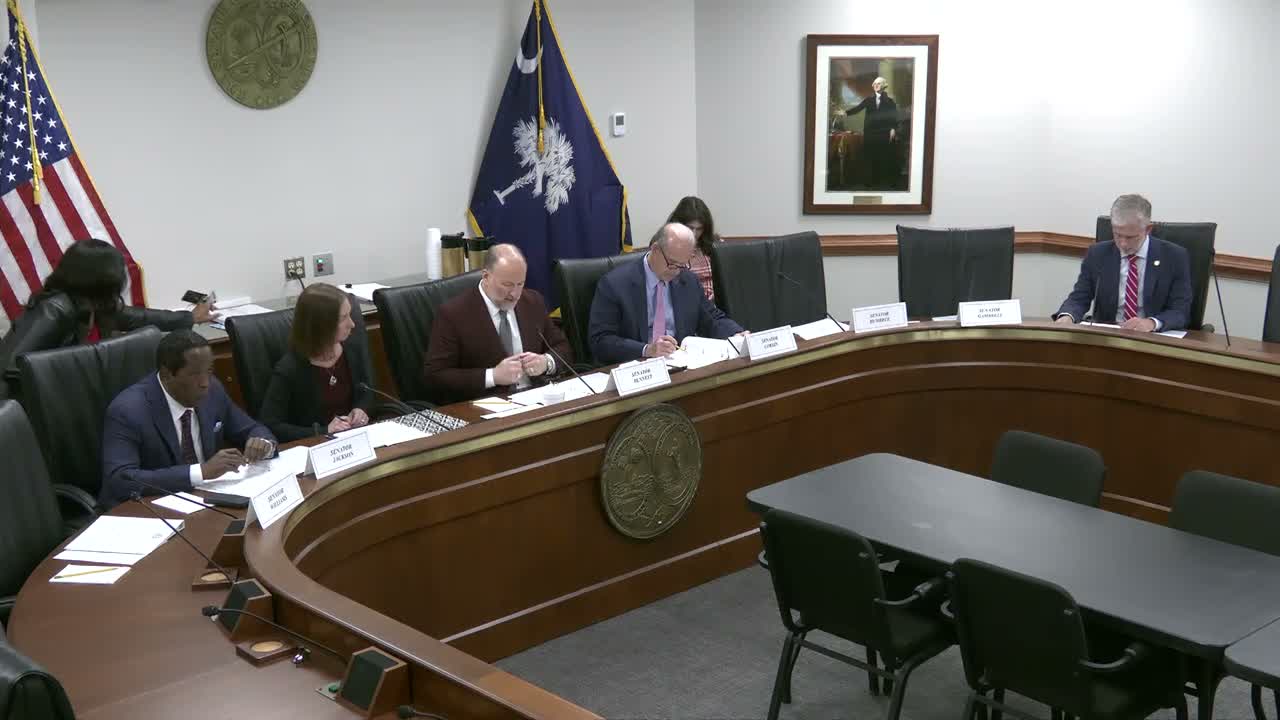
Panel advances bill to let Catawba Nation join state police pension, with limited waiver of sovereign immunity
Summary
The Senate Retirement Subcommittee on Finance voted unanimously to send S.127 to the full committee; the bill would allow the Catawba Nation to join the Police Officers Retirement System if the tribe applies and waives sovereign immunity limited to disputes arising from participation.
The Senate Retirement Subcommittee on Finance voted unanimously to give a favorable report to S.127, a bill that would allow the Catawba Nation to join the state Police Officers Retirement System if the tribe applies and meets existing board requirements and agrees to limited waiver of sovereign immunity.
Olivia, a staff member who summarized the measure for the panel, said the bill would "add the Catawba Nation upon its admission to the system to the definition of an employer for the police officers retirement system" and requires the Nation to apply to the board under current law and "comply with all the current requirements and the board's rules and regulations." She added that "the act would take effect upon approval by the governor."
Sponsor Senator Johnson framed the bill as a recruitment and retention tool, saying that communities that cannot offer retirement benefits lose officers to jurisdictions that do. "They are ... just simply asking to be allowed to join in so that they can attract and most importantly retain law enforcement," he said.
Mister Pulaski, identified in committee discussion as a Catawba Nation representative, told the panel the Nation has about 4,200 members living in South Carolina and that he would provide exact acreage later. He described the decision to waive sovereign immunity as a limited trade-off "siloed in this venue of the law," meaning the waiver applies for matters arising from participation in the retirement system while the Nation retains sovereign immunity outside that narrow context.
Justin Warner, general counsel at the Public Employee Benefit Authority (PEBA), told members the participation mechanics would mirror those for other small municipalities: officers with prior service would have that service credited toward vesting, and officers without prior service would begin accruing service when the Nation formally joins the system. "This just allows them to join the system like any other municipality," Warner said.
Committee members pressed for practical details, including how crimes on Nation land are handled and whether the Nation operates facilities across state lines. Pulaski said the tribe operates two Kings casinos in North Carolina while its legal and residential presence is primarily in York, Lancaster and Chester counties in South Carolina; he also said the Nation is building a courtroom and expects it to be finished by year end.
After questions and discussion, the chair entertained a motion for a favorable report to the full committee. The motion passed unanimously; the chair noted that Senators Gambrell and Hembry sent proxies supporting the measure. The bill now moves to the full committee for further consideration. The act, if passed by the legislature, would take effect upon the governor's approval.