Get Full Government Meeting Transcripts, Videos, & Alerts Forever!
Get email alerts on the Police Retirement topic
No spam. Unsubscribe anytime.
Subcommittee advances bill letting Catawba Nation join state police pension plan
Summary
The Retirement Subcommittee for Finance voted to favorably report S.127, which would allow the Catawba Nation to join the Police Officers Retirement System if the tribe applies, complies with board rules, and waives sovereign immunity limited to the retirement system; the measure now goes to the full committee.
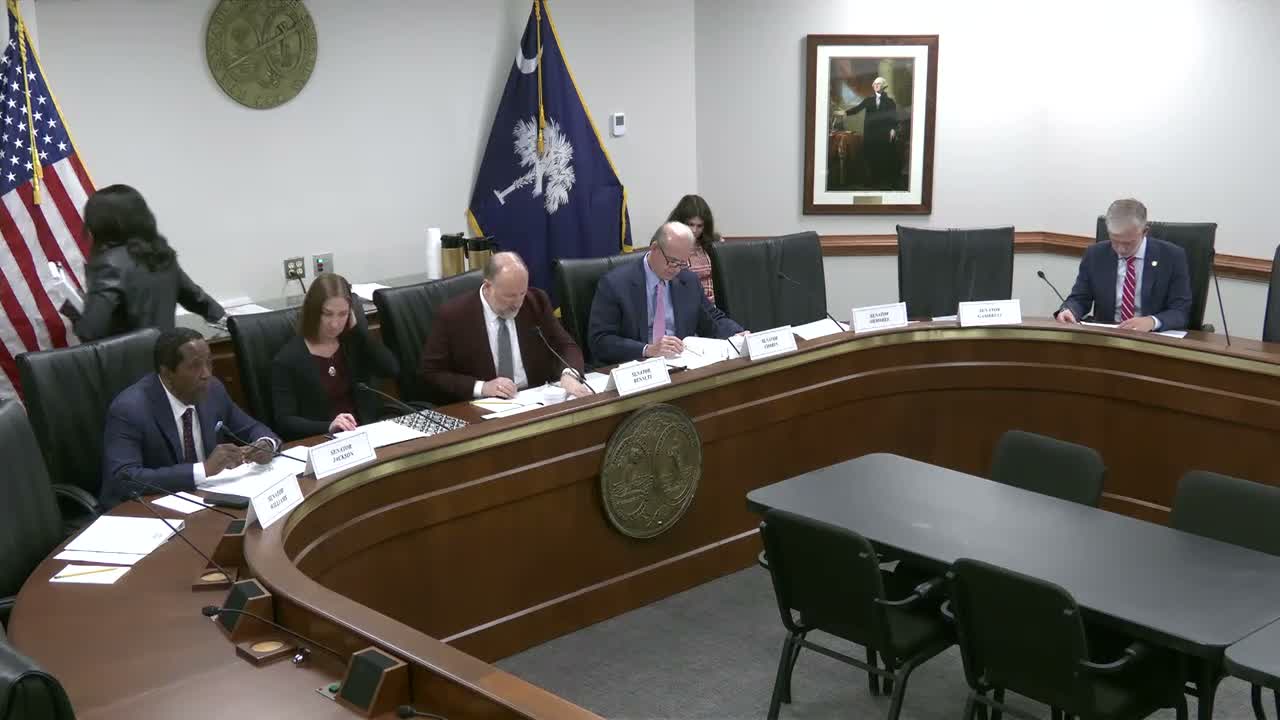
The Retirement Subcommittee for Finance voted to give S.127 a favorable report to the full committee after hearing that the bill would let the Catawba Nation join the state Police Officers Retirement System if the tribe applies and accepts specified conditions.
Olivia, a staff presenter, told the subcommittee that the bill would "add the Catawba nation upon its admission to the system to the definition of an employer for the police officers retirement system," set application requirements referencing sections 9-11-40 and 9-11-43, require compliance with board rules, and require that tribal employees be principally engaged in governmental police duties; she also stated that "the act would take effect upon approval by the governor." Justin Warner, general counsel at PEBA, said admission would operate like any small municipality joining the system and that officers with prior service would have that service credited while officers without prior service would begin accruing service upon joining.
Senator Johnson, the bill sponsor, framed the change as a recruitment and retention tool for the tribe's law enforcement: "they are wavering sovereign immunity as it relates to this system," he said, explaining the tribe agreed to limit sovereign immunity in the narrow context of the retirement plan so the system could administer benefits and enforce obligations. A representative of the Catawba Nation told the panel the tribe has about 4,200 members in South Carolina and said it now fields three police officers (with a fourth anticipated), describing the waiver as "only siloed in this venue of the law" and not a blanket surrender of sovereignty.
Members asked about operational details, including land acreage and cross‑state arrangements; the Catawba representative said exact acreage would be provided later and described partnerships with neighboring counties and law enforcement for off‑duty casino security in North Carolina. Committee members also discussed whether officers' prior service would count toward vesting; Warner said prior service would be credited and that there are no special pension rules beyond those that apply to other small employers that join the system.
The chair called for and entertained a motion for a favorable report; the committee voted by voice and the chair announced, "Ayes have it, with Senator Gambrell and Senator Hembry who sent me their proxy," reporting the bill favorably to the full committee. The transcript does not record a roll-call tally or identify who made or seconded the motion. The measure will take effect if approved by the governor, per the bill text presented to the panel.
Next steps: S.127 was favorably reported to the full committee; the committee did not set or record a specific date for further consideration in the transcript.