Get Full Government Meeting Transcripts, Videos, & Alerts Forever!
Get email alerts on the Climate And Sustainability Element topic
No spam. Unsubscribe anytime.
San Anselmo advisory committee reviews draft climate, sustainability and resiliency element; members press on equity and affordability
Summary
Consultants presented a draft sustainability/climate element for San Anselmo’s general plan; members welcomed the framework but pressed for clearer timelines, equity safeguards, and more public engagement after a survey that received 14 responses. The committee approved minutes and set follow-up workshops.
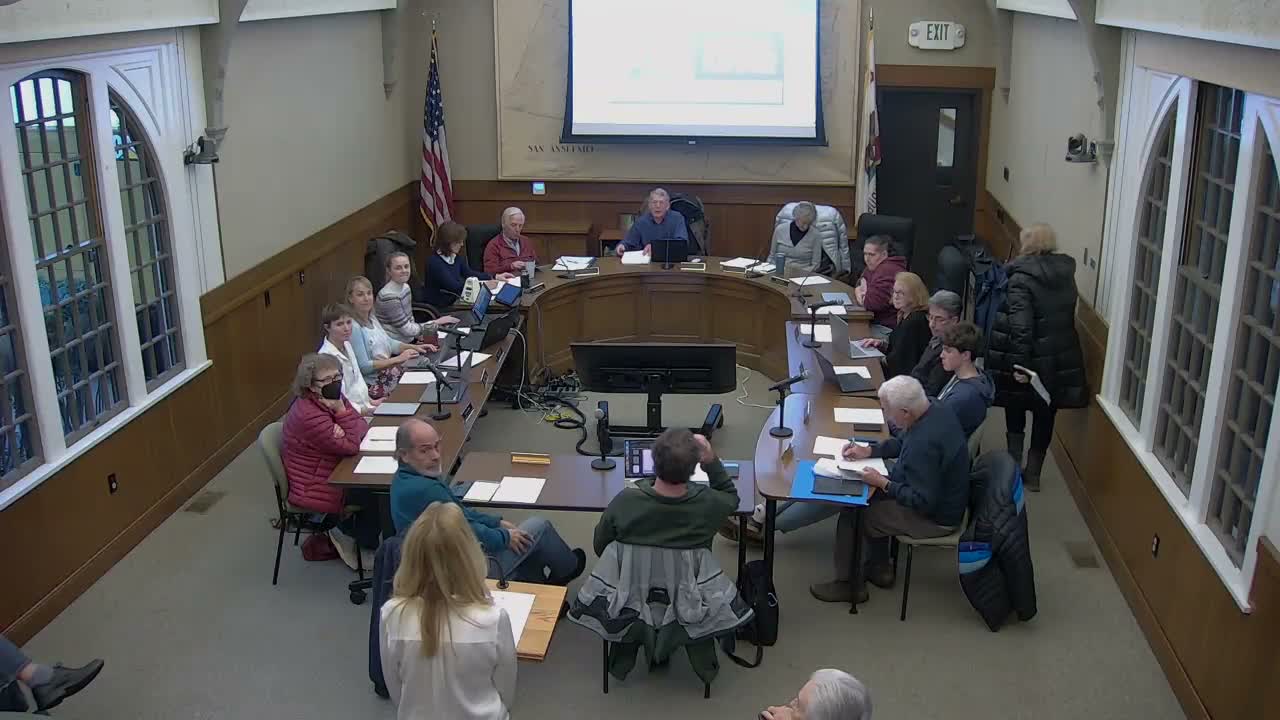
San Anselmo’s General Plan Advisory Committee spent its meeting reviewing a draft sustainability, climate-change and resiliency element presented by consultants Christine O’Rourke and Bob Brown, with committee members focusing questions on community outreach, affordability of electrification and protections for vulnerable residents.
The consultants framed the new general-plan element around three pillars — greenhouse gas mitigation (emissions reduction and carbon removal), sustainability and adaptation/resiliency — and said the element is intended to sit above and remain consistent with the town’s more detailed Climate Action Plan. “There are three legs to this stool of our new general‑plan element,” Christine O’Rourke said, describing the relationship between mitigation, sustainability and resiliency.
Why it matters: The element will guide town policies around buildings, transportation and natural resources at a higher policy level and will inform later implementation work that assigns timing, departments and funding. Committee members repeatedly pressed that high-level goals must be paired with explicit equity and affordability considerations so low‑income residents and renters are not disproportionately burdened by any future mandates.
Key points and details
Presentation and state context: O’Rourke summarized climate-science projections and state policy milestones — citing AB 32 (2006), later targets tied to 2030 and the statewide net‑zero-by‑2045 ambition — and noted an updated state building code that takes effect Jan. 1, 2026, will push greater electrification and energy‑budget requirements for new construction. She also described Bay Area Air District rules phasing out certain natural‑gas water heaters and heating equipment on a staged schedule.
Local inventory and priorities: The consultants showed San Anselmo’s 2022 greenhouse‑gas inventory (the most recent available) and said emissions are down roughly 25% since 1990, but that the remaining emissions are increasingly concentrated in transportation (about 58%) and natural‑gas use in buildings (about 34%). The town’s climate action plan and an EV strategy adopted earlier remain the primary implementation vehicles for many measures.
Outreach and sample size: The team described outreach including a pop‑up, an Oct. 10 workshop and an online survey. The consultants said the survey received 14 responses; when asked, they confirmed demographic questions were not collected. Chair Rod Kerr and others urged broader community outreach ahead of any proposed mandates.
Committee concerns and debate: Members broadly supported the effort but voiced several consistent concerns: the need to prioritize education and incentive-based programs before imposing mandates; equity protections for low‑income households and renters; clearer implementation timing and who pays for transitions (e.g., heat pumps, induction stoves); and caution about moving ahead of state law where preemption or cost issues may arise. “If we’re serious about those goals, it’s going to take a major, major effort,” Bob Brown said, acknowledging the scale of change required to reach long‑term targets.
Policy suggestions offered: Committee members suggested adding explicit actions to promote appliance‑replacement programs and public education campaigns, considering reach/green building codes, clarifying tree‑planting versus urban‑forest protection, and embedding an equity lens that prioritizes the needs of the most vulnerable residents.
Process and next steps: Brown described the document as a draft that will be refined by the Climate Action Commission and staff; members were told the element will later carry a separate implementation plan with timing (near‑, mid‑ and long‑term), responsibilities and potential funding sources. Staff announced upcoming opportunities for public input: a Jan. 23 public workshop on commercial districts and community design, and additional GPAC meetings scheduled for Jan. 9, Feb. 13 (special meeting), March 13 and April 10. The consultants will circulate slides, the PowerPoint and sample hillside ordinances.
Votes at a glance: The only formal action taken was approval of the previous meeting’s action minutes. Chair Rod Kerr called for a motion; a member identified as Sarah moved to approve the minutes and Eileen Burke seconded. The roll-call vote was recorded and the minutes passed unanimously.
What to watch next: Staff and consultants will post the presentation materials and a homework packet; the committee encouraged members to promote the Jan. 23 public workshop to increase participation. The Climate Action Commission will review refined language and the GPAC will revisit the element in subsequent meetings.
Ending: The chair closed the meeting after assigning follow‑up homework and scheduling extra meetings to allow more time for review and public outreach.