Get Full Government Meeting Transcripts, Videos, & Alerts Forever!
Get email alerts on the Rezoning Winchester East topic
No spam. Unsubscribe anytime.
Frederick County planners weigh rezoning for Winchester East as developers seek credit for future Route 37 work
Summary
A developer seeks rezoning to allow up to 303 homes and a credit against school and public‑facility proffers for dedication and partial construction of a future collector (Route 37). County staff said the proposal preserves creek buffers and trail connections but warned the credit would reduce monetary contributions for schools; commissioners raised precedent, fiscal and engineering concerns. (Public hearing scheduled Jan. 15, 2025.)
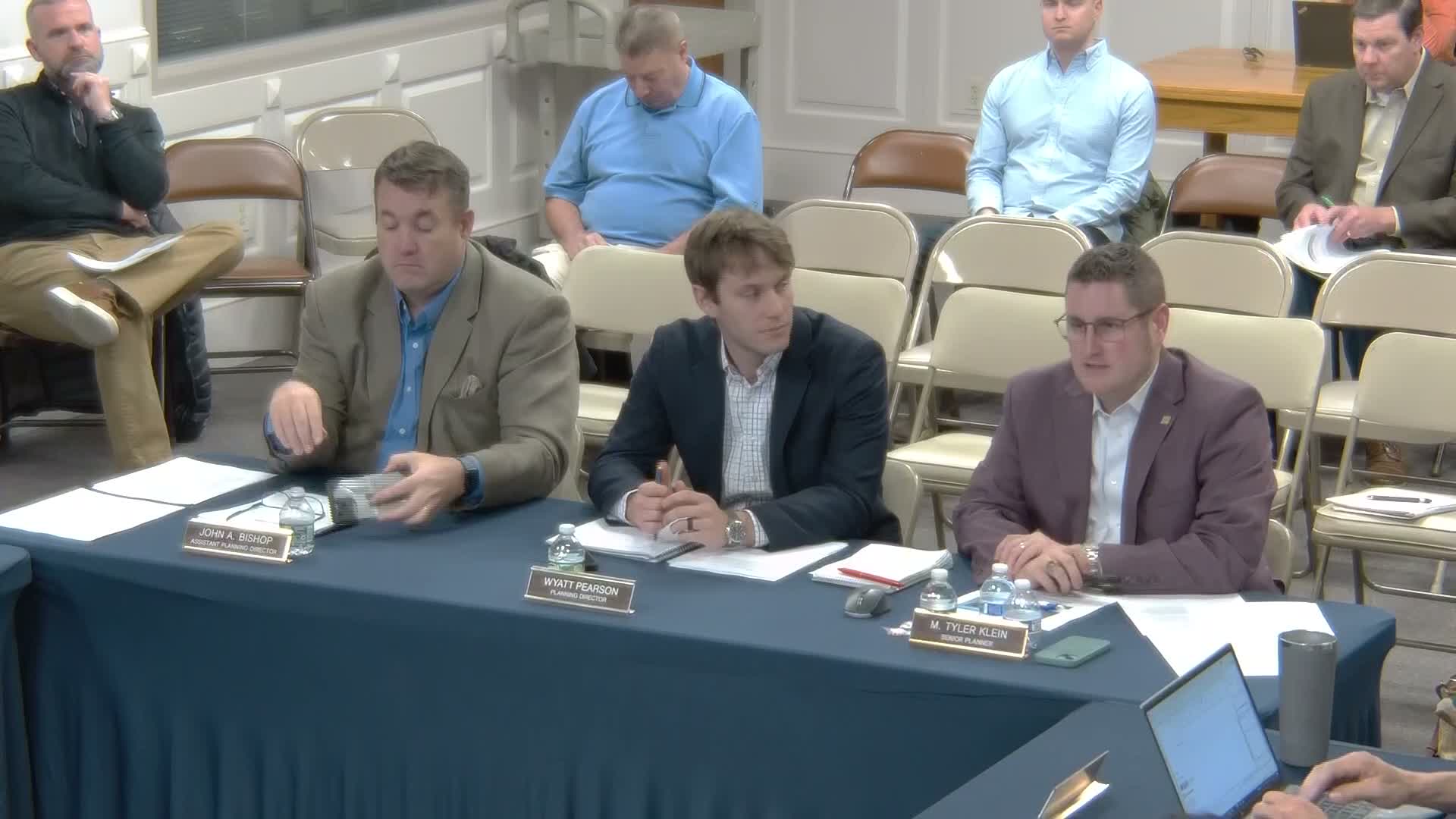
Frederick County planning commissioners spent a work session reviewing a rezoning request for a project identified in staff materials as Winchester East at Opekin Creek, where the applicant seeks to rezone two parcels at 2737 and 2747 Sensenia Road from RA (rural area) to RP (residential performance) and allow up to 303 residential units. Staff said the parcels appear in presentation materials as approximately 91.7 acres (the application packet also later references 9.71 acres in another place), and the generalized development plan proffers a combination of detached and attached housing, open‑space preservation along the Opekin Creek watershed, and trail connections.
The applicant team told the commission it will dedicate a 104‑foot right‑of‑way for a future Route 37 alignment across the property and construct a two‑lane section of that roadway on part of the dedication to provide immediate access to the new neighborhood. Applicant representative Ty Lawson said the developer is seeking a partial monetary credit tied to the right‑of‑way dedication and construction to offset some of the proffer amounts that otherwise would be paid per unit. "We're proffering to build the two‑lane section that you see. That's at the sole cost of the developer," Lawson said, adding the credit is not intended to make the developer whole for the value of those improvements.
County staff described how the proposal interacts with the county's capital impact model and proffer rules. The planning staff reported the county's current model projects a capital impact contribution of $17,322 per single‑family detached unit and $15,596 per townhouse unit; staff also said the applicant has requested a per‑unit credit of about $4,299.88 for right‑of‑way dedication (a reduction that staff estimated would total roughly $1.2 million in aggregate in the application materials). Staff cautioned that applying the credit would reduce the county's upfront monetary contributions available to offset capital impacts for schools and other facilities and that the proposal as currently proffered would not fully align with the capital impact model outputs for residential development.
Traffic and access were central to the discussion. The applicant and the county's traffic consultant said their traffic impact analysis examined three study intersections with counts and background development; the consultant said the earlier traffic study analyzed 283 units and estimated about 180 afternoon peak trips from that development, and that increasing to 303 units would raise trips by roughly 7 percent and add approximately two seconds of average delay at study intersections. The developer argued that constructing an initial two‑lane segment—designed with limited access and minimal cross streets—would provide circulation benefits and could be a template for future segments on the east side. Staff and several commissioners noted a remaining gap between the developer's proposed terminus and the existing Hollow Crossing Way; distance estimates discussed in the meeting ranged from several hundred feet to roughly 0.4 mile, and staff cautioned that significant elevation changes in the gap could make a simple culvert infeasible and might require a bridge or other engineered structure.
Commissioners expressed strong concern about precedent and equity. Multiple planning commissioners said they had not seen a similar credit structure in Frederick County proffers and worried that approving a credit for right‑of‑way dedication plus construction would reduce funds for schools, fire and rescue, parks and other capital needs or otherwise shift costs to current county taxpayers. One commissioner framed the tradeoff bluntly: "What is more important, a pie in the sky for 37 that may not be built for decades or money for the schools that we need now?"
Staff and the applicant also addressed environmental and neighborhood impacts. The proffer statement includes commitments to preserve the Opekin Creek watershed for open space and to provide a natural‑surface trail; staff noted much of the preserved area is steep or flood‑prone and therefore unlikely to be developed for active recreation. The applicant committed to follow Phase I cultural resources study recommendations and to construct sidewalks and a 10‑foot shared use path along Cincinnati Road consistent with the comprehensive plan. Commissioners raised concerns about pedestrian safety in adjoining neighborhoods that lack sidewalks and about stormwater and steep slopes flagged in outside comments.
County staff said it would re‑run the capital impact model using the updated 303‑unit figure and provide clarification on which schools would serve the site before the public hearing. Staff also reminded the commission and public that the item will be scheduled for a public hearing on Jan. 15, 2025, and that any revised proffers must be submitted to staff at least eight days before that hearing.
The work session provided no formal vote; it was informational and intended to identify issues for refinement before the public hearing. The planning commission asked the applicant to provide more detailed cost breakdowns supporting the right‑of‑way credit, to clarify timing and engineering language in proffer language about the transportation improvements, and for staff to provide updated fiscal and school‑capacity modeling prior to the hearing.