Get Full Government Meeting Transcripts, Videos, & Alerts Forever!
Get email alerts on the Land Use Rezoning topic
No spam. Unsubscribe anytime.
Developer seeks TM zoning for Middletown site; board questions proportional signal contribution and adjacency to elementary school
Summary
An applicant asked to rezone a Middletown‑area property to the TM (Technology/Manufacturing Park) district, offering buffers, a 10‑acre public‑use tract and cash proffers. Commissioners pressed the applicant on signal cost shares, truck vs. car trip accounting and whether certain industrial uses should be proffered out.
County staff introduced rezoning application O924 for Middletown LLC, asking the commission to rezone property east of Route 11 and north of Mustang Lane from an RA district to the TM (Technology/Manufacturing Park) district. Staff said the TM district implements the county’s mixed‑use industrial/office future land‑use designation and noted the proposal includes enhanced screening, a 10‑acre tract proffered for public use, stormwater facilities sized for both industrial and public uses, and monetary contributions toward infrastructure.
The applicant described the generalized development plan as separating the site into an industrial area and a public‑use area, and proffering landscape buffers ranging from 75 to 150 feet along Mustang Lane and Valley Pike and preservation of existing stone walls. The presentation included a vehicle‑trip cap tied to the industrial portion of the site and a proposal to provide a 10‑foot multi‑use trail along Route 11. The applicant said it would provide a $3,000 contribution for interpretive signage on the public‑use parcel and a $200,000 contribution toward regional signalization improvements at the I‑81 ramp/Reliance Road/Valley Pike area.
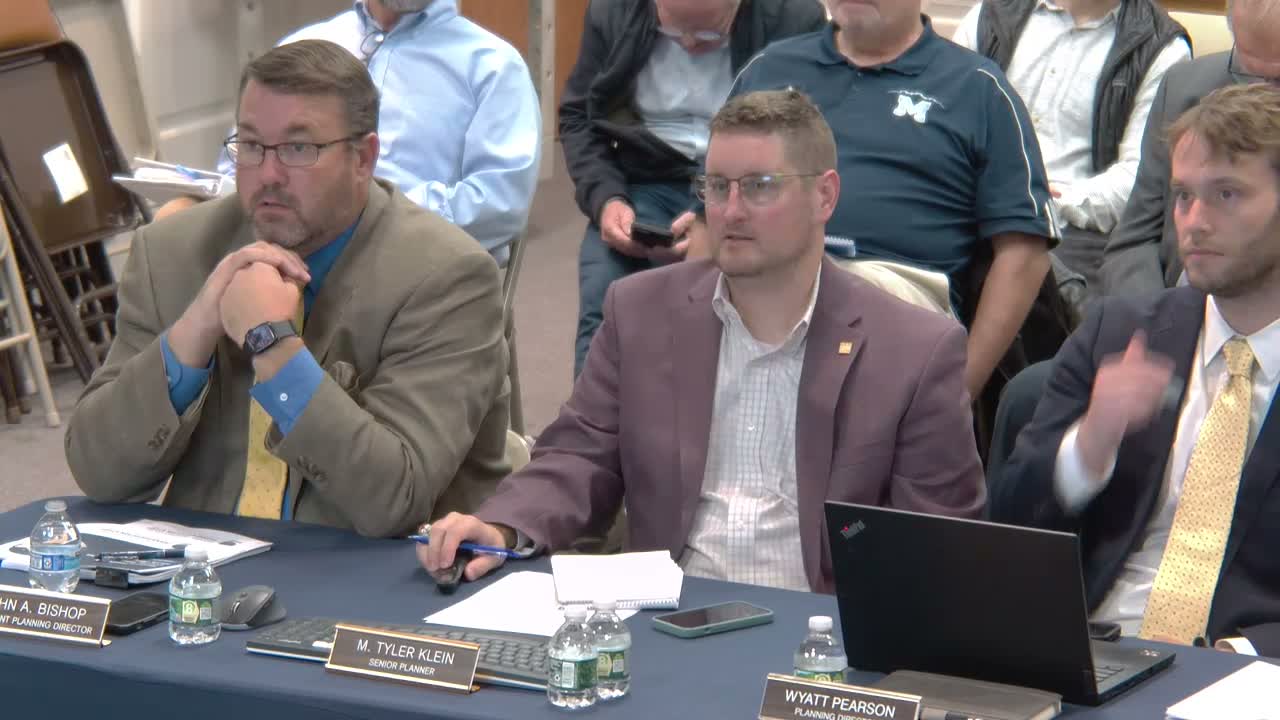
Commissioners focused much of their questioning on transportation impacts and fairness of the cash proffer. One commissioner said, “I am never in favor of shifting responsibility for money from a developer to taxpayers,” and urged that if intersections will be signalized to mitigate project impacts the developer should more directly fund construction rather than a general cash donation. The applicant defended the $200,000 figure as its proportional share, saying modeling showed the rezoning represented roughly 14 percent of peak‑hour trips at the interchange and that signal costs vary widely depending on scope and final design.
Board members also pressed on adjacency to Middletown Elementary School and the risk of tall industrial buildings near school property — the TM district allows up to 60 feet in building height — and asked whether any potentially sensitive uses should be specifically proffered out. The applicant agreed to remove guided‑missile manufacturing from the list of potential uses. The applicant also committed to provide a viewshed and line‑of‑sight analysis for the public hearing to show whether a 60‑foot building would be visible from the school.
Staff flagged several unresolved items for the planning commission to consider before a public hearing: the sufficiency of the applicant’s transportation contribution relative to likely signalization costs, the question of whether Mustang Lane (currently a private access easement serving the school) should be conveyed into public right‑of‑way, the precise vehicle‑trip cap language, and the timing and content of any revised proffers (bylaw deadline: revised proffers filed fewer than eight days before the hearing can lead to tabling). A public hearing was announced for December 4.
Clarifying note: the transcript includes inconsistent acreage figures (one slide or comment references 1.25 acres while other presentation material refers to 101.25 acres and a 70.85‑acre industrial area plus a 10‑acre public use tract). The applicant and staff discussed the developable areas and how buffers and stormwater facilities reduce net developable acreage; the discrepancy will need to be clarified in staff materials ahead of the hearing.
The planning commission did not vote on the rezoning at the work session; staff and the applicant will return materials and the applicant will supply the requested viewshed analysis and any revised proffers for the upcoming public hearing.