Get Full Government Meeting Transcripts, Videos, & Alerts Forever!
Get email alerts on the Lake Frederick Icsa topic
No spam. Unsubscribe anytime.
Frederick Water defends $20 ICSA fee and blames high chlorides for Crooked Run violations
Summary
Frederick Water's director told supervisors the $20 monthly ICSA fee is intended to cover an estimated $8 million shortfall tied to retiring Crooked Run and pumping to Parkins Mill; he rejected claims from the Lake Frederick Work Group about misapplied fees and inapplicable code citations.
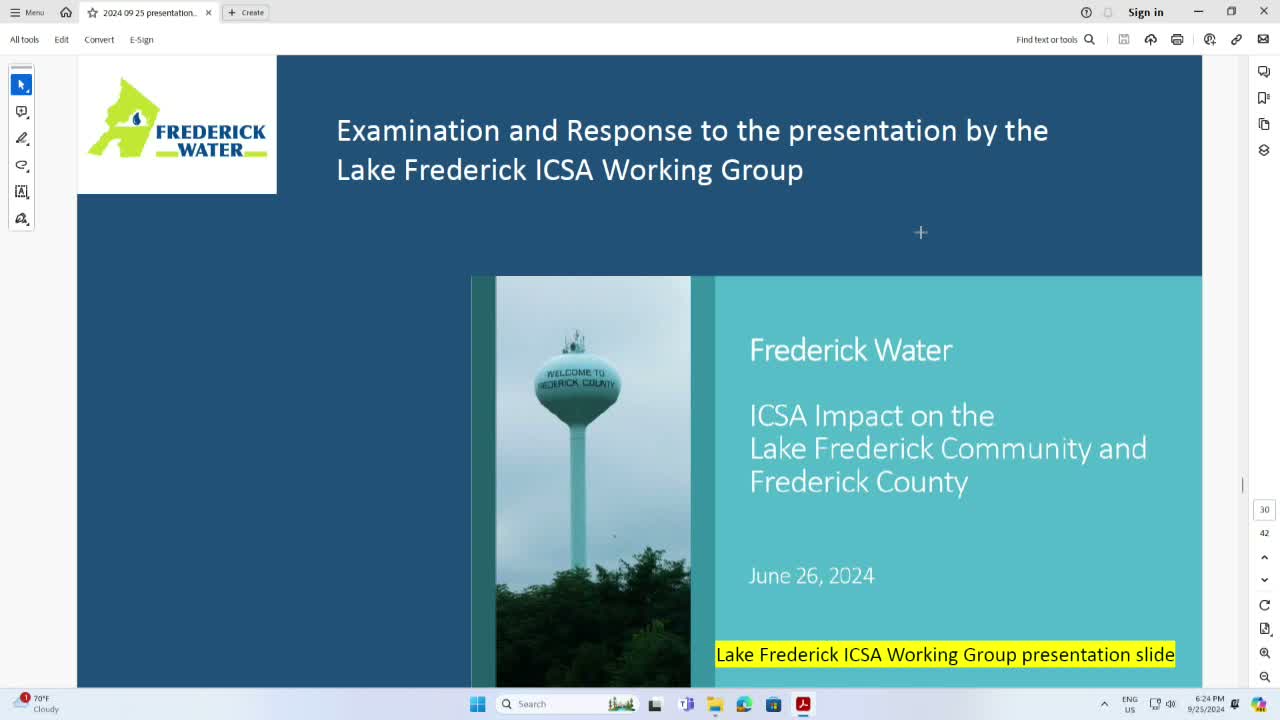
Eric Lawrence, executive director of Frederick Water, defended the authority's response to the Lake Frederick Work Group and explained why the ICSA plan and a $20 monthly charge were adopted to address wastewater permit violations and project funding shortfalls.
Lawrence said Crooked Run has had persistent permit violations (including ammonia, nitrogen and particularly chlorides) and that engineering reviews and DEQ input concluded upgrading Crooked Run would not address the chloride problem. "Stop giving us the chlorides and we can address the violations," he said, arguing the practical fix is to retire Crooked Run and pump flows to Parkins Mill for treatment.
The proposed inter-county service area (ICSA) solution expands collection and treatment capacity across a 3,400-acre service area and creates funding pathways that include Clark County cost-sharing and ICSA availability fees. On project finance, Lawrence said the Crooked Run pump station and force-main work is about $20 million; Clark County will contribute roughly 25 percent for the portion it uses, Frederick Water has applied for grants (about $3.8 million pending) and expects ICSA availability-fee revenue of roughly $3.5 million as Lake Frederick builds out, but the authority still sees an estimated $8 million shortfall.
"There's an $8,000,000 unknown and that $20 a month is going to contribute towards that," Lawrence said, explaining the fee is intended as a partial, temporary contribution while the authority continues to pursue grants and other revenue sources.
Lawrence directly disputed several assertions in the work-group presentation. He said the group cited state statutes that do not apply to Frederick Water because the authority is chartered under the Virginia Water and Waste Authorities Act and is not a public utility regulated under Title 56. He also said the work group overstated Frederick Water's revenues: "The developer received $7,500,000 in sewer availability fee payments. Frederick Water got 1,600,000.0," he said, adding that those developer receipts were used for on-site amenities, not for Frederick Water's treatment projects.
Homeowners and supervisors raised concerns about fairness and process in question-and-answer: several supervisors noted that homeowners and their associations were not parties to earlier litigation that involved the developer and Frederick Water and asked why plant design did not anticipate chloride issues. Lawrence said the permit structure and subsequent DEQ clarifications meant that even planned upgrades would not have removed chloride limits; the agency discovered an error in permit-tier conditions that changed the viability of an upgrade as a solution.
Why it matters: the dispute affects who pays for wastewater work and whether households in Lake Frederick face a new recurring charge while other customers may also share costs. The issue touches regulatory compliance (DEQ and VPDES permits), developer contributions, and potential ongoing subsidies by other Frederick Water customers.
Next steps: Lawrence said staff will circulate the detailed responses and materials they prepared addressing the work-group slides, the authority will continue to apply for grants and the Board will continue discussing fee structure and allocation in future meetings.