Get Full Government Meeting Transcripts, Videos, & Alerts Forever!
Get email alerts on the Land Use Rezoning topic
No spam. Unsubscribe anytime.
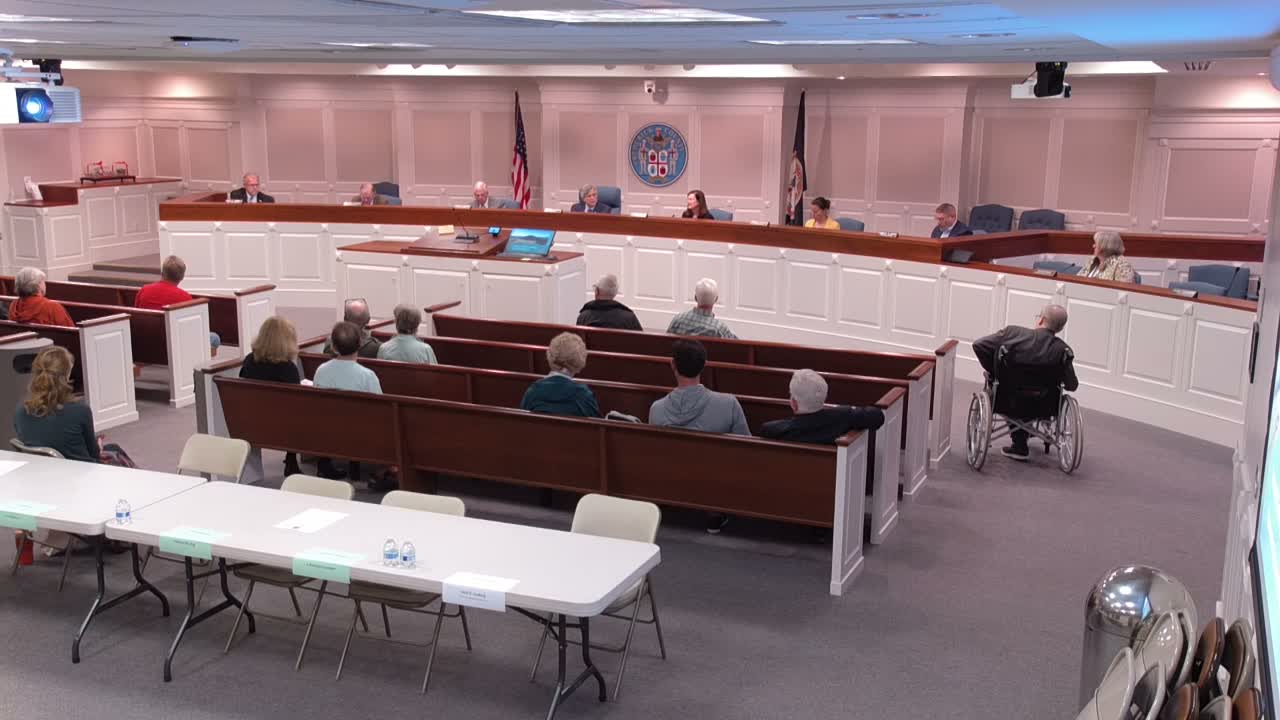
Frederick County board denies Fruit Hill rezoning after residents and staff cite traffic and data‑center concerns
Summary
The Board of Supervisors voted to deny Rezoning 624 (Fruit Hill), a proposed mixed business/industrial development that would have included up to 2.4 million sq ft of industrial/warehouse space and a 300,000 sq ft parcel reserved for a possible data center. Concerns centered on traffic impacts, the I‑81/Route 11 interchange and community noise and water use.
The Frederick County Board of Supervisors voted to deny Rezoning 624 — a proposal to rezone about 220 acres near Exit 323 into 189 acres of M1 light industrial, 20.64 acres of TM (technology/manufacturing) and 10.34 acres of B2 general business — after residents, staff and board members raised concerns about transportation impacts and the potential for data‑center development.
Planning staff told the board the application would enable roughly 2,400,000 square feet of buildings and proffers reserved 300,000 square feet in the TM parcel specifically for a potential data center. Staff flagged that an estimated 85% of the overall buildout would be warehousing/distribution — not the mixed office‑industrial uses envisioned in the Northeast Land Use Plan — and noted the traffic impact analysis did not fully address needed upgrades to the I‑81 northbound exit ramp.
"They are proffering to construct it as 2 lanes, with a trail associated with it on a 104 foot right of way," planning staff said when describing the proposed Fruit Hill Road and turn‑lane improvements, but added the TIA still called for additional ramp or interchange work that could require federal approvals and significant time.
Developer representatives defended the proposal and the proffers. John Foote, representing the applicant, summarized proffers for roadway improvements, berms and buffers, and said EQUS has built similar projects and believes traffic can be managed. Foote noted the team used the Institute of Transportation Engineers (ITE) trip generation manual for modeling: "We modeled everything on ITE to determine the impact," he said, adding the applicant's internal counts at comparable warehouses were lower than ITE projections.
But several nearby residents warned the board about environmental, noise and infrastructure risks. Linda Reid (Shawnee District) opposed allowing a data center because of what she described as large electricity demands, diesel generator noise and air pollution: "These data centers use diesel fuel, they pollute our air and they are very loud and they are not desirable in a rural community," she said. Other speakers asked whether adequate fiber, substation capacity and public water exist to support large data‑center cooling loads.
Board members debated trade‑offs between economic development and transportation or quality‑of‑life impacts. Several supervisors stressed the county already has locations zoned for warehouse uses and that the rezoning’s predominant warehousing mix may not match the comprehensive‑plan intent for that subarea. One supervisor warned that without addressing the I‑81 ramp issue, the county could be left shouldering risk and costs.
A motion to deny the rezoning, based on lack of comprehensive transportation conformance and failure to upgrade the I‑81 interchange, passed on a roll‑call vote. The board recorded the motion as a denial, and the rezoning will not move forward in its current form.
What happens next: staff and the applicant may continue to negotiate infrastructure commitments or propose alternative zoning and transportation mitigation, but the board’s vote ends consideration of Rezoning 624 as presented tonight.