Get Full Government Meeting Transcripts, Videos, & Alerts Forever!
Get email alerts on the Landfill Finance topic
No spam. Unsubscribe anytime.
Consultant urges gradual tipping-fee increases as Frederick County plans for long‑term landfill costs
Summary
A consultant presented a multi‑decade pro forma showing Frederick County’s landfill has healthy reserves but faces large future capital and potential leachate‑treatment costs; he recommended phased tipping‑fee increases beginning next year to avoid borrowing and preserve operations.
A consultant hired by Frederick County told supervisors the landfill’s enterprise fund is well‑capitalized today but will need gradual revenue increases to pay for decades of capital projects and post‑closure care without borrowing.
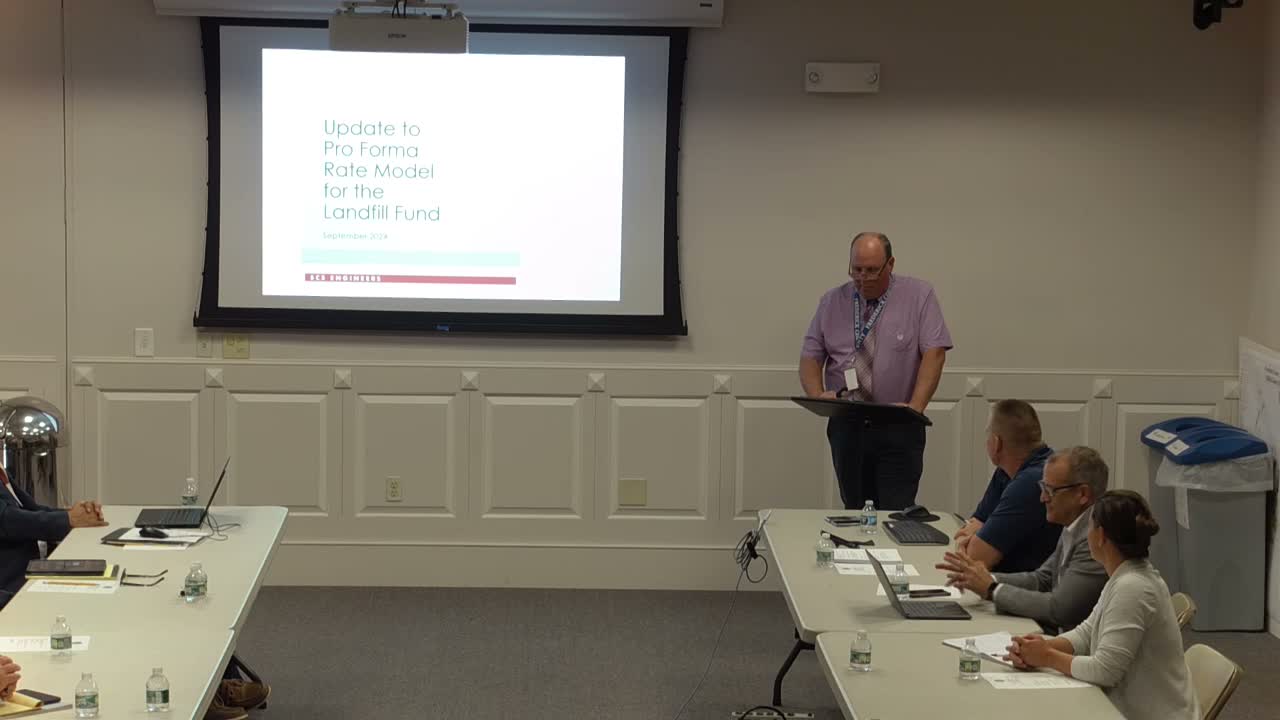
Robert Gardner of SCS Engineers presented a pro forma financial model he said was updated from prior studies (2014, 2019) to reflect recent construction, projected growth and potential new regulatory treatment requirements. “You should begin to consider rate adjustments next year,” Gardner said, urging a measured approach rather than a single large hike.
Gardner described two scenarios: an aggressive option that would raise municipal tipping fees by about $10 per ton immediately, and a moderate approach that phases increases from $24 per ton upward in steps (he noted commercial rates would be set proportionally and cited a current commercial rate near $55 per ton). He said the model assumes 3 percent CPI for inflation and a conservative 1.5 percent investment return in baseline projections, both of which can be adjusted in sensitivity testing.
County staff and the consultant emphasized why additional revenue is needed. The landfill operates on an enterprise fund model funded by tipping fees; reserves and a post‑closure trust are used to pay capital projects so the general fund should not be tapped. Staff reported roughly $64 million in reserve funds for modeling purposes and said the state currently requires a post‑closure funding obligation of about $34 million to cover closure and at least 30 years of monitoring.
Gardner said the long‑term capital picture includes cell construction, leachate equipment and possible construction of a more robust leachate treatment facility should future regulations for emerging contaminants require it. He estimated a standalone leachate treatment plant at about $11 million in the scenarios shared with the board.
Board members asked whether raising commercial rates would drive haulers away; Gardner said transport costs and existing acceptance rules make large losses of commercial customers unlikely. He recommended incremental increases to reduce community backlash and to preserve accrual balances that pay for future capital rather than relying on debt.
Michael Hopper, County Administrator, framed the policy choice for supervisors: maintain low fees now and risk falling short of future obligations, or raise revenues gradually to preserve the landfill’s cash‑funded model. “We’ve got to slowly increase these tipping fees in order to have the revenues for the future,” he said.
The board will use the pro forma and scenario information in the upcoming budget season, with staff promising to return with more detailed budgets and recommended rate schedules for consideration.
Provenance: topicintro SEG 1017; topfinish SEG 1524